A museum director offers a history lesson on the world’s third-largest economy.
When the U.S. National Science Foundation (NSF) announced July 14 that it would award $15 million over the next two years to launch the NSF STELLAR Engine in the Rochester/Finger Lakes region of Upstate New York, the news marked the perfect metaphor for what binds the Great Lakes region together.
The NSF Engine will advance the Science, Technology and Engineering of Lasers and Laser Applications Research (STELLAR) for manufacturing, defense, communications and healthcare to strengthen U.S. competitiveness in global markets. The award, matched by $16 million in New York state support over the next six years, is designed to establish an internationally competitive technology and innovation cluster in the region.
Some would say the Great Lakes region already fits the bill. Look at the data. According to the Council of the Great Lakes region, the Great Lakes Commission and BMO Capital Markets, the binational Great Lakes region generates a yearly economic output of $6 trillion if you count just the eight U.S. states and two Canadian provinces bordering the five Great Lakes. That figure balloons to $9.3 trillion when you measure the output of the much wider Great Lakes-St. Lawrence Seaway River Basin.
To put that output into perspective, if the region were its own country, it would rank as the third-largest economic force on the planet — behind only the U.S. and China. Home to more than 107 million people, the Great Lakes region supports an estimated 55 million jobs.

“Roughly 84% of the continent’s freshwater and 21% of the world’s freshwater is stored in these five lakes.”
— Kate Fineske, Executive Director, National Museum of the Great Lakes
When you think of its importance to U.S.-Canada trade and the binational economy, the region accounts for nearly 40% of all cross-border trade between the two countries, generating a staggering sum of $278 billion in cross-border commerce per year.
The region is able to accomplish all of this because of its natural and built-in competitive advantages. Among them are these assets:
- Freshwater Economy and Natural Resources
- Global Gateway: St. Lawrence Seaway and Trade Corridors
- Central Location and Market Access
- Energy Infrastructure and Reliability
- Cost Competitiveness
- Quality of Place
Where the Regional Advantage Originates
Without the Great Lakes region, the economies of the U.S. and Canada would look very different. Think of the region’s impact on just three industries: manufacturing, maritime shipping and recreation and tourism.
The region produces the lion’s share of North American automobiles and heavy machinery. Ford Motor Company, General Motors, Stellantis, Jeep, John Deere, Caterpillar, Honda, Toyota, Harley Davidson and many other global vehicle brands operate huge assembly plants throughout the region — factories that attract suppliers and vendors from literally all over the world and the hundreds of thousands of workers who are employed by them.
Automotive assembly OEMs in the Great Lakes region produce nearly 5 million vehicles per year. Comprising mainly plants in Michigan, Ohio, Indiana, Illinois, Wisconsin and Ontario, these factories combine to account for the largest share of overall North American light-vehicle manufacturing, representing about 45% of total continental output.
When you study maritime shipping, the binational Great Lakes-St. Lawrence Seaway transports more than 160 million metric tons of commercial cargo each year. More than 300,000 workers owe their livelihood to this interconnected waterway system.
And for those enjoying the beaches, parks, boating, fishing, hunting, backpacking, camping and other outdoor recreational pursuits of the Great Lakes, the tourism impact of the region accounts for over $50 billion a year in spending. By the end of this year, regional cruise ship spending will exceed $300 million in direct economic impact as well.
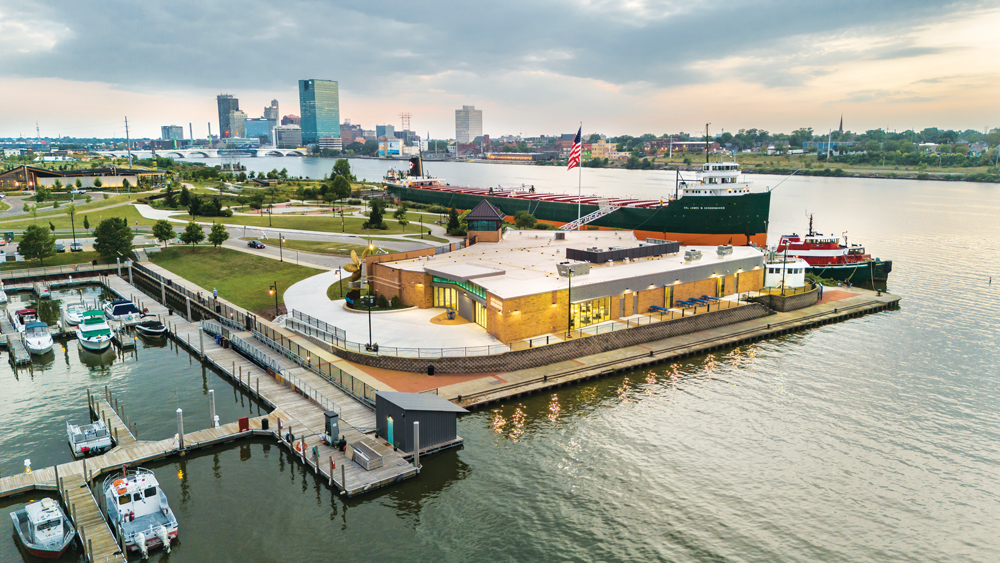
To get a closer look at how the Great Lakes impact all aspects of the regional economy, I turned to Kate Fineske, executive director of the National Museum of the Great Lakes in Toledo, Ohio. She runs a 14,000-sq.-ft. museum situated directly on the Maumee River in Northwest Ohio’s largest city. The museum has been around for 82 years.
Why Toledo? “We are at the crossroads of Great Lakes conversations,” she says. “The museum started in Cleveland and then moved to Vermilion, Ohio, before choosing Toledo in 2014. They looked all over the Great Lakes. You can reach everything conveniently from here. We have a very diverse population and of course that classic Midwest friendliness.”
Fineske says that people who grow up around the Great Lakes come to find that almost every aspect of their lives revolves around these majestic bodies of water. “I grew up vacationing on Mackinac Island,” she says. “Lakes have always been an important part of my life. They are my favorite place to vacation. Cruise vessels now travel the Great Lakes. They are basically the equivalent of freshwater oceans.”
A Legacy of Maritime Commerce
Part of the job of the National Museum of the Great Lakes is to tell the story of commerce. “This is, first and foremost, a history-based museum,” says Fineske. “We share and celebrate the past and future of the Great Lakes. The vessels that have sailed these waters built the economy of this region on both sides of the border. The ships are the behind-the-scenes engines of commerce.”
Whether it was carrying logs to the paper mills of Green Bay, transporting steel to be used in the fabrication of tanks, planes and warships to fight World War II, or ferrying automobiles destined for Europe, the cargo ships that sailed the deep waters of the Great Lakes built the Canadian and American economies over a century.
Keeping the Great Lakes in their natural condition is paramount if both nations want to thrive for the next century, adds Fineske. “Roughly 84% of the continent’s freshwater and 21% of the world’s freshwater is stored in these five lakes,” she says. “Lakes Huron, Superior, Michigan, Erie and Ontario supply drinking water to 30 million Americans and millions of Canadians. They also support over 1.5 million jobs. Making sure the health of the water is there to continue the supply of food sources and jobs is of critical concern. We have to pay close attention to how we use our freshwater resources.”
When I asked Fineske if she was concerned about the long-term impact of people moving from the Great Lakes region to the warmer confines of the Sunbelt, she said, “Not really. We have the source of water. We will eventually see the population return to the Great Lakes. I feel like the next population boom will be in this portion of the country. As long as we remain good stewards of these resources, we will thrive.”