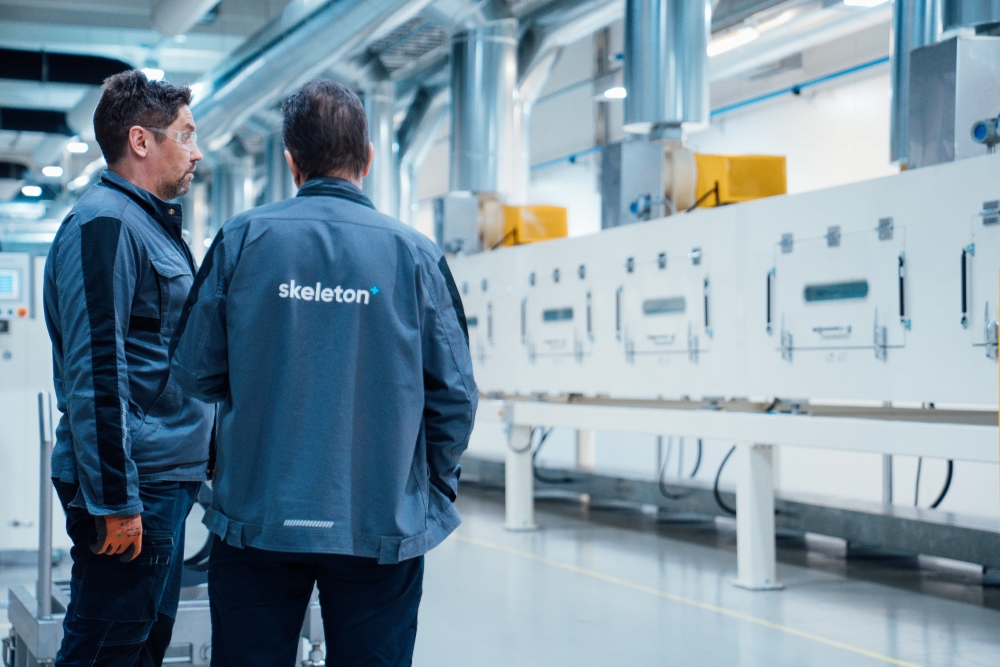
The Nordics have become a hotspot for data centers and related industries. One company developing power solutions to meet the pressing global demand from data centers and AI computing factories is Skeleton Technologies, headquartered in Estonia just a stone’s skip south of its new “SuperBattery” facility in Finland.
Ahead of the Curved Graphene
Skeleton Technologies, which develops and manufactures energy storage solutions for transportation, manufacturing equipment, AI data centers and grid applications, got its start in 2009 with graphene-based supercapacitors. Headquartered in Tallinn, overlooking the Baltic Sea, the company started operations last year in Germany, has eyes on its first North American site in Texas and is now enjoying a foray into Finland thanks to the 1GW SuperBattery factory that started operations there in late 2025.
“We initially chose the Varkaus site in Finland because it already had existing battery manufacturing infrastructure and skilled industrial talent in the area,” says Skeleton Technologies Chief Operating Officer Timo Koljonen. “Shortly after the acquisition, Skeleton opened a new R&D development unit at Lappeenranta University of Technology, Finland’s leading electrical engineering university.”
Koljonen adds that production in Varkaus has been going well since opening the €50 million site last year, and that the company is ramping up operations step-by-step.
Skeleton Technologies boasts a proprietary “Curved Graphene” material that supports enhanced conductivity and surface area, allowing for a much higher energy and power density compared to conventional supercapacitors.
Koljonen says that “unlike traditional batteries, graphene-based supercapacitors can handle millions of charge-discharge cycles with minimal degradation, making them especially valuable in applications that require frequent bursts of power or rapid energy recovery. Skeleton’s Curved Graphene technology also eliminates the need for critical raw materials such as cobalt, nickel, copper and graphite that are commonly used in conventional battery technologies. This reduces supply chain risk, lowers environmental impact and strengthens energy security by decreasing dependence on scarce or geopolitically sensitive materials.”
Graphene-based supercapacitors tend to be limited by production cost, scaling difficulties and lack of consistent energy storage efficiency. Skeleton Technologies has come out ahead of these barriers — selling byproducts from the production process to offset costs and maintain pricing competitiveness and designing their own specialized production facility and machinery to scale up production.
The SuperBatteries made at the Varkhaus facility can charge in under 90 seconds and withstand more than 50,000 charge/discharge cycles.
Energy and Growth
Skeleton Technologies was awarded €7 million for a Varkhaus campus expansion from the Just Transition Fund (JTF), a funding instrument facilitated by the European Commission to support the transition of regions facing structural change to a climate-neutral economy. About 40% of Finland’s electricity is powered by nuclear generation, followed by wind, hydropower and bioenergy. At present, 95% of Finland’s electricity production is carbon neutral.
According to a CBRE report from November 2025, more than half (57%) of AI-focused colocation capacity deals that were signed in Europe in the first nine months of the year were signed in the Nordic region. Finland specifically has been successful in recruiting data center projects — Microsoft Azure, Google, Hetzner and atNorth all have campuses located or to be built in the region’s easternmost nation.
Skeleton is working with a group of leading European tech companies to build AI capacity across Northern Europe. The company also staked its first North American site — an engineering facility in Houston, Texas. Koljonen says that due to the demand in the United States for Skeleton’s products, the company is planning to begin manufacturing AI data center solutions there this year and pursue an initial public offering (IPO) in 2027.