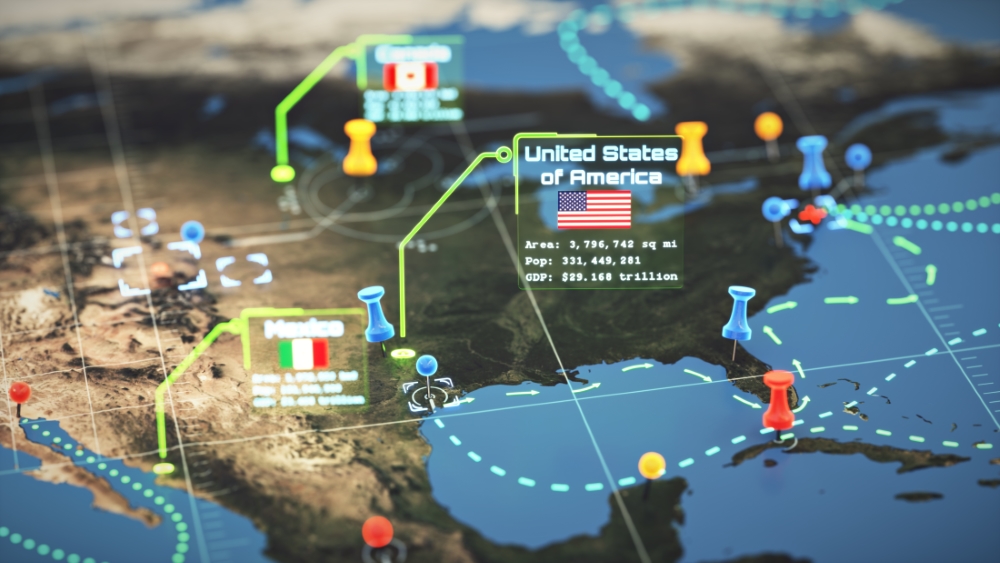
USMCA negotiations have been stacking up all year. Who will stand to benefit when trade talks are over?
Six years ago, North America trade relations fell under a new arrangement of the land — the United States–Mexico–Canada Agreement, or “USMCA.” The 2020 trade deal replaced the North American Free Trade Agreement (NAFTA), which had been directing negotiations and trade between Canada, Mexico and the U.S. since 1994.
Former Georgia Senator Saxby Chambliss, who was a speaker at a 2026 State of Higher Education multi-panel event I attended on Georgia Tech’s campus this past February on USCMA’s past, present and future, entered the U.S. Senate on the heels of NAFTA’s passing.
In Retrospect
Chambliss recalled how “NAFTA scared farmers in central and southern Georgia” during his term, noting that textile entities specifically were concerned about U.S. operations moving to Mexico. Originally opposed to NAFTA while campaigning, Chambliss pivoted his perspective on the international trade deal after winning his senate seat.
According to Chambliss, NAFTA was “one of the best things from a trade perspective that we have ever done.” He noted that ongoing negotiations surrounding USMCA will ultimately pull on the same issues that arose in the early ’90s around NAFTA, namely the “rules of origin” factor. He summarized the point efficiently at the February event, months before USMCA negotiations went sideways in summer 2026.
“It’s a technical but practical issue that comes up every time we negotiate [USMCA] again,” he said. “There’s a product sold in the U.S., but it’s been transferred a bunch before it hits the market in the U.S. What is the origin of that product?”
Chris Clark, president and CEO of the Georgia Chamber of Commerce, pointed at this same issue later during that same event Chambliss, members of Georgia’s business and educational fabric, and diplomats from Canada and Mexico who work closely on foreign trade matters attended in February.
Clark noted that “Ford builds vehicles in Detroit,” but that automotive parts “move between countries over 50 times” even when Mexico is left out of the logistics math.
Antonio Ortiz-Mena, a Georgetown University professor born in Mexico City and raised in Washington D.C. by a diplomat father, also attended the February event and noted that USMCA negotiations are “a way to reset bilateral trade relations. [Mexico is] a huge asset, not a liability, as some people have thought for many decades.”
“What’s at stake is much higher than what we had before that,” Ortiz-Mena added. “In my view, it’s trust and the security of the North American region through trade. It’s about remaining neighbors who trust each other and continue to trade with each other. It’s not about the trade deficit — it’s much bigger than just that.”
Emotions are clearly tied up in USMCA talks. On July 1, the U.S. declined to automatically extend USMCA. The move meant that the agreement will undergo more joint reviews, carried out each year, instead of automatically renewing for another 16 years as set out by the original language of the trade deal.
In August 2026, negotiation talks held between Canada and the U.S. fell apart, with both countries’ leaders accusing one another of not playing fair. The U.S. and Mexico will hold their next round of bilateral USMCA negotiations in September 2026 in Washington, D.C.
Chambliss noted in February that the U.S. is “the envy of the free world with our political system here, and despite all our political problems, we are still the envy of the free world.”
The retired senator also went on to add, to applause, that “if it were up to me, I would eliminate all tariffs. Let’s sure enough just have a free trading world. Unfortunately, the relationship between the United States [and its] trading partners over the years have involved tariffs, and it’s gotten out of kilter.”
Relationships Matter
The USMCA discussion held by the Georgia Chamber of Commerce and the Georgia Partnership for Excellence in Education on Georgia Tech’s campus in February 2026 was an assembly of expert minds from all three nations.
One speaker, Rosaline Kwan, Consul General of Canada to the Southeast U.S., addressed the room on what speaker Alasdair R. Young, a Georgia Tech professor at the Sam Nunn School of International Affairs, labeled a “sophisticated agreement between countries,” meaning USMCA.
“Strengthening North American trade relationships and our partnerships is vital in remaining resilient and competitive and having our three countries be well positioned to compete on an international stage,” Kwan remarked.
USMCA has been met with some controversy — as any trade arrangement involving barrels of money is bound to be. Globally, the economies rolled up in USMCA have a collective nominal GDP of just over $37 trillion (Canada at $2.51 trillion, Mexico at $2.12 trillion and the U.S. at $32.28 trillion).
The U.S. and Canada trade almost $900 billion yearly in goods and services. The State of Georgia and Canada trade relationship values at around $14 billion yearly. In 2025, bilateral trade between Mexico and the U.S. was valued at around $870 billion.
Consul General of Mexico Rafael Laveaga also spoke at the February 2026 meeting (and was seated at my table, where I was busy typing up notes). He stated that the largest Canadian trade mission had visited Mexico just a few weeks earlier, with 340 trade organizations and more than 300 delegates. He noted the historic nature of the trip and that the country’s relationship with Canada “couldn’t be better at this time.”
Louise Blais, Canadian diplomat, former United Nations ambassador, former consul general of Canada in Atlanta, and senior advisor for international affairs at the Business Council of Canada, said, “It’s been very difficult for Canada. Normally Canada would have had renewal and support. We are a trading nation. USMCA is completely part of its DNA. It’s emotionally difficult for Canada and is compounded by the [proposed] annexation of Greenland.”
Digital sovereignty is another key issue that has come during USMCA negotiations, Blais noted.
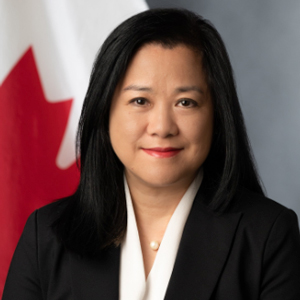
“Strengthening North American trade relationships and our partnerships is vital in remaining resilient and competitive and having our three countries be well positioned to compete on an international stage.”
— Rosaline Kwan, Consul General of Canada to the Southeast U.S.
Ortiz-Mena stated that Mexico’s priorities in USMCA’s renegotiation are two-fold: 1) To increase the level of certainty for the rules of trade and investment and see if there can be a dialogue for national security and 2) to be the least disfavored nation in USMCA.
At the time of the February 2026 event held on Georgia Tech’s campus, Ortiz-Mena noted that over 50 phone calls had taken place between Mexican President Claudia Sheinbaum and U.S. President Donald Trump on USMCA.
“We are growing a thicker skin on getting blamed,” said Blais on how Canada was dealing with the incendiary trade negotiations with the U.S., adding that “Mexico is used to this.”
Despite trade disruptions due to tariffs, Blais noted that about 89% of Canadian exports into the U.S. were USMCA-compliant and tariff free.
Ortiz-Mena also noted that the relationship between the U.S. and China was contentious, which triggered a string of conversation on how North American countries should prepare for the rise and solidification of China’s global economic growth.
“China wasn’t a big deal when 1994 NAFTA was negotiated. Now it is,” said Chambliss when the country came up in discussion in a conversation about cars. “China is producing a high-quality product at a cheaper rate than we can develop and produce in Mexico, U.S. or Canada … it’s not a U.S., Mexico and Canada issue. It should be a North American national security issue that we debate and that we solve in this agreement.”
Trade Talks
The USMCA informational session held on Georgia Tech’s campus earlier this year concluded with a fireside chat held between Joannah Hollis, senior investment officer for the Government of Canada, and Sonny Perdue, former Georgia Governor (2003 – 2011) and former U.S. Secretary of Agriculture (2017 – 2021).
At the time, Perdue was chancellor of the University System of Georgia — a position he retired from a couple months later. Perdue, who was a veterinarian and agriculture businessman in Georgia before serving in public office, pointed to that experience as foundational when entering NAFTA negotiations in the early ’90s.
“It doesn’t make any sense that we create barriers between our three nations that are detrimental to the economic prosperity of all three. We have all benefited from the trading relationship.”
— Sonny Perdue, former Georgia Governor, former U.S. Secretary of Agriculture and former Chancellor of the University System of Georgia, on USMCA’s uncertain future
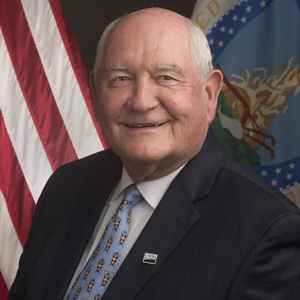
“As governor, economic development was part of the role,” Perdue told Hollis. “We tried to grow our presence by bringing companies to Georgia and provide opportunity for local Georgia businesses to have access to the market. Your next-door neighbors should be your best trading partners. Your best customers are those you are already doing business with. Go do more.”
Perdue imparted a great admiration for the parliamentary process in Canada, a country he frequently visited and worked with during his time in politics.
“The parliamentary system created really great leaders,” he said. “I developed immense respect for their thoughtfulness and their ability to make good decisions as opposed to popular elections.”
Perdue noted that when he started his tenure as U.S. Secretary of Agriculture in 2017, he received a phone call on his second day from then-U.S. Secretary of Commerce Wilbur Ross asking if the U.S. should withdraw from NAFTA. It was a suggestion that left Perdue shaken.
Ultimately, NAFTA did come to its planned end, with several experts noting that the ’90s trade deal wasn’t meant to last forever.
“It doesn’t make any sense that we create barriers between our three nations that are detrimental to the economic prosperity of all three,” said Perdue. “We have all benefited from the trading relationship.”
Divining USMCA: A Q&A with Former
Ambassador Antonio Garza
What do you think will be the outcome of the USMCA bilateral meetings that started in July?
GARZA: The joint statement out of Mexico City following Ambassador Greer’s meetings with Economy Minister Ebrard and President Sheinbaum was undeniably positive. It appears that serious discussion was had on steel and aluminum, and a fourth round of meetings has been set for Washington in September. But the real story? I continue to believe that ever since Washington officially rejected the automatic 16-year extension back on July 1st, the background music has changed. Even as both sides pursue interim arrangements by year-end, we have formally entered an era of rolling uncertainty.
OK, so what do I mean by rolling uncertainty? It means these scheduled negotiating rounds aren’t simply routine checkups. They are effectively a well-structured, multi-year pressure campaign in the guise of a USMCA review process. Washington is going to keep squeezing Mexico on automotive rules of origin, labor standards and Chinese supply chain circumvention. And look, even though they aren’t strictly trade-related, don’t think immigration, security and rule of law will ever be too far off the agenda. USMCA will survive, and so will the uncertainty and bilateral tensions.
How do you see the recent news about USMCA negotiations impacting investment in Mexico?
GARZA: The immediate fear is that a shift to annual reviews will freeze, or at least chill, foreign direct investment because capital hates uncertainty. But if you look deeper, that USMCA-related anxiety is already being exacerbated by some serious domestic challenges within Mexico. For investment to thrive, the Sheinbaum Administration must do more about energy reliability, water infrastructure and the rule of law.
So, how will investors actually react to this mix of news? I think you’ll see a shift in how they spend, not if they spend. You’ll likely see fewer announcements about mega projects with long time horizons because of that ticking 10-year expiration clock and those local infrastructure bottlenecks. But nimble, high-yield assembly plants and automated near-shoring facilities? Those may actually speed up because they can generate a return long before 2036 and a win for Mexico, provided they can secure basic power and legal certainty.

“What happens to the region if we lose that anchor, that which allows us to leverage our respective strengths? We lose more than a trade deal, we lose our capacity to build on our collective prosperity, and the foundational shield for North American security.”
— Antonio Garza, Retired U.S. Ambassador to Mexico and Senior Advisor at White & Case, on the possibility that the U.S. leaves USMCA
If the U.S. pulls out of USMCA, how will the lives of people living in North America be affected?
GARZA: People usually focus on automotive supply chains and sudden tariff spikes, which would obviously be brutal for major corporations. But the deeper, human impact would be a direct hit to the daily standard of living for families all across North America. Decoupling would trigger job losses and long-term structural inflation on everyday essentials, everything from your grocery bill to your electronics.
And there’s a bigger picture here, as well. What happens to the region if we lose that anchor, that which allows us to leverage our respective strengths? We lose more than a trade deal, we lose our capacity to build on our collective prosperity, and the foundational shield for North American security. North American security and prosperity is our best response to China and other rising powers. Walking away doesn’t just create a border or immigration crisis with Mexico, it leaves us more vulnerable in an increasingly dangerous world. — Kelly Barraza