
Deputy Governor and Tennessee Department of Economic and Community Development (TNECD) Commissioner Stuart C. McWhorter has been a busy man. In mid-May, during the same week that he hosted South Korean Ambassador Kang Kyung-wha in Nashville and cut the ribbon on Shoals Technologies Group’s new Mega Facility in Portland, he and the governor received word from the National Football League that Super Bowl LXIV will be coming to Nashville in 2030.
In a letter he wrote to Tennessee stakeholders following these momentous events, McWhorter said, “This week served as a powerful reminder of why Tennessee continues to lead the nation in economic development and why the work happening across this department matters so much to the future of our state. Over the course of just a few days, we saw firsthand how Tennessee’s relationships, strategic vision and collaborative approach are positioning us at the center of some of the most important industries shaping the global economy.”
One of those industries is the global coffee business, and in that industry there is no bigger name than Starbucks. On April 21, Gov. Bill Lee and McWhorter joined Starbucks executives in announcing that the global coffee company will invest $100 million to expand its North American presence by locating a Southeast corporate office in Nashville, where it plans to employ up to 2,000 workers over the next several years.
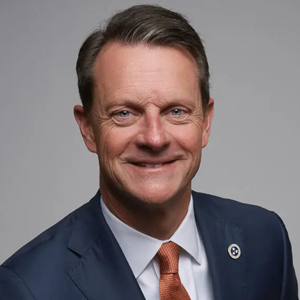
“Workforce is considered one of the most important and precious utilities we have. Governor Lee spent his career in the private sector. He gets it. He understands the value.”
— Stuart C. McWhorter, Deputy Governor and TNECD Commissioner
The company said that the Nashville office will directly support continued coffeehouse expansion and rising customer demand, particularly in the southeastern U.S., while working closely with the company’s global headquarters in Seattle.
For McWhorter and his team of professionals at TNECD, landing Starbucks, Shoals Technologies and other large investments is a direct byproduct of the work they do all year long to create an environment in which businesses thrive. From Amazon and Starbucks to Korea Zinc and Craig Manufacturing, Tennessee lands game-changing capital investments across the state because Tennessee delivers an ecosystem that fuels business growth.
Analytics from Site Selection magazine confirm this. Tennessee consistently performs at a top five level in overall business climate, according to the publication’s annual survey of its readers, and in the magazine’s recent Site Selectors Survey, site consultants nationwide said that Nashville was the No. 1 city in America for corporate headquarters projects.
Site consultant Jay Garner, president of Garner Economics in Atlanta, said, “Tennessee’s business climate is high-performing, cost-competitive and workforce-strong, with solid rankings in cost of doing business, logistics and business friendliness. I have always felt that the business climate in Tennessee has been consistently good, even when there was a gubernatorial change and changes in the state legislature.”
In other words, Tennessee delivers stability, consistency and predictability—three qualities businesses covet in a location. In the following interview, McWhorter outlines TNECD’s priorities and approach to economic development and discusses how the state is set up to maintain this momentum for many years to come.
You have a very diverse background in entrepreneurship, corporate finance and strategic planning. How are you able to draw upon all of those skill sets and your deep business management experience in leading the Tennessee Department of Economic and Community Development?
MCWHORTER: I have been fortunate to have a lot of interesting opportunities in my career. It has been fairly diverse. Most of my career was spent in the venture capital business. Ultimately, it is an evaluation of people’s ability to start and grow a business. That translates into our grant program and how we compete with other states. At the end of the day, it is about how we invest taxpayer dollars. Governor Lee is very pro-business. Tennessee provides a business environment that is conducive to business. At TNECD, we evaluate companies’ ability to perform and be successful.

McWhorter helps Florim USA celebrate National Tile Day at Florim’s giant tile plant in Clarksville, where Florim recently christened a new $35 million facility expansion.
Photo courtesy of TNECD
How is TNECD organized to help companies find the best business location in Tennessee, and then, once they are here, thrive?
MCWHORTER: Our department has three components: the Business Development Team; the Community and Rural Development Team; and the Innovation, Entrepreneurship and Small Business Team. The Business Development Team drives economic development across Tennessee’s 95 counties. We divide the state into nine regions and have staff located in each one. Those regional staff members report to the assistant commissioner for business development and work closely with local communities to understand their needs and position them for economic growth and business recruitment. Having people who live and work in these communities is critical to our success.
Your office and the office of Governor Lee have worked hand in hand to improve the overall business environment of the state. What are some of the key reforms and upgrades that you have implemented to make Tennessee a more competitive state for business?
MCWHORTER: It is a variety of things. Nashville is the largest economic engine in the state, with entertainment and tourism serving as major drivers of the local economy. As a state with no income tax, we rely heavily on tourism and sales tax spending. Beyond Nashville, I would point to the state’s commitment to workforce development and CTE [career and technical education] training. We are constantly providing resources for upskilling. Companies look to us to reskill and upskill their workforce. Tennessee’s K–12 system, CTE programs and Technical Trade School System all play an important role in that effort. Workforce is one of the most important and valuable assets we have. Governor Lee spent his career in the private sector, so he understands the value.
We also continue to invest in our roads, waterways, ports and airports. Logistics is a critical component to companies that call Tennessee home.
In addition, we remain fiscally conservative. We save money for rainy days, keep taxes low and maintain a business-friendly regulatory environment. We know that businesses value certainty, and we provide that in Tennessee.
Foreign direct investment has been a mainstay in your state for a long time, and your office works year-round to promote it. You and your team travel frequently to other countries to market and promote Tennessee as a preferred destination for FDI. How is your state measuring up in that regard, and what are some big corporate project FDI wins in Tennessee?
MCWHORTER: We are big fans of FDI. We took the FDI relationship-building approach in 2010. Former TNECD Commissioner Bill Hagerty put his imprint on the program because of the international work he did. Everything we do today is a direct result of what he put in place in 2010. Today, we have five people who live in other countries: three in Europe and two in Asia—Tokyo and Seoul. Japan and Korea are our two most active FDI partners. It goes back to Nissan locating a plant in Smyrna in the 1980s. We have about 200 Japanese companies now. Nearly 50,000 Tennesseans are employed by Japanese businesses.
Our second biggest source of FDI is Korea. The largest project in Tennessee last year was by Korea Zinc. They brokered a deal with the U.S. government to open a zinc processing plant in Clarksville/Montgomery County to process zinc and a dozen other rare earth minerals. It was a $6.6 billion capital investment. They trust the handshake, and that is just the beginning of our relationship. We want to be with them as they grow.
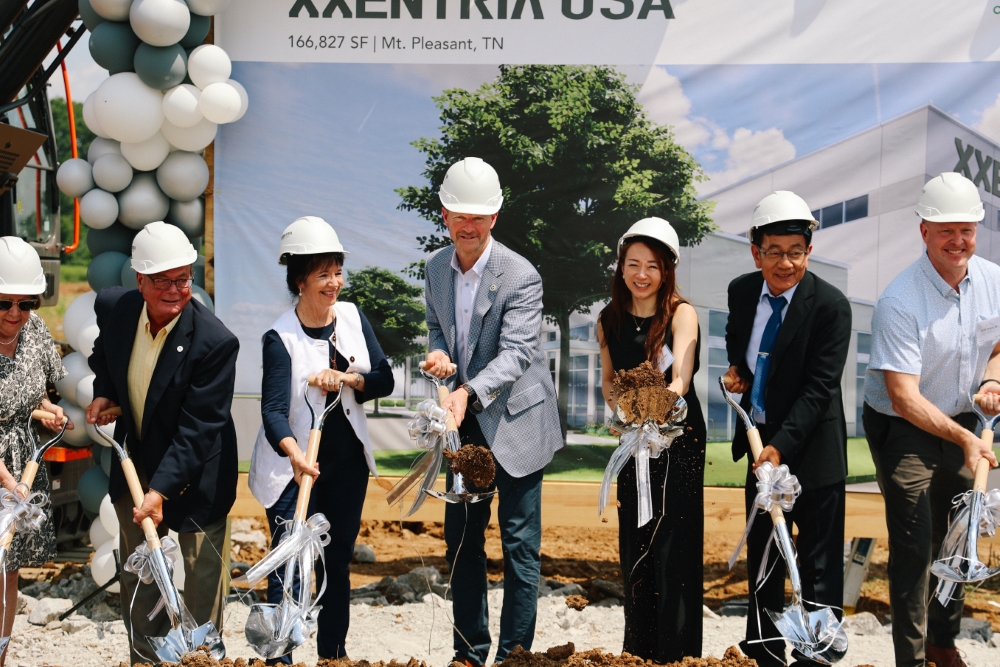
McWhorter turns dirt at the official groundbreaking of Taiwanese company Xxentria USA’s $45 million plant in Mount Pleasant.
Photo courtesy of TNECD
How did your team arrive at the adoption of “Tennessee: Experience High Volume” as your organization’s new marketing campaign? What did that process look like, and what do you hope to achieve with this new marketing push?
MCWHORTER: We are super excited about the new branding. The “Mastered in Tennessee” branding campaign launched in 2010. It worked really well, but it was time to make a change. “High Volume” can mean many things. From innovation and workforce quality to energy reliability, manufacturing output, music and economic growth, Tennessee consistently delivers results at scale. So far, it has been very well received.
When people ask why they should invest in Tennessee as a business location, how do you answer?
MCWHORTER: We recognize that this is a serious business decision. In every case, there are shareholders that care very deeply about how the company spends their capital. We will never promise something we can’t deliver just to get the win. We know we must provide shovel-ready sites. Companies don’t have time to wait.
Ultimately, it is about the people in our state. We have close to 7.5 million people. We are the Volunteer State. That means we all work together. We are very well aligned across the state. CEOs and site consultants tell us that all the time, and we plan to keep it that way.
“We are a state that continues to be fiscally conservative. We save money for rainy days. We keep taxes low. We keep regulatory policy friendly. We know that businesses want certainty, and we provide that in Tennessee.”
– Stuart C. McWhorter, Deputy Governor and TNECD Commissioner
Which industries are growing at the fastest rate in Tennessee now?
MCWHORTER: Right now, it is the new nuclear industry. We have a special grant program around the nuclear energy supply chain. Much of that is centered around Oak Ridge in East Tennessee. We have had a nuclear energy ecosystem there for decades. Since the nuclear fund launched in 2023, it has supported projects representing $8.5 billion in capital investment and 2,200 new jobs.
What is the expected impact of hosting Super Bowl LXIV in 2030? How will that bolster your overall marketing push for economic development in Tennessee?
MCWHORTER: We are super excited about that. It has been a dream for the state and the city of Nashville for quite some time. We knew that the new NFL stadium we are building for the Tennessee Titans would give us a great shot at it. It happened pretty quickly. The Titans will play in that stadium starting next year. We have added more hotel rooms in the last several years, so we are ready.