
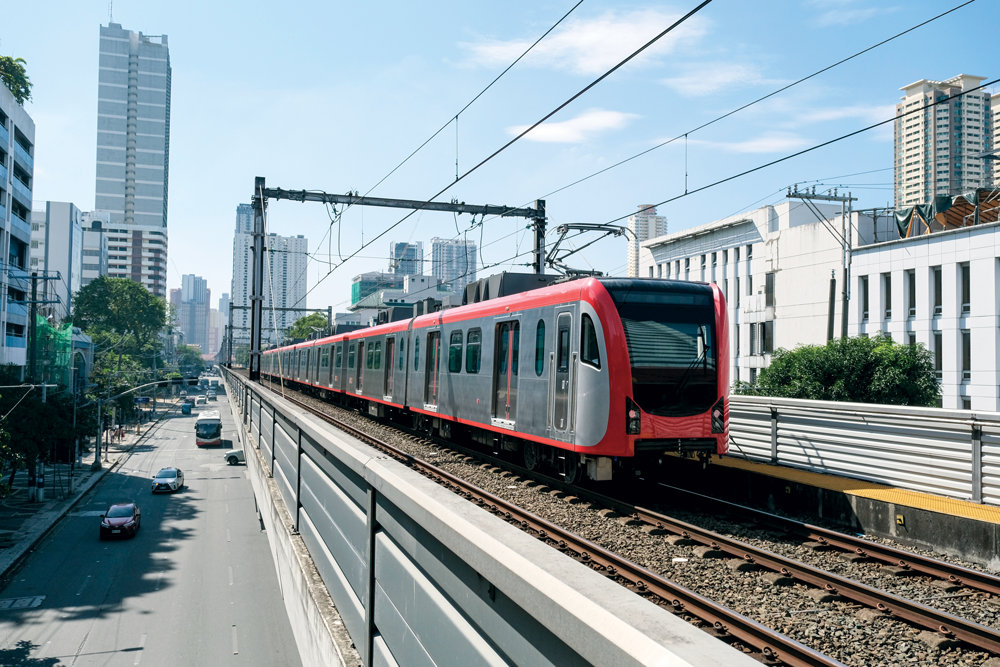
Insights from Manila show how transit infrastructure is changing to keep up with commuters.
by Kath Taburada & Kevin Jara, Colliers
for many people in the Philippines, commuting takes up a lot of time — an average of two to three hours each day. Traffic congestion is a serious barrier in metro Manila. According to the 2025 TomTom Traffic Index, Manila ranked 40th globally and 12th in Asia as one of the most congested cities, with commuters losing seven full days a year sitting in traffic. To this end, the city has been investigating how to improve transit options for its people while also seeing the benefits of building out sites that could entice business stakeholders and site selectors.
Expanding new transit in a dense and highly built-up city like Manila is challenging because infrastructure delivery must contend with right-of-way acquisition, fragmented land ownership, utility relocation, funding constraints and coordination across multiple national and local agencies. These are not purely transport issues; they are urban planning issues that require rail, road, land use, zoning, pedestrian access and private-sector development to move in the same direction.
For transit-oriented development (TOD) to succeed, stations must function as connected urban nodes rather than isolated stops. This means providing safe and shaded walkways, reliable last-mile connections, clear wayfinding and mixed-use developments that allow people to work, shop and access services within a short walk of transit. Without this integration, new rail lines may improve mobility but may not fully capture the economic and real estate value of the areas they serve.
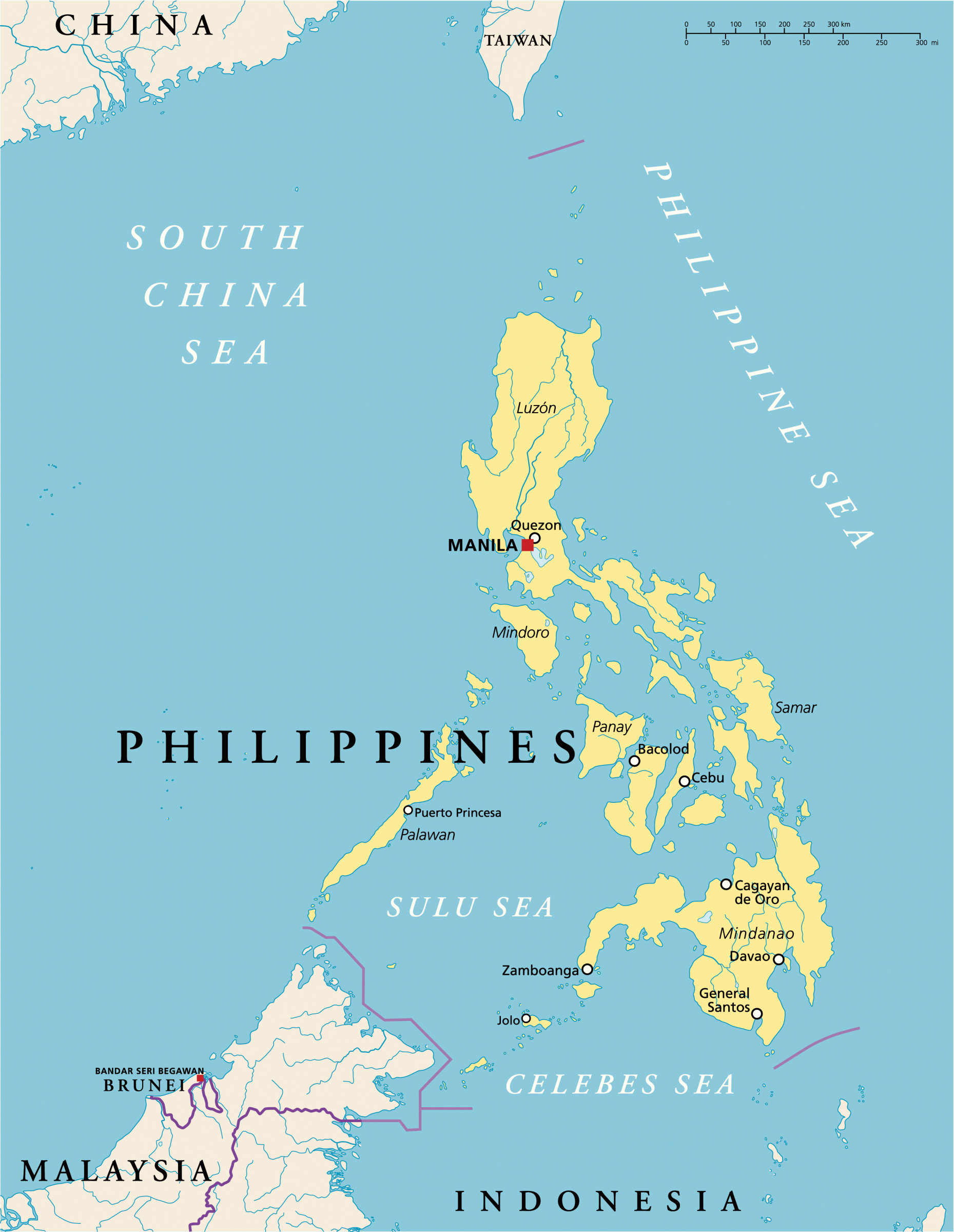
Map: Getty Images / PeterHermesFurian
Seeking Solutions
Government agencies are increasingly addressing these challenges by planning major infrastructure projects as part of a more connected network. A recent example is the Senate-DepEd Transit-Oriented Development (SEED) Project in Taguig, where the Philippines and the United Kingdom completed a feasibility study for a 13-hectare (32-acre) commuter-centered hub. The project is planned at the junction of the future North-South Commuter Railway and Metro Manila Subway, with a proposed interchange that can reduce the walking distance between the two rail systems. This shows how TOD planning is moving toward more pedestrian-centered and mixed-use station districts.
“The SEED Project exemplifies what this looks like at ground level,” Philippine Department of Transportation Secretary Giovanni Lopez said about the project update in August 2026. “In Taguig, a 13-hectare complex will demonstrate how education, residential and commercial spaces can co-exist around transit modes, creating an environment where students spend less time commuting and more time studying, where families have genuine mobility choices and where the city itself becomes more livable and sustainable.”
At the same time, the private sector has become a more active partner in improving the commuter experience around transport-linked developments. SM Prime Holdings, for example, has partnered with government to ease the daily urban commute by supporting transport integration and commuter-friendly access around its developments. This is critical because successful TOD projects require shared execution: Government provides the mass transit backbone while developers, businesses and communities help activate the areas around stations and make them more usable throughout the day.
Transit Options and Site Selection
Strong transit options have become a decisive factor in how companies choose office locations in the Philippines. For occupiers, accessibility is no longer just a matter of convenience, as it directly affects employee attendance, retention, productivity and the overall appeal of the workplace, especially in a hybrid environment where many firms still require employees to report to the office on specific days.
Locations near rail stations, intermodal terminals and major transport corridors are becoming more attractive because they reduce commute friction and widen the accessible labor pool. In Metro Manila, where travel time and transport costs remain among the biggest barriers to returning to the office, proximity to reliable transit can be a clear differentiator in site selection.
This is already being reflected in leasing activity. About 80% of metro Manila office transactions are located near a transit station or transport hub, highlighting how occupiers are placing greater weight on accessibility when choosing office locations. We are also seeing this in major pre-leasing activity, including a significant transaction closed in an upcoming transit-oriented development in Mandaluyong, which reinforces the market’s confidence in transit-linked office projects.
Boosting Quality of Life and Investment Through TOD
Strong transit access can help unlock economic growth by improving mobility, increasing foot traffic and making locations more attractive to businesses, workers and investors. In metro Manila, we are already seeing this reflected in the way office demand and mixed-use development are clustering around transport-connected locations. Colliers has noted that a significant share of metro Manila office deals are occurring in close proximity to transit hubs, which shows that accessibility is becoming a more important requirement for occupiers.
About 80% of Metro Manila office transactions are located near a transit station or transport hub.
New transit development can also significantly improve quality of life by making daily commutes shorter, safer, more predictable and less costly. In metro Manila, where many workers spend hours traveling to and from work, better transit can free up time for family, rest, education and other productive activities. In our view, mobility should be seen not only as an infrastructure issue, but also as a quality-of-life issue.
This is particularly important in the Philippines, where many workers continue to travel from surrounding provinces such as Cavite, Laguna, Bulacan and Rizal into metro Manila for employment. Better transit and TODs can help reduce the friction of daily commuting while supporting more balanced growth across the metro area and nearby growth corridors.
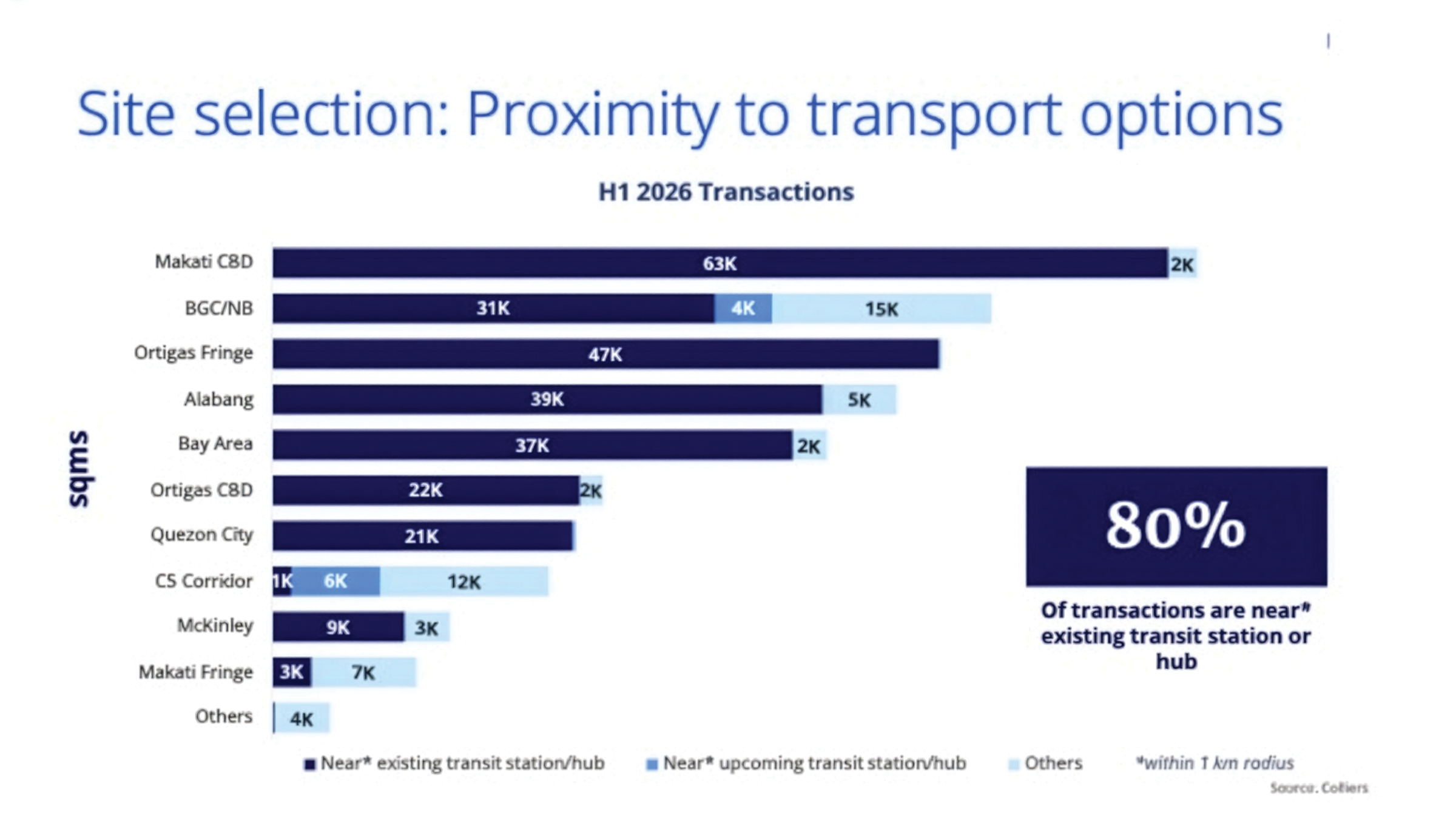
Chart courtesy of Colliers
Reliable public transport also improves access to jobs and services. For many Filipinos, transport availability determines where they can work, how much they spend commuting and how much time they lose on the road. When transit is connected to walkable, mixed-use districts, it becomes easier for people to access offices, schools, healthcare, retail and public services without depending heavily on private vehicles.
One Ayala in Makati is one of the clearest local examples of a successful TOD. It integrates an intermodal transport hub, a retail component, a hotel and office towers in one highly accessible location along EDSA (Epifanio de los Santos Avenue) and Ayala Avenue. Its direct connection to MRT-3 Ayala Station and other public transport modes makes it a strong model for how transit, commercial uses and pedestrian movement can be organized within a dense business district.
The project also shows the occupier-side value of TOD projects. One Ayala was constructed during the COVID-19 pandemic, at a time when the office market was facing a sharp downturn and many companies were reassessing their space requirements. Despite this challenging backdrop, tenants still took the opportunity to lease space in the development, reflecting confidence in the long-term value of a highly accessible, transit-oriented location. Its office component has attracted major tenants such as Optum and ING, underscoring how companies are increasingly prioritizing accessibility, employee convenience and connectivity in their site selection decisions.
Read more about transit-oriented development insights connected to a $1.4 billion investment by the Maryland Transit Administration to modernize light rail in the Baltimore region.
Kath Taburada (kath.taburada@colliers.com) is a research manager and Kevin Jara (kevin.Jara@colliers.com) is director of office services at the Manila office of Colliers.