Where does the value come from when we talk about “value-added agriculture?” The definition of the term involves transforming agricultural products into something new, “finished” or inherently more valuable via processing methods, consumer-directed marketing and other means.
Ukraine, historically known as a breadbasket country due to its optimal growing conditions for wheat, also has a centuries-old story in cultivating hemp. The plant was a popular driver of this industrial sector in Soviet Ukraine during the early 20th century, experiencing a drop-off after the collapse of the Soviet Union in 1991. Although the present reality of war in the country has not made economic redevelopment a cakewalk, it has not stopped Ukrainian enterprise from taking root.
Raw Potential
“Ukraine has a long history of growing and processing hemp and flax,” writes Ma’Rijany Hemp Company Commercial Director Ihor Didok in an email to Site Selection. “The maximum area of hemp cultivation in Ukraine was 150,000 hectares [more than 370,650 acres] in the early 1980s, which is more than the area of hemp cultivation in the entire world currently. Ukraine was a center for breeding hemp varieties for different purposes. In fact, it was Ukrainian breeders who developed the world’s first non-THC hemp varieties. Therefore, we are building on a solid foundation.”
Ma’Rijany Hemp’s new $30-million hemp facility in the Zhytomyr Oblast region aims to rebuild and diversify Ukraine’s fiber processing abilities, strengthening the country’s textile industry competitiveness and fortifying rural economic development.

“Our contribution to Ukraine’s economy lies in creating jobs, reviving the rural region, bringing in export revenue and, we hope, in the future, revival of the bast fiber processing ecosystem, which will directly impact the competitiveness of Ukraine’s textile industry.”
— Ihor Didok, Commercial Director, Ma’Rijany Hemp Company
“Our company focuses on producing long and short textile-quality fiber,” Didok says about the products the company makes. “Unfortunately, the ecosystem for processing this fiber into textiles does not exist in Ukraine. Therefore, we are exclusively export-oriented. Our contribution to Ukraine’s economy lies in creating jobs, reviving the rural region, bringing in export revenue and, we hope, in the future, revival of the bast fiber processing ecosystem, which will directly impact the competitiveness of Ukraine’s textile industry, which currently operates almost exclusively on imported raw materials.”
The Zhytomyr Oblast region has a longstanding reputation for bast (stem) fiber cultivation and flax. In 2023, Ma’Rijany Hemp Company began restoration of a flax facility abandoned over 30 years ago, with operations beginning in late April 2025 and a projected annual processing output of raw material between 12,000 and 14,000 tons.
The company’s fiber and hurd products are already in the European market. Hurd is the woody core found in fiber-bearing plants and can produce short fiber, which is used in mixed-yarn, non-woven products, paper products and sustainable construction materials.
Cultivating Hemp
In 2026, Ma’Rijany Hemp expects to significantly expand the geography and scope of its work with European partners. Didok cites the region’s climatic conditions, particularly the August fogs, as enabling excellent results for field retting of both hemp and flax.
“Retting” is the process of separating the bast fiber in plants from non-fibrous materials to create fibers that can be used in final products like yarn, textiles, rope and composite materials. This has been done mainly in two ways. Dew/field retting is done by laying stalks of hemp, flax, jute and other similar fibrous plants evenly on a field, allowing dew and rain along with soil fungi and bacteria to break the stalks down for harvesting. The other method involves submerging the plant in water so that anaerobic bacteria can digest the stalks.
Duration of retting is key. Harvest too early, and the valuable fibers may not be ready to separate from the woody portions of the plant. Wait too long, and the quality of the fiber may not be as high. Water retting typically yields higher quality product, though dew/field retting is the more common process today due to lower costs, higher yields and lack of odor associated with anaerobic bacteria in water retting.
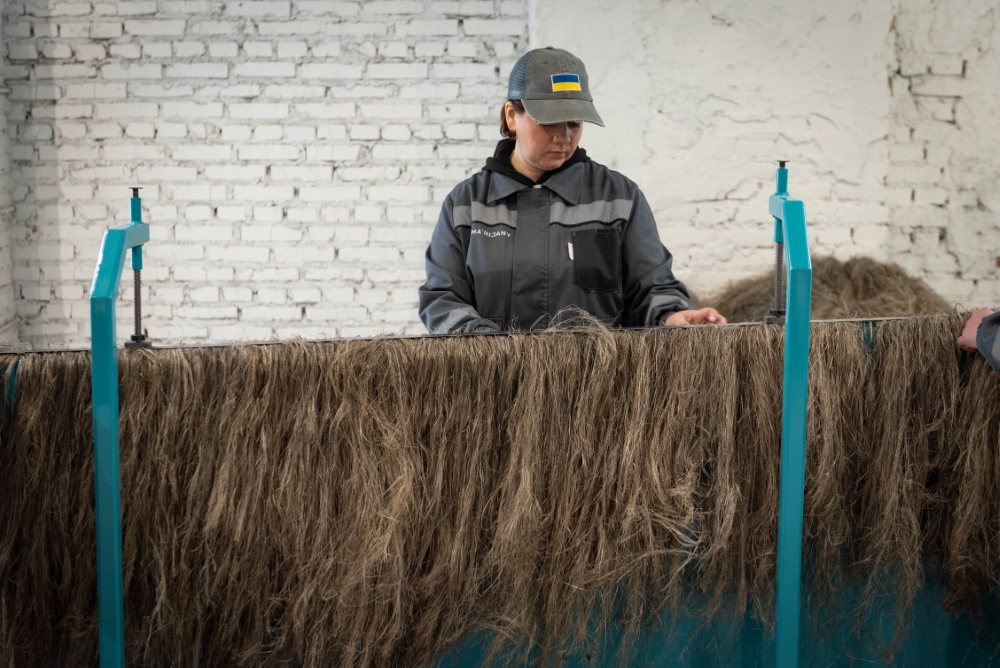
Ma’Rijany Hemp blends these centuries-old cultivation methods with modern technology like a customized scutching production line from Belgian manufacturer Vanhauwaert. Scutching involves separating impurities like woody parts, short fibers and other elements from a raw plant.
“We continue to work on deepening our processing capabilities, including grinding hurd into fine,” says Didok about the future of the facility, its agricultural machinery fleet, land bank and over 1,400 cultivated hectares of hemp. Future expansion plans will boost annual output to 20,000 tons of hemp. The facility is the anchor and first production site of the Ma’Rijany Industrial Park in Zhytomyr.
Didok also said the company would investigate processing micronized fractions, which are tiny particles of natural plant compounds commonly used in medications/nutritional supplements to treat chronic venous disease and other conditions.
According to a 2025 article on industrial hemp by authors Olga Nykolyuk and Karyna Sych of Polissia National University, revitalization of the hemp sector in Ukraine began in 2012 after restrictive permits directing its cultivation were lifted. This followed growing external market demand, and the amount of industrial hemp acreage has grown steadily every year since then (save for a bumpy 2018 that had a loss in cultivated areas due to new requirements for storage facilities housing narcotic drugs, psychotropic substances and the like).
Ukraine saw a record year for industrial hemp in 2024, with cultivation area totaling between 2,600 and 3,000 hectares (6,425 to 7,414 acres) in the country — untouched by wartime climate.