
What’s making West Tennessee ripe for corporate investment?
Tennessee is a trusted partner for industry, offering a low-tax, pro-business environment alongside interstate connectivity that strengthens the western portion of the state’s logistics corridor. There is Interstate 40, which runs east-west, crossing Memphis and Jackson and connecting the state laterally, and Interstate 55, running north-south in the southwestern part of Tennessee, connecting Memphis to Mississippi, Arkansas and beyond.
Several big names also populate the western part of the state—Swedish-Swiss technology company ABB has a corporate office in Memphis and invested $80 million in early 2025 for a new advanced manufacturing facility in Selmer. The 320,000-square-foot facility will produce low-voltage electrification products when operational in late 2026. FedEx, AutoZone and International Paper are also all headquartered in Memphis.
Eighty-five miles northeast of Memphis and 130 miles southwest of Nashville, there’s the city of Jackson in Madison County. Almost 70,000 people live in Jackson, a known and popular waypoint in West Tennessee for business and logistics. What makes the city and region ideal for corporate and operational infrastructure? Greater Jackson Chamber Chief Economic Development Officer Mandy White has a few thoughts on the topic.

“What makes Jackson and West Tennessee stand out is the fact that we offer a strategic location, a strong workforce and a unified business-friendly approach. Companies can reach major markets from here easily. They operate at a lower cost, and they benefit from workforce activity that we help develop.”
— Mandy White, Chief Economic Development Officer,
Greater Jackson Chamber
Great Things in Greater Jackson
“What makes Jackson and West Tennessee stand out is the fact that we offer a strategic location, a strong workforce and a unified business-friendly approach,” White said. “Companies can reach major markets from here easily. They operate at a lower cost, and they benefit from workforce activity that we help develop. The feedback we get from projects that we’ve won is how our community works together. We move quickly. We solve problems, and we really build long-term relationships. We believe that people are going to want to do business with people they know, like and trust. So that relationship building and those authentic connections that we formed during the recruitment process are key.”
White says another advantage is the Jackson Energy Authority, a one-stop shop for all the utilities (water, wastewater, gas, electric and telecom fiber to the home) companies need to grow. Zooming out, Madison County has seen $3 billion in investment dollars from new and expanding companies, diversifying its industry base and strengthening its workforce pipeline.
The sectors of automotive, food, plastics, metals and battery/battery component manufacturing have all seen attention in the Greater Jackson Metro the past several years. In the last year, the city saw $268 million in investment.
“One non-traditional win that we have had in the last year and a half was recruiting Denver Air, which brought commercial jet service back to Jackson—something we haven’t had in over 25 years,” White said. “We have had prop planes, eight- or nine-seaters, and now we have a 50-passenger jet that has 12 weekly flights to Atlanta and Chicago. That really opens up Jackson to the world.”
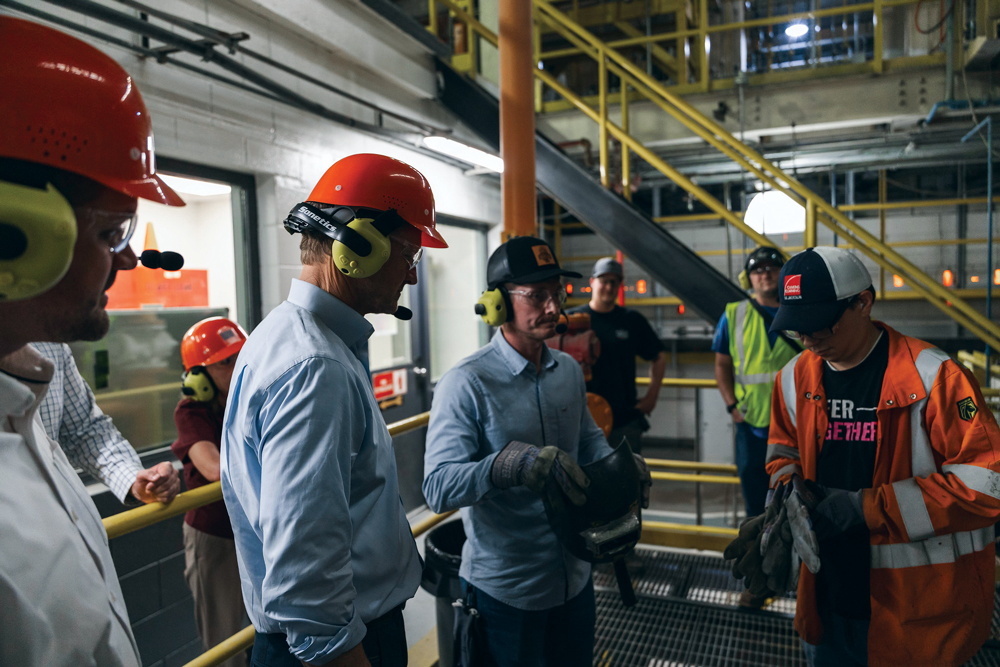
Deputy Governor and TNECD Commissioner Stuart C. McWhorter tours an Owens-Corning manufacturing plant in Jackson, Tennessee.
Photo courtesy of TNECD
Other recent wins in Jackson include a $425 million facility from paper products company Georgia-Pacific’s Dixie® brand, which opened in 2024, and a manufacturing facility from Atlanta-based packaging company Printpack.
White notes that the most effective tool among the city’s incentive programs for recruiting new and expanding industry is Jackson-Madison County’s Payment in Lieu of Tax (PILOT) program, which allows qualifying manufacturing, distribution, call center or data center projects to significantly reduce their tax burden during early stages of development. Companies eligible for the PILOT program take on a lease-back arrangement with the Jackson Industrial Development Board.
“That allows us to support companies that are making investments in our community and creating jobs for the first time, while also supporting our existing industries as they pursue opportunities to expand and compete for growth among their sister facilities,” White said about PILOT and the city’s recruiting philosophy. “We want Jackson to be strongly considered so we’re able to offer the same level of incentives for existing companies as we do for new ones. It’s important that we use it strategically and we make sure that it’s a return on investment for our community through job creation, capital investment, the quality of jobs or the average wage. One thing that’s been more important in the last few years is that we’re looking for companies that want to be partners with our community. We are selective as to which projects we try to recruit and to which companies we offer incentives.”
White says City of Jackson leaders are as focused on the quality of a project as they are on the sector to which it belongs, remaining intentional about the opportunities they pursue. She says employers and employees alike prize Jackson’s quality of life and sense of community, often finding more amenities than they might have expected thanks to Jackson’s location between other major Tennessee metro areas.
“We have a local symphony, a ballet, theater, outdoor concerts throughout the year, a growing art scene,” she said. “We also have great options for getting outside—parks, hiking and running. We have the oldest marathon in the state of Tennessee here. Our downtown has really come to life with a lot of new residential units and new shopping opportunities in addition to the work opportunities that are here and a strong mixed-use development that has had great success.”
Small Towns See Revitalization
Under the Tennessee Downtowns program, the Tennessee Department of Economic and Community Development (TNECD) provides grants and coaching to communities seeking improvements to their downtown corridors. Applications are accepted every two years, and the initiative is affiliated with the Tennessee Main Street program. Communities chosen for the Tennessee Downtowns program undergo a 24-month course that involves revitalizing their downtowns by receiving training in economic development literacy, heritage tourism and preservation efforts. The program also allows TNECD to collect data on the impact of community and rural development in the state.
In 2026, four communities in West Tennessee were awarded a $20,000 innovation grant under the Tennessee Downtowns program in its 10th round. They included the small towns of Dyer and Medina in Gibson County, Henning in Lauderdale County and Moscow in Fayette County. Three other communities in Tennessee were also selected in the 2026 Tennessee Downtowns cohort: Harriman, Red Bank and Rutledge.
“Congratulations to the seven communities we’re proud to welcome into the Tennessee Downtowns program,” said Tennessee Main Street Director Kim Parks when the new communities were selected this year. “We look forward to continuing to partner with these communities to make all of Tennessee a better place to live, work and raise a family.”
Other Main Street and Tennessee Downtowns communities in the western part of Tennessee include but are not limited to Arlington and Collierville in Shelby County; Covington in Tipton County; Halls and Ripley in Lauderdale County; Dyersburg and Newbern in Dyer County; Tiptonville in Lake County; Rossville and Somerville in Fayette County; Humboldt, Milan and Trenton in Gibson County and Dresden, Greenfield, Martin and Gleason in Weakley County.
Presently, there are 50 Main Street communities recognized in the Volunteer State. If a community is selected and completes its Tennessee Downtowns program, it becomes eligible for TNECD’s Tennessee Downtown Improvement Grant, which provides up to $400,000 for historic restoration and repairs of downtown corridors, and TNECD’s Tennessee Placemakers Entrepreneurship Fund, which helps nonprofits, local governments and educational/entrepreneur centers build coworking spaces, train entrepreneurs and support small business ventures.
A total of 15 grants from the Tennessee Placemakers Entrepreneurship Fund, with a grant amount of over $1.6 million, have been awarded since its launch in FY2019.