Workforce opportunities reach every corner of the Prairie State.
What makes Illinois one of the best places for workforce development in the United States? A statewide commitment to providing and creating new programs, training opportunities and resources for those seeking professional development certainly helps.
Illinois ranked No. 3 in Site Selection magazine’s 2026 Workforce Development Rankings. In the Midwest region, the state finished first. “As our economy continues to succeed and expand, we’re making sure that no one is left behind,” said Lieutenant Governor Juliana Stratton in January 2026. “By investing in workforce development and expanding access to education and training, we’re ensuring that opportunity reaches every corner of our state — and that we succeed together.”
A (Quantum) Leapfrog Moment
South Side Chicago received a boon in the field of quantum computing technology last year in September with the groundbreaking of anchor tenant PsiQuantum at the Illinois Quantum and Microelectronics Park (IQMP). PsiQuantum will be home to the first utility-scale, error-corrected quantum computer at IQMP, according to a press release from Illinois Governor JB Pritzker’s office. Illinois has spent decades building the foundation for a thriving innovation ecosystem, says Harley Johnson, CEO of IQMP.
“Governor Pritzker recognized early that quantum computing is a once-in-a-generation technology with the potential to reshape the global economy and everyday life,” Johnson says. “He knew Illinois was uniquely positioned to lead because of our world-renowned national laboratories, top-tier research universities, global transportation access, a thriving business community and eager workforce supported by a robust talent pipeline.”
The State has invested hundreds of millions of dollars in building Chicago’s talent pipeline. These investments include $200 million for the Chicago Quantum Exchange’s education and training programs, $500 million in the Discovery Partners Institute and the Illinois Innovation Network and $500 million for IQMP. A 124-mile quantum network with supercomputing centers at the Argonne Leadership Computing Facility and the University of Illinois’ National Center for Supercomputing Applications adds to the state’s R&D and commercialization infrastructure in quantum tech.
Notably, Illinois awards almost 40,000 degrees and certificates in quantum-related fields, including almost 12,000 from community colleges. According to analysis conducted by the Boston Consulting Group in 2024, as many as 191,000 quantum tech jobs are predicted in the Illinois-Wisconsin-Indiana region by 2035.
South Side Chicago will house IQMP at what once was a U. S. Steel facility that closed in 1992 and stayed vacant for 30 years. Johnson observes that “building the IQMP on the former South Works site provides an opportunity to turn the neighborhood’s industrial history into new prosperity: The location offers unmatched access to universities, national labs and transportation for local, regional, national and global connectivity. This is a generational chance to transform a site that once fueled the city’s, state’s and nation’s 20th-century economy into the epicenter of the quantum industry in America in the 21st century.”
The list of quantum-related workforce development programs in Illinois is staggering. IBM’s FutureNow Chicago delivery center will take advantage of City Colleges of Chicago’s “Moonshot” apprenticeship program, supported by philanthropy and the State of Illinois, which will recruit and train 500 apprentices over five years and graduate students from the two-year program with associate degrees. IBM has committed to hiring one-third of the program’s qualified graduates.
In April 2026, Quantum Across Illinois brought quantum industry employers to 10 public university and colleges in the state: College of DuPage, Harper College, Olive-Harvey College, Governors State University, Wilbur Wright College, College of Lake County, University of Illinois Chicago, Western Illinois University, Northern Illinois University and Illinois State University. PsiQuantum, Infleqtion, IBM, Pasqal and Quantum Machines were all IQMP tenants involved in the statewide initiative and worked together with IQMP, Illinois EDC and the Chicago Quantum Exchange to educate more than 1,000 students on the local careers and opportunities in quantum.

“Some students already had familiarity with quantum, and they told us that the biggest surprise was a new sense of community. Those students told us that they met peers who shared the same research interests and left feeling connected to the growing industry.”
— Harley Johnson, CEO, IQMP, on Quantum Across Illinois, a statewide workforce and educational initiative
“We were encouraged to see how much genuine engagement the program generated,” says Johnson. “Many students were energized by the chance to explore future career paths and excited to learn about opportunities they hadn’t considered before. Some students already had familiarity with quantum, and they told us that the biggest surprise was a new sense of community. Those students told us that they met peers who shared the same research interests and left feeling connected to the growing industry.”
Saturday Morning Quantum* (SMQ*) is yet another quantum education program in Illinois that’s been running for two years. Chicago Public Schools and Fermilab (Fermi National Accelerator Laboratory) modeled the free, 10-class course for high schoolers after Fermilab’s Saturday Morning Physics program, which has been running for over four decades. The rising “quantum scholars” in SMQ* spend 10 Saturdays learning directly from Fermilab scientists and experts in a hands-on, active learning approach that involves visiting Fermilab’s campus in Batavia and seeing firsthand all the cutting-edge tech the space has to offer. More than 80 students in two cohorts have participated in SMQ*.
Manufacturing Success
The state of Illinois has been working toward developing its entire manufacturing vertical. The Illinois Manufacturing Excellence Center (IMEC) got its start in 1996 and works with over 3,500 Illinois manufacturers annually to optimize and grow business operations and compete globally. This involves providing training programs, workspace simulations, on-site and classroom learning and designing apprentice programs for specific companies and trades. In 2025, IMEC helped create or retain 6,871 jobs among its clientele and had an aggregate impact of over $905 million to the Illinois economy. Some of those clients include hazardous material storage company Safety Storage Inc., tooling manufacturer Header Die and Tool Inc. and security tech company Giesecke+Devrient.
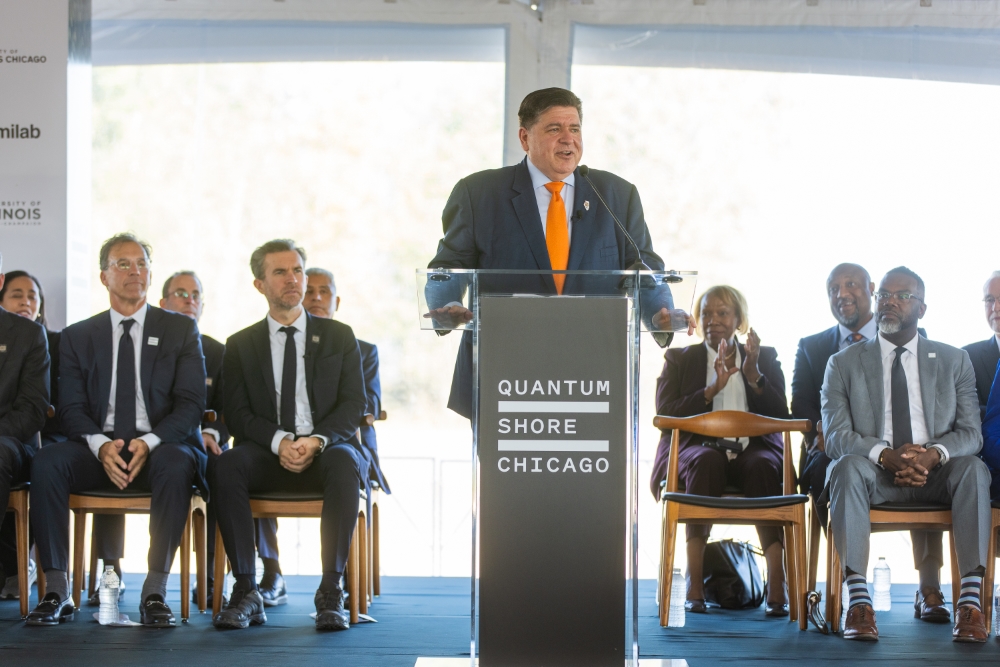
Illinois has invested heavily in being a leading force in quantum R&D, infrastructure and workforce training. Gov. JB Pritzker spoke at the groundbreaking of the IQMP, located at Quantum Shore Chicago.
Photo courtesy of Related Midwest
In January 2026, Gov. Pritzker and the Illinois Department of Commerce and Economic Opportunity (DCEO) announced $24 million in grant funding to establish six Manufacturing Training Academies (MTAs) at community colleges in Illinois’ downstate regions, another chapter in the state’s leadership and participation in the historic manufacturing scene that defined most of the Midwest’s economies for the past century. The funding will support facility and equipment upgrades that will prepare a generation of workers in the fields of advanced manufacturing, clean energy production, cryogenics science and more.
“Illinois community colleges are uniquely positioned to help power the state’s manufacturing future,” said Brian Durham, executive director of the Illinois Community College Board, when the MTA expansion was announced. “Through programs like the Manufacturing Training Academies, we’re connecting education and industry to deliver hands-on, high-tech training that meets the evolving needs of employers and opening opportunities to well-paying careers for Illinois residents.”
Manufacturing companies seeking to grow in Illinois can also turn to the Illinois Manufacturers’ Association (IMA), a trade association that got its start in 1893. The IMA Education Foundation funds workforce programming in school districts and all levels of higher and vocational education. The IMA also provides grant funding up to 50% to cover hard-skill training costs incurred by manufacturers through their Employee Training Investment Program (ETIP), which had 150 companies and over 30,000 employee participants involved in 2025; the State of Illinois funds IMA’s ETIP program.
DMG MORI Federal Services Inc. (DMG MORI) announced earlier this year that it would spend $40.5 million on a new advanced manufacturing R&D facility in the Chicagoland area. The global machining manufacturer’s new site will also have a dedicated partnership with City Colleges of Chicago, connecting students to desirable jobs in the industry.
Illinois EDC President and CEO Christy George said in February 2026 that “this expansion advances additive manufacturing and automation while creating accessible pathways to high-quality careers. Through its partnership with City Colleges of Chicago, DMG MORI is helping expand opportunity, strengthen talent pipelines and ensure more Illinoisans can participate in the future of manufacturing.”
Many Paths for Illinois Workers
Chicagoans have many options to choose from when looking for refining and adding to their skillsets. Take, for example, Xchange Chicago, which is jointly run by the Comer Science & Education Foundation, IT consultancy and technology-based managed services provider SDI Presence and nonprofit P33, which aims to drive inclusive tech and innovation growth in the Chicagoland area. Xchange Chicago opened a $20 million tech training hub at Greater Grand Crossing in November 2025, offering to train individuals in IT-based skills at the 28,000-sq.-ft. site that also aims to collect commercial tenants. Xchange Chicago provides apprenticeships and jobs for trainees at local employers, wrap-around services and other workforce development-based training. The project, backed by the City of Chicago, is expected to create up to 8,000 new tech jobs and have a $160 million economic impact locally.
“Xchange has already created dynamic career pathways and economic opportunities for more than 50 South Side residents in just over a year. The partners who brought Xchange to life, and the customers who believed in the vision, have made this beautiful new tech facility in Grand Crossing
a reality. ”— Chicago Mayor Brandon Johnson at the Greater Grand Crossing opening
“Xchange has already created dynamic career pathways and economic opportunities for more than 50 South Side residents in just over a year,” said Chicago Mayor Brandon Johnson at the Greater Grand Crossing opening. “The partners who brought Xchange to life, and the customers who believed in the vision, have made this beautiful new tech facility in Grand Crossing a reality. Together, their mentorship, training and supportive resources are helping to build a stronger Chicago and paving the way for thousands of life-changing technology jobs here on the South Side.”
Corn Belt Ports, which comprises four inland regional port districts in western Illinois and handles almost 100 million tons of freight each year across 50 riverfront counties in five Midwest states, has found partners in the higher education and skilled trades field to further maritime workforce development.
Western Illinois University, together with Corn Belt Ports, announced in April 2026 the establishment of the Corn Belt Ports Rural Logistics & Maritime Training & Education Consortium, which involves several higher education institutions from four states: Black Hawk College in Moline, Illinois; Carl Sandburg College in Galesburg, Illinois; Culver‑Stockton College in Canton, Missouri; Eastern Iowa Community Colleges; Illinois Central College in East Peoria; John Wood Community College in Quincy; Northeast Iowa Community College in Peosta, Iowa; and the University of Wisconsin–La Crosse and Western Technical College, both in La Crosse, Wisconsin.
Another success from Illinois is the apprentice opportunities borne out of the Climate and Equitable Jobs Act (CEJA), signed into law by Gov. Pritzker in 2021. CEJA’s Craft Apprenticeship Program focuses on funding accredited to or established programs for workers looking to enter the electrical and clean energy trades, especially pre-apprenticeships and youth-focused training in designing, installing and maintaining solar and electrical equipment.