
The Volunteer State reimagines its approach to building a labor pool.
In November 2025, the State of Tennessee launched a new workforce initiative, TNWorks, that combines the efforts of multiple state agencies, regional workforce boards and local industry partners to connect employers with workers and strengthen the local workforce.
“Tennessee has a strong history around coordination between state agencies and working together,” said recently appointed TNWorks Executive Director Brooks Young. “But now with TNWorks, our strategy moving forward is to further break down any silos that are there and, instead of having sort of this casual or informal collaboration and coordination, really structure our strategy around workforce needs and employer needs and build those talent pipelines across industry sectors.”
Brooks explained that Tennessee employers are navigating a very competitive labor market, and some industries face shortages in skilled talent—particularly in high-growth sectors like manufacturing, healthcare, transportation and technology. He added that “another piece of that challenge is many employers are competing for workers from the same labor pool. That’s why TNWorks is focused on not only workforce development, but also workforce participation.”
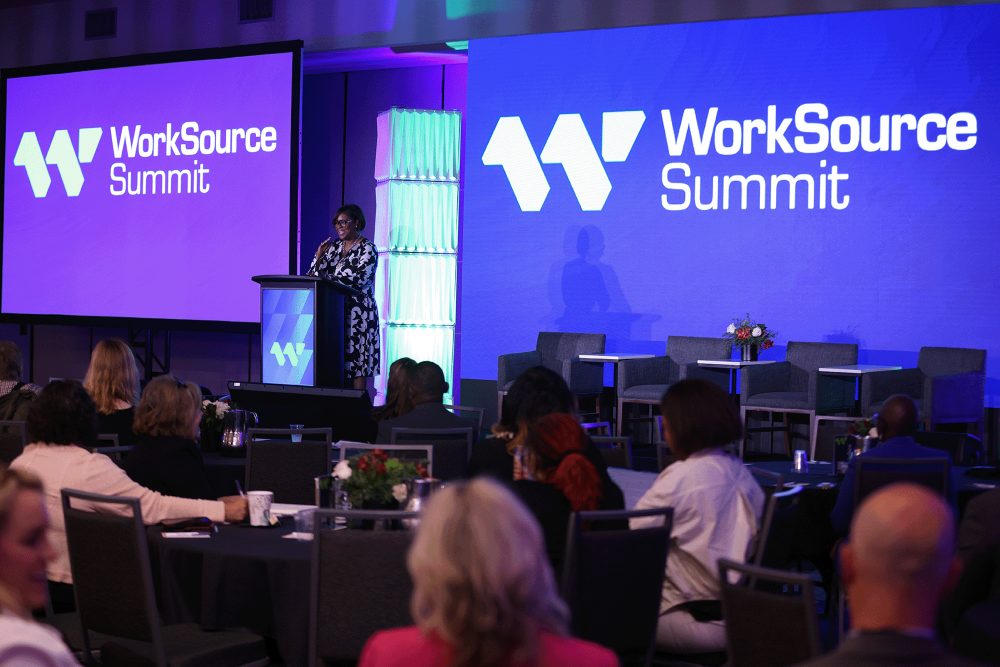
TNWorks collaborates with the six state agencies in Tennessee that involve workforce development. In May 2026, the Tennessee Department of Labor and Workforce Development hosted the WorkSource Summit, a new event offering insights into everything workforce- and economy-related in Tennessee.
Photos courtesy of TNWorks/Tennessee Department of Labor and Workforce Development

Working Together on Workforce Development
A big benefit of TNWorks’ organizational structure is the fact that all partners and state agencies can have seats at the same table, identifying talent pool barriers and solving them in tandem with industry and government partners.
The six state agencies working together under the TNWorks umbrella include the Department of Labor and Workforce Development, Department of Economic and Community Development, Higher Education Commission, Board of Regents, Department of Education and Department of Human Services.
Brooks said that “as we continue to grow and support businesses and communities across the state, prepare the workforce and build talent pipelines, it’s going to take more than just those six agencies. Part of our focus over the next year or two is making sure we are aligned at the state level and that same alignment extends to the regional level, with local partners and communities fully on board.”
TNWorks itself has been in development for a couple of years. After workforce participation, the second highest priority for the organization is strengthening relationships with new and existing employers in Tennessee and continuing to improve that alignment across workforce systems, said Brooks.
“We have seen significant population growth, and that’s driven by both natural growth and migration from other states,” said Brooks about what’s bringing workers to Tennessee. “We’re attracting people because of economic opportunity and affordability and quality of life. That growth has created tremendous momentum for Tennessee economically. At the same time, it’s increased the importance and need for strategic workforce planning. Employers need to know that they can access these talent pipelines that can keep pace with their needs as they expand and as populations shift. It’s important, especially in a place like Tennessee, to remember that we’re seeing growth not just in the urban areas, but in rural areas as well. That means these workforce strategies have to be flexible and regionally responsive.”
Tennessee Department of Labor and Workforce Development Commissioner Deniece Thomas also notes that the time TNWorks and collaborators spend together helps fuel the new workforce initiative in meeting the needs of Tennessee employers.
“I believe that good strategic, seamless partnerships and integration come from spending time and planning together,” said Thomas. “What I’m proud to say about TNWorks is this was not six individual agencies coming up with their own plan and trying to force it together. This plan is six agencies plus us sitting down and doing the formative work—saying, ‘How do we bring all of our resources and assets together and align them in a way that’s valuable and makes sense to business and industry?’ It’s helped our team really gel and know how to move with fluidity so that all the company sees is delivery.”

“I believe that good strategic, seamless partnerships and integration come from spending time and planning together. This was not six individual agencies coming up with their own plan and trying to force it together. This plan is six agencies plus us sitting down and doing the formative work—saying, ‘how do we bring all of our resources and assets together and align them in a way that’s valuable and makes sense to business and industry?’”
— Deniece Thomas, Commissioner, Tennessee Department of Labor and Workforce Development
TNWorks aims to continue to learn from business and industry case studies in its portfolio and grow its assets and investments in a way that can showcase value to Tennessee businesses, said Thomas. Some of those organizations TNWorks and its preceding configurations have worked with include Amteck, Morgan Steel, Tennessee Valley Authority and Global Location Strategies.
Supporting the Pipeline
Thomas added that Tennessee has been a great location for R&D and as a hub for innovation. This is aided no doubt by the ample universities powering advancements in science and technology, including Vanderbilt University and the University of Tennessee (UT) system.
“Tennessee has a strong history around coordination between state agencies and working together. But now with TNWorks, our strategy moving forward is to further break down any silos that are there and instead of having sort of this casual or informal collaboration and coordination, really structure our strategy around workforce needs and employer needs and build those talent pipelines across industry sectors.”
— Brooks Young, TNWorks Executive Director

Notably, UT has focused on keeping education accessible and affordable for students, with tuition rates across its colleges in Knoxville, Chattanooga, Pulaski (UT Southern) and Martin only rising 1.4% on average each year over the past five years.
About 55% of UT System undergraduates finish their education debt-free, and the UT System has set a goal of increasing that number to 64% by 2030. Another noteworthy fact is that 86% of UT System undergraduates are either employed or enrolled in graduate school within six months of graduating, adding value to the workforce pipeline in Tennessee and beyond.
“Supporting economic development and workforce needs is also essential to the UT System’s mission,” said University of Tennessee System President Randy Boyd. “Working closely with employers and economic development partners across the state helps our universities and institutes better understand Tennessee’s workforce needs and the skills students need to succeed.”
Last year in Tennessee, 75 economic development projects and $11.2 billion in capital investment were announced. With such deep and wide investment comes the need for training and educating a dynamic, emerging workforce. TNWorks’ closer partnership with the Tennessee Higher Education Commission and the Tennessee Board of Regents will certainly help in the overall drive to grow the state’s economy.
“When higher education is at the table,” said Tennessee Higher Education Commission Executive Director Dr. Steven Gentile in November 2025, “we can ensure that the degrees, the programs, the curriculum that our institutions are providing directly align with the workforce needs of today and of tomorrow.”