
To understand the full scope of global startup ecosystem activity, we like to weigh our resources. After a year of global turmoil, tariffs and temperamental economies, Site Selection set out to check the pulse of innovation and entrepreneurship within the world’s top metropolitan areas.
To do so, we’ve explored the findings of ecosystem reports from StartupBlink and Startup Genome, while factoring in the latest Global VC Ecosystem Rankings from Pitchbook. Our research team combined these analyses to measure shifts encountered by the world’s leading markets over the year, pinpointing where capital and forward-looking talent are settling in. The chart displays the world’s top 15 metro regions rank after blending the findings from those three sources.
The top two metros — San Francisco-Oakland-Fremont, California and New York-Newark-Jersey City, New York-New Jersey — remained firmly in their respective ranks for the third year in a row. However, the London metro area in the United Kingdom broke away from a prior two-year tie with California’s Los Angeles-Long Beach-Anaheim metro (No. 4), solidifying this year’s third place rank. Encompassing Massachusetts and New Hampshire, the Boston-Cambridge-Newton metro secured its No. 5 position for a second consecutive year.
The Shanghai metro region in China moved down one spot to No. 7 rank, replaced by Beijing. One or both of these regions saw a slight decline across all three reports from StartupBlink, Startup Genome and Pitchbook. Startup Genome released its new 2026 ecosystem report at press deadline, so while those insights are not factored into Site Selection’s metro rankings it is important to note a few changes. Beijing fell from No. 7 as Los Angeles rose to sixth place; Singapore (No. 8) rose one rank to swap places with Seoul and Shanghai (No. 11) was replaced by Seattle in the top 10.
StartupBlink’s fresh report showed both Beijing and Shanghai experienced around 20% negative growth, while as a whole China saw -7.9% growth. It notes that these declines come as a normalization from growth seen in 2025. I asked the company’s CEO Eli David Rokah if normalizations of this scale are surprising to see and about the greater impact this fluctuation had on this year’s index.
“The decline is not entirely surprising, mainly because China experienced a very strong increase in the previous year. In that sense, part of what we are seeing this year is a balancing effect after a year of unusually high growth,” says Rokah. “That said, this should not be interpreted only as normalization. It is also clear that the Chinese ecosystem did not have a strong year in terms of startup ecosystem output.”
He says the results were relatively disappointing compared to what StartupBlink has seen from China in previous years but there’s one more aspect to consider. Historically, gathering full insights on the country’s market and startup activity isn’t always easy, making it a difficult ecosystem to measure. In the case of an ecosystem’s decline, his researchers take three elements into account: actual weaker performance; a balancing effect after a strong year prior; and the ongoing challenge of getting the full scope of China’s ecosystem data.
“Overall, the fluctuation had a meaningful impact on the rankings, especially for cities like Beijing and Shanghai,” notes Rokah. “But it does not necessarily change the long-term importance of China as one of the world’s major startup markets.”
“Part of what we are seeing this year is a balancing effect after a year of unusually high growth.”
— Eli David Rokah, CEO, StartupBlink
That sentiment rang true across all findings. Despite these cities’ declines on a global scale, Beijing remains the No. 1 startup ecosystem in Asia, while Shanghai claims No. 4, according to Startup Genome. Beijing holds Asia’s top rank for its AI-native cluster as Shanghai comes in second for ecosystem performance, R&D and talent strength. Pitchbook weighs its locations based on growth (30%) and development (70%) when calculating an overall score. From Q4 2019 to Q3 2025, Beijing and Shanghai saw the lowest growth across all top 10 locations, at scores of 21.3 and 22.3, respectively. However, both cities’ development scores during that six-year period were higher than top 10 locations such as Boston, Massachusetts, London, UK, Austin, Texas and Seattle, Washington.
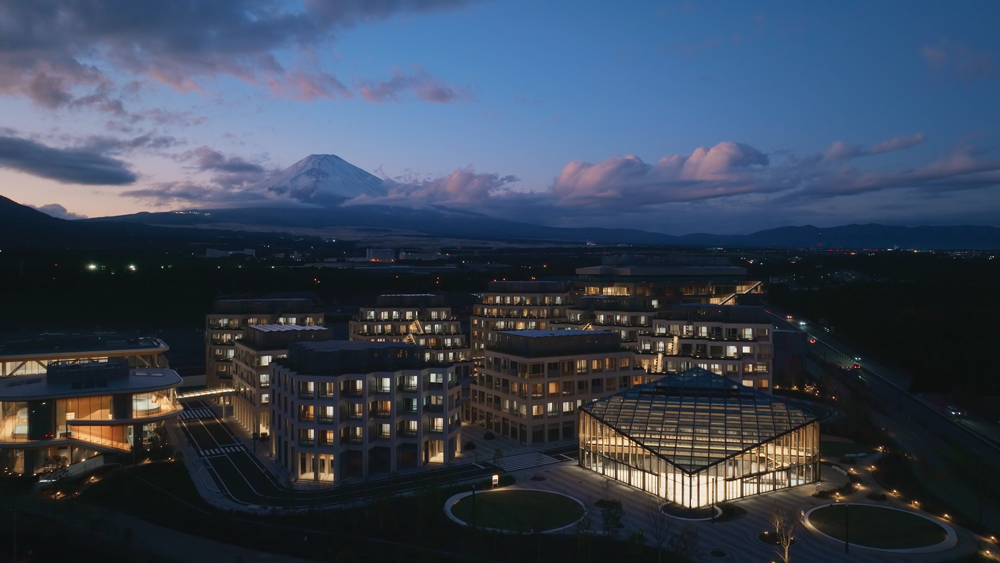
Toyota Woven City, the pilot city for mobility innovation in Susono, Japan, that launched its Invention Garage in April, is on the outskirts of a Tokyo-Kanto region that leaped from No. 40 to No. 9 in this year’s startup ecosystem rankings.
Photo courtesy of Toyota
That AI boom in the U.S. is prevalent when examining how the fastest-growing privately held U.S. companies within the Inc. 5000 overlap with our index’s top metros. Within the greater San Francisco metro, Palo Alto-based AI video generator company AKOOL secured the list’s No. 1 rank in 2025, experiencing 37,364% growth over three years. Four years after launching, Boston-based AI dental assistant platform VideaHealth was 28th on the list, followed by No. 45 AI cloud computing platform CoreWeave within the New York metro region.
In terms of Inc. 5000 concentration in Site Selection’s top startup ecosystem metros — accounting for all industries — New-York-Newark-Jersey City, NY-NJ, holds the highest number of Inc. 5000 firms at 372. Meanwhile, the Los Angeles metro’s 253 firms top the Bay Area’s total of 150 firms.
Startup Ecosystems on the Move
Despite ongoing geopolitical conflict in Israel, Tel Aviv’s startup ecosystem remains stable in the No. 8 rank. However, in comparison to last year, metros in Paris and Seoul no longer close out our top 10. In a year’s time, the Tokyo-Kanto Major Metro Area in Japan emerged from No. 40 to No. 9, while Seattle-Tacoma-Bellevue, Washington, climbed four spots to claim a top 10 rank.
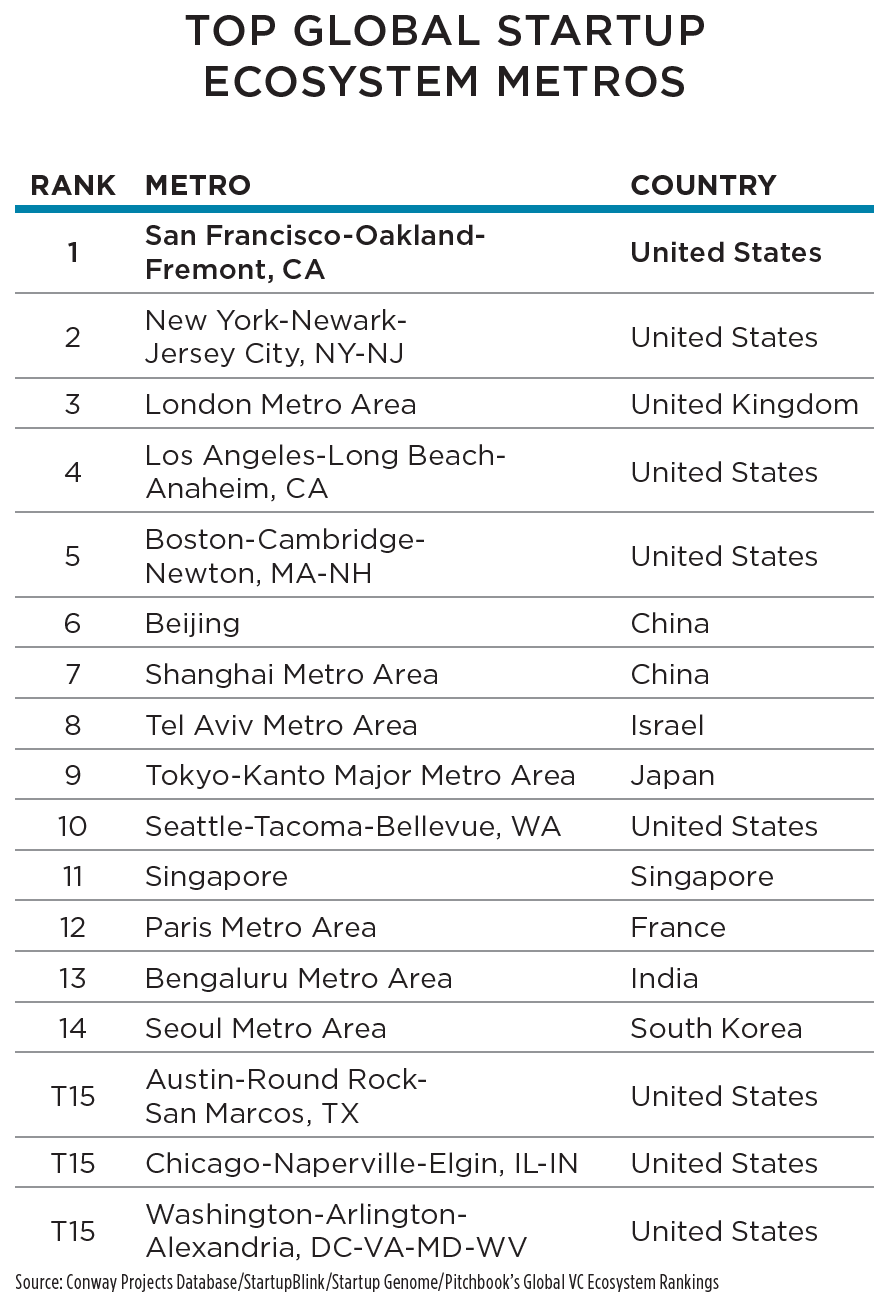
In an interesting twist, U.S. metros Austin-Round Rock-San Marcos, Texas, Chicago-Naperville-Elgin, IL-IN, and Washington-Arlington-Alexandria, DC-VA-MD-WV, experience a three-way tie (No. 15). It reflects a slight decline for the greater Washington and Chicago metros, although it’s a three-rank boost for the Austin metro, which elsewhere in this issue once again ranks No. 1 among all U.S. metros in Site Selection’s annual Sustainability Rankings.
According to data from Dealroom, Austin region startups have seen immense growth in the past five years, raising $8.1 billion in venture capital in 2025. That VC funding is expected to double this year as startups in the metro have already drawn in $4.4 billion and are on track to reach a projected $10.5 billion. Autonomous surface vessel manufacturer Saronic Technologies and energy company Base Power are two Austin-based startups that represent $2.8 billion of VC funding raised so far this year. Out of the entire state, startups in this region accounted for 72.5% of all VC funding in 2025 and currently represents 69.6% as of June 2026.