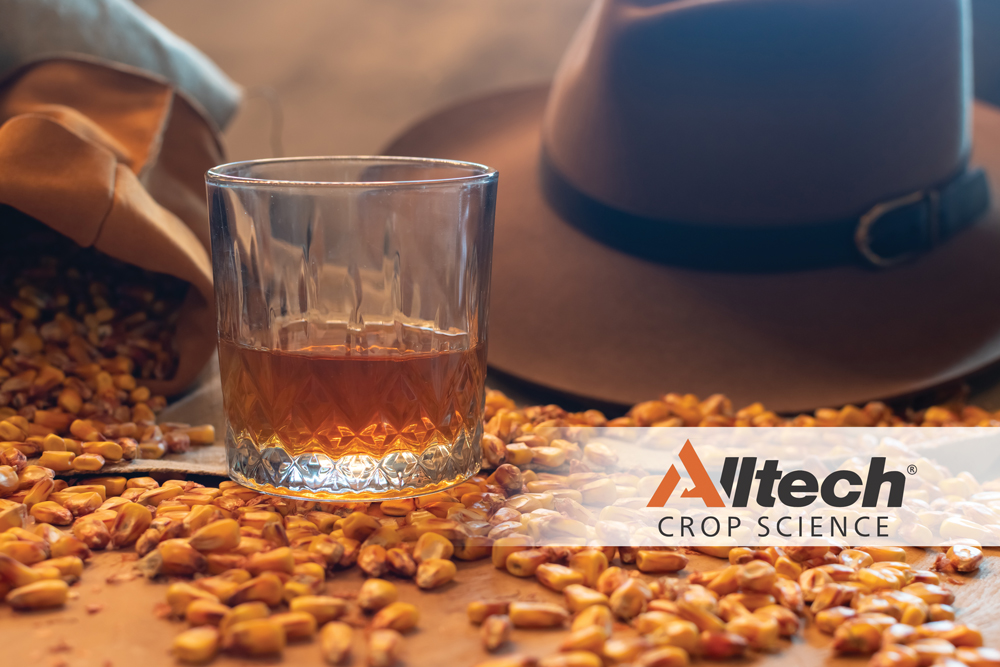
Emerging agricultural enterprises find a perfect match in the Bluegrass State.
“From an agtech perspective, we have such a diverse industry,” says Jacob Ball, executive director at Lexington-based agritech accelerator Bluegrass AgTech Development Corp. “Kentucky is great for on-farm trials and test beds.”
Bluegrass AgTech is just one of many entities revolutionizing the agricultural industry in the Bluegrass State, renowned for its fertile farmland. The organization has partnered with major players in the Kentucky ag scene, including founding partner Alltech, to incentivize and derisk on-farm growth in the Lexington area. One of the state’s strengths as a high-performing agricultural producer is its diversity of operations, standing out against single-commodity markets. Kentucky has between 12 and 12.5 million acres of farmland and about 69,000 farms, most of them small-to-midsized.
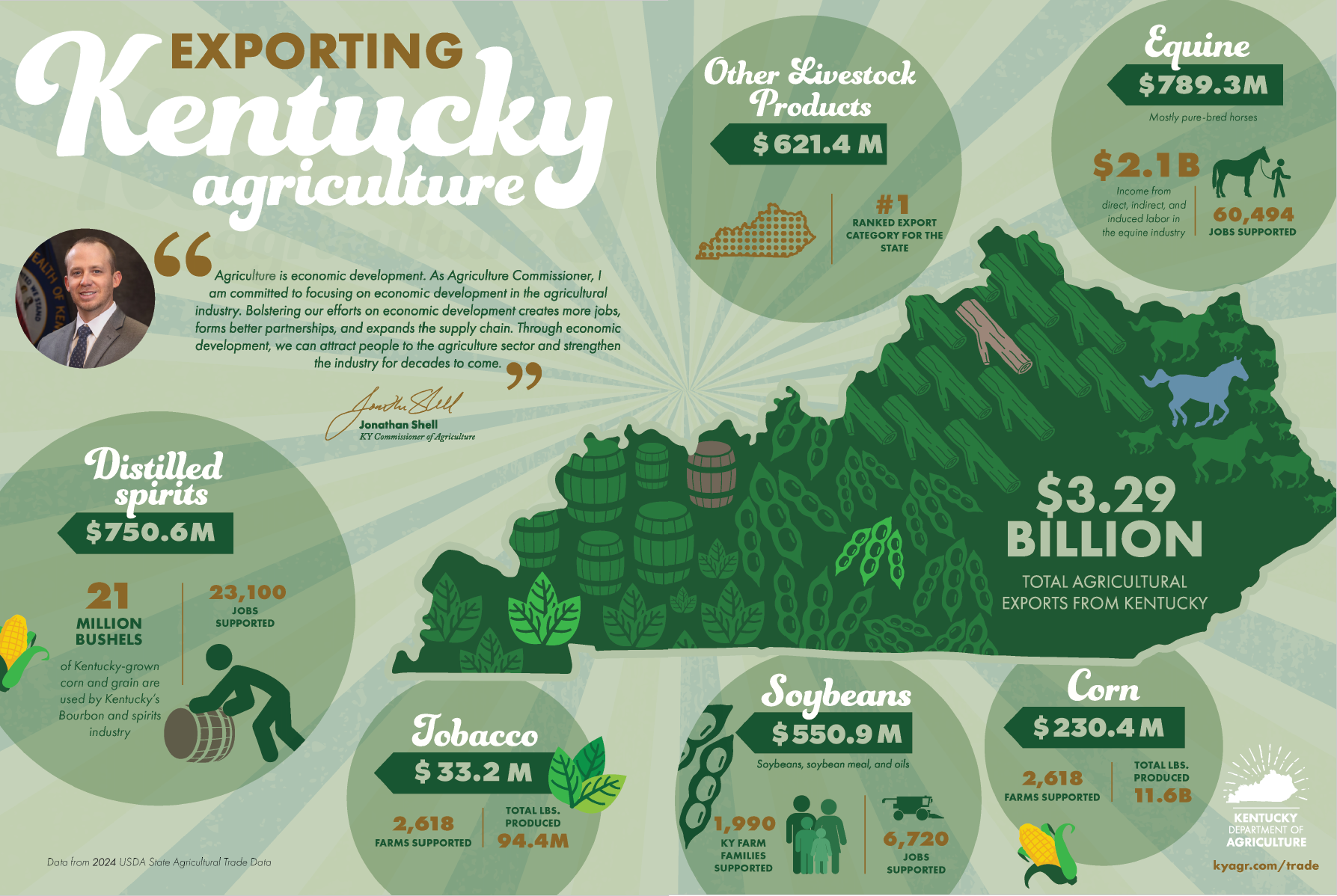
The state’s agribusiness economy is a powerhouse, generating over an estimated $8 billion in agricultural cash receipts yearly in 2024 and 2025, with the agricultural industry having an annual impact of approximately $50 billion on the state year to year. Hunter Jones, director of economic development at the Kentucky Department of Agriculture, notes that Kentucky is ideal for biotech/agtech companies, boasting a diversity of agricultural products that includes grain, corn and soybeans as well as livestock (horses, cattle, poultry and swine), and a strategic location for distribution.
“Kentucky is a one-day drive from two-thirds of the U.S. population,” he says. “It also has multiple Interstates bisecting the state (I-24, I-65, I-71, I-64 and I7-5). In addition to the vast network of highways, Kentucky has two major air terminals, UPS Worldport in Louisville and the Amazon and DHL Global Superhub terminals right outside of Cincinnati in Hebron. Kentucky is also strategically placed along multiple river systems, including the Ohio and the Mississippi rivers.”
Tech has found its home in Kentucky’s ag sector. Ball remarked on the existing business infrastructure, noting the network of six Kentucky Innovation Hubs “to help support founders, producers and tech in the state, making the state attractive not only for a company to locate here, but most importantly, keep Kentucky people here.”
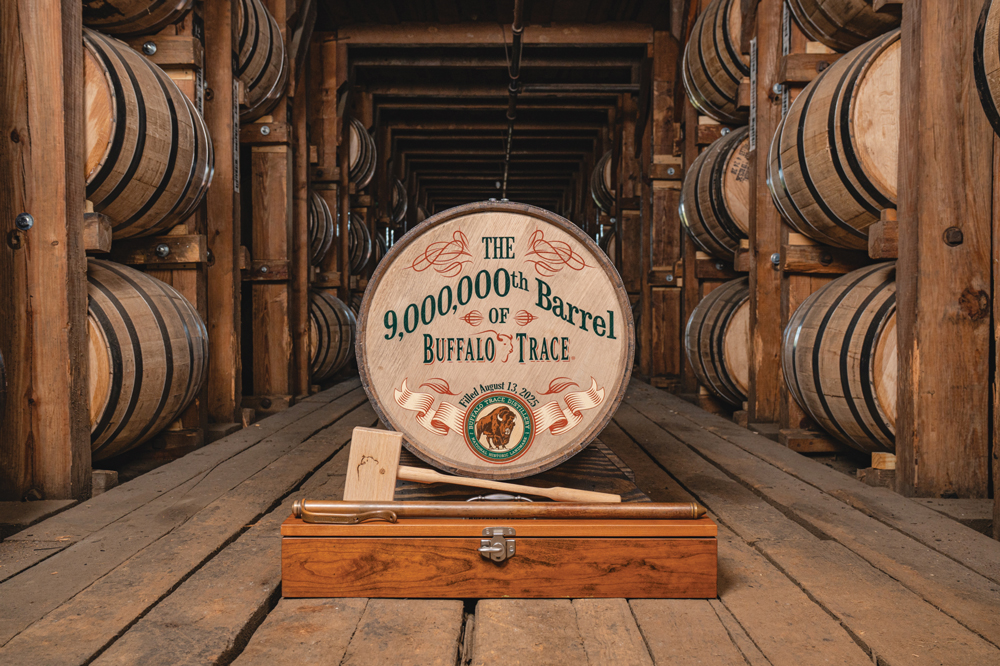
Buffalo Trace Distillery produced their 9 millionth barrel in 2025.
Photo courtesy of Buffalo Trace
A Spirited Operation
Meridian Biotech, started in Lexington in 2017 and the first biotech company to locate in Frankfort, develops sustainable biotechnologies by upcycling fermentation byproducts. The company is set to build a $40 million facility in Frankfort that will create 35 high-paying, highly skilled jobs. When asked why Frankfort was chosen for the site, Meridian Biotech’s president Brandon Corace says that it was influenced by their partnership with famous distiller Buffalo Trace, producer of top shelf bourbon including hard-to-get Blanton’s. The Buffalo Trace distillery is located next to the planned Meridian project, situated close enough to allow for the pipeline transfer of distillery byproducts (also known as “stillage,” the nutrient- or grain-rich leftover byproduct in alcohol distillation). The byproducts will be recycled into aquaculture products, pet foods and organic fertilizer.
“Collaboration with Buffalo Trace has been very strong and constructive,” says Corace. “The relationship has evolved over time from early technical validation on our side to a true partnership where the level of cooperation from their end has always allowed us to be more efficient with the process of putting this together, whether that’s through the pilot work, engineering or commercial project development. We developed a very good relationship that has been ongoing for the past couple of years. Both of our teams share a common view on operational efficiency [and] see a huge opportunity here to innovate and provide a better alternative for their byproducts for the long-term future.”
The Frankfort facility, which has begun finalizing structural and process engineering plans for the project, will comprise three to four acres, with 60,000 to 70,000 square feet planned for the processing site, office and administrative space, lab space and potentially an R&D facility.
“We want to help develop the agtech and biotech industry in Kentucky by utilizing our technology and providing a more sustainable way to look at these byproducts throughout the bourbon industry,” says Corace. “We’ll be working with multiple universities across the state, including Kentucky State University. We’ve already started collaborating and doing some testing with Kentucky State. They have an aquaculture research center. And then also meeting with their engineering department to develop long-term internship programs — things like that that could really help contribute to Frankfort.”
Corace emphasized that Frankfort was also chosen for the Meridian Biotech site due to how welcomed the company felt by city and state officials, noted as highly engaged and collaborative in supporting the project, and the pro-business environment. A strong logistics hub, advantageously located in Central Kentucky, ample utilities, favorable industrial zoning and manufacturing presence coupled with low cost of living and minimal congestion compared to major metro areas also made Frankfort a “compelling, long-term base for scaling biotech and agtech operations,” according to Corace.
Franklin County Economic Development Director Penny Peavler also notes that the Meridian Biotech project is “a beautiful story of public and private working together for the benefit of all. Thirty new engineering jobs will be coming to Frankfort in a new industry (biotech) for the area at an infill location. It’s a win-win scenario for all parties involved.”
From Mash to Renewables
Another company harnessing stillage byproducts is Grissan Renewable Energy, headquartered in London and founded a century ago with roots in the Scotch whisky industry. Grissan partners with distillers to process cereal-based residues and waste products (wheat, corn, barley and rye) into renewable natural gas and fertilizer/soil conditioning products. The company’s first U.S. operation will find its home in Marion County in Central Kentucky in the form of a $62.7 million facility. The site will include 15,500 square feet of office space, including an education center, and a renewable gas production facility located on 59 acres. Spent mash from distilleries will be transformed into natural gas and fertilizer products at the site. Twenty full-time jobs will be created, including engineering and operational roles.
When the Grissan Renewable Energy facility was announced at the end of 2024, Kentucky Governor Andy Beshear said of the project that “each time a company chooses to locate here in Kentucky, especially to establish its first operation in the United States, it’s a glowing testament to this great state, its resources and skilled workforce. This is an incredible project for the Marion County community that will have a positive impact on the commonwealth’s sustainability initiatives to reduce our carbon footprint.”
A Crop of Cutting-Edge Products
About a half-hour south of Lexington is Nicholasville, where Alltech has been headquartered since 1985. Last October, the company broke ground on a new $4.6 million expansion at its main campus. The 15,000-square-foot facility will be the company’s first U.S. manufacturing plant focusing only on crop science technologies, producing biological fertilizers and more than 30 products that will enhance soil fertility and crop quality and reduce the need for chemical and synthetic inputs on agricultural land. Over 66,000 gallons of biological fertilizer per shift per month will be produced at the site once operational, and six new manufacturing jobs will be created to support the newly expanded site.
“Fermentation has always been at the heart of our business, and this facility allows us to apply that expertise in new ways to support crop health, productivity and sustainability,” stated Dr. Mark Lyons, Alltech president and CEO, at the groundbreaking event. “We’re proud to strengthen our presence at our global headquarters in Kentucky, creating an innovation and manufacturing center that will serve U.S. farmers, strengthen our local community and continue to advance the science of agriculture.”
Alltech’s reach is global, with more than 75 manufacturing facilities and five bioscience centers on an international level. The company develops agricultural products for livestock, farming and food industry applications. Alltech’s customer base comprises more than 140 countries. The new Nicholasville facility will follow the company’s crop science production sites in Brazil and Spain, providing biological solutions for farmers with environmentally friendly biofertilizers and supporting the often unpredictable agricultural supply chain both domestically and globally.