
The Empire State leverages partnerships, a skilled talent pool and a strengthening supply chain to sustain hefty investments in Central New York.
When non-New Yorkers think of the Empire State, their first thoughts may jump directly to New York City and its dizzying activity. Still, there is much to offer businesses and workers alike in the central and upstate regions of the state. A conversation with two thought leaders at CenterState CEO, a Syracuse-based independent economic development group and chamber of commerce serving a 12-county region in Central New York, shows what the region is doing right to retain and expand its corporate and workforce base.
Building Sustainably
I asked Robert Simpson, CEO of CenterState CEO, what the typical sales pitch for interested companies sounds like for the organization he leads. His answer surprised me:
“We tend not to pitch,” he says. “For us, economic development is not about winning a deal, landing a project. To us, economic development is about building sustainable economic partnerships with companies that are interested in capturing the global value stream and distributing that value stream as much as they can back to our own community here in Upstate New York.”
Simpson points to Upstate New York’s assets in innovation, workforce and natural resources as reasons why companies find success in the area. Large-scale manufacturing has been a runaway industry, given Micron Technology’s $100 billion semiconductor manufacturing complex in Clay, New York, which broke ground in January 2026 and is expected to be operational in 2030. The site will include four semiconductor fabrication facilities and is expected to create about 9,000 direct jobs.
“Manufacturing is in our DNA, and it’s really fun to be watching this resurgence in advanced manufacturing in Upstate New York — the region reclaiming part of its birthright,” Simpson observes.
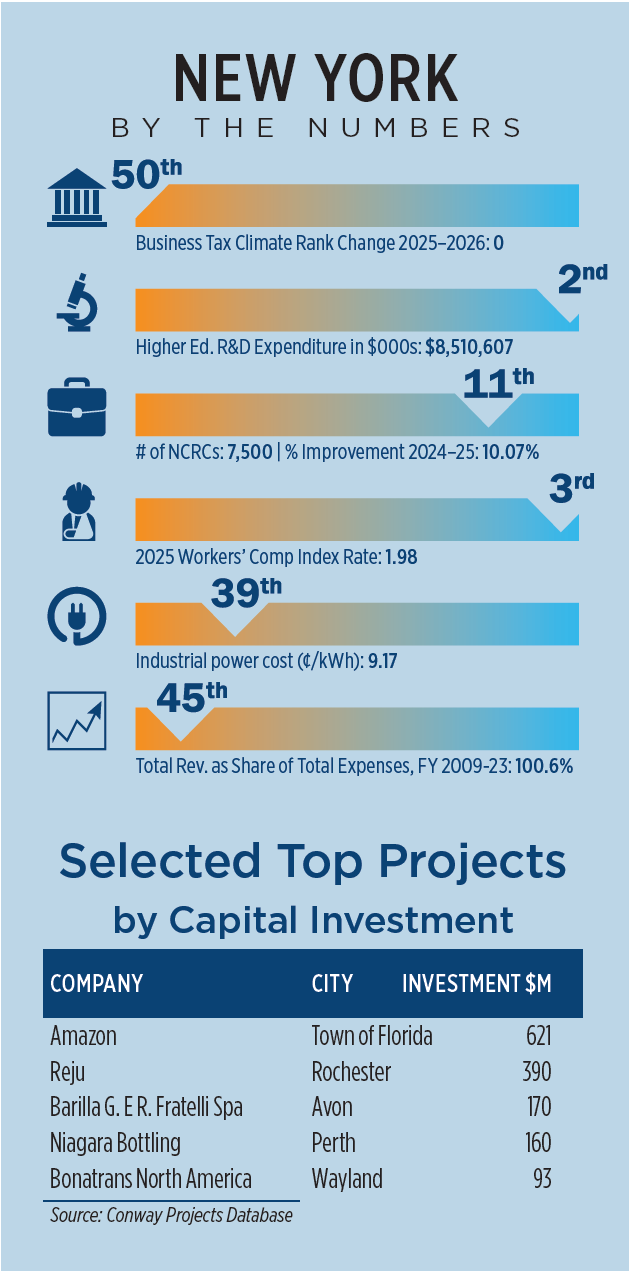
One benefit of the Micron fab, which is the largest private investment announced in New York State to date, is the rising tide picking up existing local businesses.

“To us, economic development is about building sustainable economic partnerships with companies that are interested in capturing the global value stream and distributing that value stream as much as they can back to our own community here in Upstate New York.”
— Robert Simpson, CEO, CenterState CEO
“There’s a lot of conversation about Micron, and it’s big and it’s splashy, but there are folks who have ridden the wave through the not-great times in Upstate New York who are poised to really capture some market share now,” says Honora Spillane, senior vice president of inclusive growth at CenterState CEO. “We’re helping them understand what that looks like, what the resources are for them and how to help them grow and be successful.”
She mentions the NY Smart I-Corridor, a coalition of more than 1,000 organizations across Buffalo, Rochester, Syracuse and Ithaca in Upstate New York. The federally designated tech hub’s primary goal is to develop a top domestic semiconductor manufacturing research cluster, but it also focuses on supporting existing businesses already in the semiconductor supply chain and de-risking expansion processes for them.
Microelectronics, semiconductors and other technology sectors are gaining momentum in New York. TTM Technologies, a manufacturer of printed circuit boards for national security applications, chose the town of DeWitt in Onondaga County for its $130 million manufacturing facility after a national search. The development was completed in June 2026 and created 400 high-earning jobs.
Jobs, Jobs, Jobs
In New York, a skilled labor pool and job-forward projects go together. In October 2025, New York Governor Kathy Hochul announced a $40 million investment in a workforce training facility, the Applied Technology Education Center, at Hudson Valley Community College (HVCC) that will educate and train people in applied technology and skilled trades, including building systems, automotive and transportation technologies, renewable energy and semiconductor manufacturing.
About a year ago, I spoke with Dr. Christopher McNally, department chair of the Applied Technologies Department at HVCC, about the long-term value of education and training that takes place at the community college daily. McNally recalled in our conversation that several of his students go on to study engineering.
Engineering is a common field to pursue in this region of New York, Simpson says, noting that “there are 7,250 engineers that graduate every single year from 17 engineering degree-bearing colleges and universities in our footprint. That equates to 6% of all the engineering graduates in the United States of America coming out of a region [covering] a two-hour drive from downtown Syracuse.”
Within three hours of Syracuse, there are more than 160,000 advanced manufacturing workers. The perception of these jobs is also something on CenterState CEO’s radar.
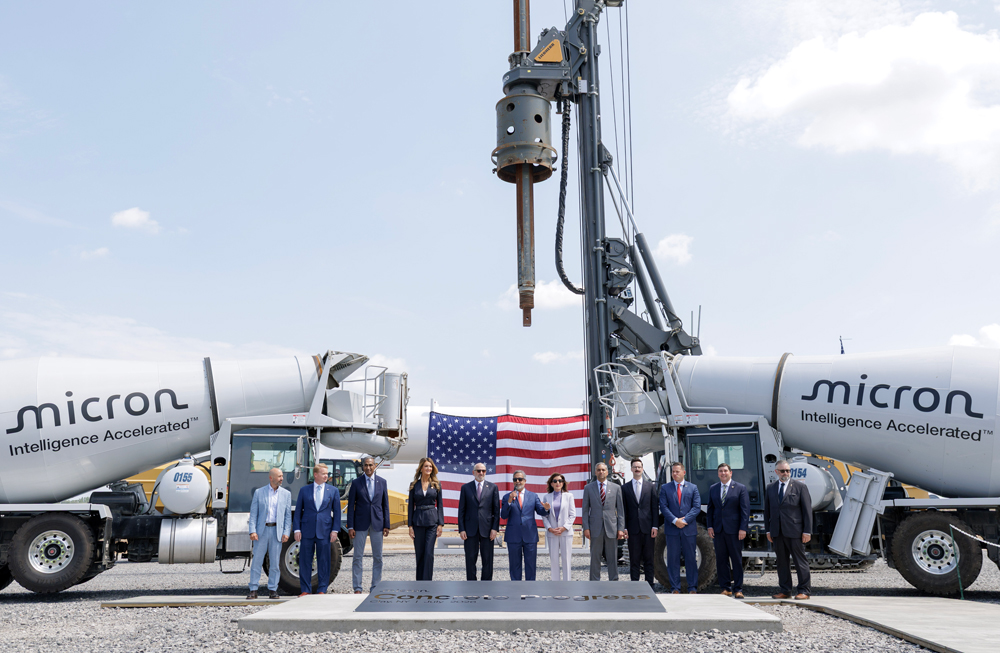
Micron Technology’s $100 billion semiconductor manufacturing complex in Clay, New York, broke ground in January 2026 and is expected to be operational in 2030. The project is expected to create 9,000 direct jobs.
Photo courtesy of the New York Governor’s Office
“These are highly advanced careers,” says Spillane. “It’s not dirty. You’re not going to come home covered in oil. These are really opportunities for generational career advancement with low barriers to entry.”
New York State has the Excelsior Jobs Program, run by Empire State Development, that provides refundable tax credits over a 10-year period to companies that meet job creation or capital investment requirements. The Excelsior Jobs Tax Credit includes a credit of up to 6.85% of wages per net new job, a credit of up to 7% of wages per net new job for a qualified semiconductor supply chain project and a credit of up to 7.5% of wages per net new job for a qualified green project or green CHIPS project.
Targeting Growth
Microelectronics has been a regional focus for the last 20 or 30 years, says Simpson, noting that “it’s an area where we have a significant amount of deep, inherent capability, including from an innovation standpoint. About 50% of all the intellectual property generated in Central New York over the last 30 years has come in what we call the sensing and microelectronics space. That’s kind of our core capability, and we’re seeing a huge amount of growth right now, driven by geopolitical needs for reshoring supply chains as well as national security–related investments that are happening all throughout the region.”
“As we look at the FDI that we will need to come with the supply chain, it’s very heavily in East Asia: Japan, South Korea, Singapore and Taiwan. That’s really where we’re having extensive conversations with companies now.”
— Honora Spillane, Senior Vice President of Inclusive Growth, CenterState CEO

In terms of foreign direct investment (FDI), Spillane says companies from Germany, Austria and South Korea favor investing in the region. Lotte Biologics, a South Korean biotechnology company and CDMO, produces biologic medicine at its East Syracuse campus. In 2022, the company spent $160 million acquiring the campus from Bristol Myers Squibb. In October 2026, Lotte Biologics announced it would partner with biotechnology company Alvotech to manufacture drug substances for multiple antibody biosimilar products at its facility in East Syracuse, which has 40,000 liters of bioreactor capacity for biologic manufacturing.
INFICON, a global company headquartered in Switzerland, also has a longstanding history of manufacturing in the region. The company produces critical sensor technologies, vacuum instrumentation, gas leak detectors and smart manufacturing software at its Syracuse facility.
“As we look at the FDI that we will need to come with the supply chain, it’s very heavily in East Asia — Japan, South Korea, Singapore and Taiwan. That’s really where we’re having extensive conversations with companies now,” says Spillane.
Upstate New York’s midsize cities of Syracuse, Oswego, Auburn, Utica and Cortland are all emerging cultural hubs. There are the Finger Lakes and Adirondacks to explore, not to mention growing infrastructure around community space and downtown Syracuse, which is undergoing a $10 million revitalization effort.
There has been more than $125 billion committed by private-sector partners to large-scale advanced manufacturing, microelectronics and semiconductor investments in the region over the last four to five years.
“That’s relatively unprecedented around the country, and it’s instantly put Central New York in the conversation as one of the fastest growing industrial regions in the United States,” says Simpson. “That’s kind of the story of how this region was born — as a community along the Erie Canal, building product and shipping it to the rest of the world. It’s really exciting to see the community come back to its roots and reinsert itself into the global value stream.”
Read more about Repurposing A Historic Factory in the Adirondacks here.