
Could Milton in North Fulton County be a microcosm of Metro Atlanta’s future?
A church management software company with deep roots in Tennessee went from having Georgia on its mind to filling up parking spaces in a suburban Atlanta office park this month. In so doing, this firm with global reach and offices on two continents sheds light on the Peach State’s future.
Chris Bacon, CEO of Ministry Brands, tells Site Selection that his company of 700 employees relocated its corporate headquarters from Knoxville, Tennessee, to Milton, Georgia in May. “We will celebrate our grand opening on June 23, but for all practical purposes, we are here,” he said in a Teams call from his new office in Deerfield Business Centre just off State Road 400 in Milton.
A few hundred yards away, Georgia Department of Transportation (GDOT) employees were laying the groundwork for the biggest road project in state history: the $11 billion SR 400 Express Lanes venture — a planned six-year effort to add two toll lanes in both directions of Metro Atlanta’s most congested highway. How busy is it? More than 400,000 vehicles use the SR 400/I-285 interchange daily.

Deerfield Corporate Center is the reimagined Deerfield Business Park of the future, per B Developments.
If you want to know how redevelopment is reshaping the six cities that make up North Fulton County, Georgia, Milton is ground zero. Faith-based Ministry Brands’ relocation is but the latest move in a corporate run on space in this envied region of Greater Atlanta.
Ministry Brands initially leased 6,200 sq. ft. from UBS Realty Investors in One Deerfield Centre on Morris Road, but the diversified church technology conglomerate eyes big growth. More than 50 Ministry Brands employees already live and work in metro Atlanta even as the company recruits more talent. Bacon himself worked remotely before Ministry Brands set up shop 30 miles north of downtown Atlanta. Ultimately, the firm plans to house at least 100 workers on site in Milton.
Ministry Brands serves 90,000 churches
and faith-based groups
and processes $6.5 billion in charitable
giving electronic transactions annually.
How big is Ministry Brands? More than 90,000 churches and other faith-based organizations worldwide rely on the firm for everything from charitable giving transaction processing to background checks on new hires. Annually, the company processes over $6.5 billion in giving and tithing for churches. To date, Ministry Brands has performed around 2 million background checks on people applying for positions.
After launching embedded payment technology powered by AvidXchange in April, Ministry Brands Chief Revenue Officer Brandon Sharrett said, “At Ministry Brands, our focus is on equipping churches with tools that simplify day-to-day operations and allow them to focus on mission and congregation.”
Ministry Brands has been expanding for years. In May 2023, the firm established a technology hub in Galway, a university town in western Ireland. When the tech hub opened, Dara Calleary, then Ireland’s minister of state for trade promotion, digital and company regulation, said, “This new investment in Ireland is a nod again to the talented workforce at our disposal. Ministry Brands is an industry leader, and this center allows them to further focus on new product innovation.”
Founded in 1997, Ministry Brands also maintains offices in Tampa, Florida; Tulsa, Oklahoma; and the Phoenix suburb of Chandler, Arizona. Bacon says Milton in north metro Atlanta meets the company’s needs. “We’ll start by having 54 people work in the office in Milton,” he notes. “Moving here is a strategic long-term investment.”
When I asked why they decided to move from Tennessee to Georgia, he said, “We looked at other cities in the South, but not for long. From our perspective, the choice was obvious. We were hiring a lot of talent within a 40-mile radius of Milton due to the electronic payment processing firms and fintech leadership in the area.”

“Moving here is a strategic long-term investment.”
— Ministry Brands CEO Chris Bacon
Milton: Key Player in Transaction Alley
Milton is home to large corporate offices of Fiserv, where Bacon formerly served as president, and Ford Motor Company. Throughout Greater Atlanta, some 240 tech firms do business in banking, blockchain, information security and data analytics. Georgia State University, Georgia Tech and the University of Georgia annually produce thousands of grads in fintech, payment technology, cybersecurity and related sectors. That’s why they call it “Transaction Alley.” (Read Kelly Barraza’s recent conversation with FinTech Atlanta Executive Director Ania Lackey in “ ‘Transaction Alley’ Is Just One Part of the Georgia Fintech Scene.”)
Finding skilled talent like that is a big reason why Ministry Brands picked Milton, says CEO Bacon. “Having access to the technology and knowledge in this market is crucial to our business,” he says. “Our chief technology officer, chief people officer, head of products, head of strategy, and finance leaders are all here. We found them in metro Atlanta.”
Bacon says his firm will focus on growing its operations in both Ireland and Georgia. “We were in Knoxville for three decades. Important roots and key clients remain there, so we’ll keep 50 employees there,” he says. “But Georgia is where we’ll grow long term.”
Bacon says his company chose nature-trail-rich Deerfield Business Centre for these reasons:
- “First, 6.5 million people live here. That’s a tremendous talent pool.”
- “Office availability with access to the Georgia 400 corridor is a big draw.”
- “So many other large companies are here. This is a great place to put down roots.”
- “The infrastructure in this corridor is nearly perfect. Virtually all of the world’s largest companies have data centers here.”
- “It’s a fantastic place to raise a family. I live in Milton. I’ve been here for 14 years.”
- “With so many large churches and faith-based organizations in metro Atlanta, we’re able to bring them to our offices and collaborate. Around 400 churches that we serve are here.”
- “Hartsfield-Jackson International Airport lets us fly people direct from anywhere in the country. It was impossible to get people into Knoxville on direct flights.”
Bacon says Ministry Brands needs collaboration space and finds it in Milton. The property in Deerfield includes a large amphitheater that the company intends to use for its Healthy Church Summits and other gatherings.
Over the years, the firm grew through acquisition, buying 55 brands. “They provide services in digital banking, mobile apps, charitable giving, etc. We serve one in every three churches in America,” Bacon says. “Everything we build is connected and empowers the church.”

“We are a 20-year-old city that is just now entering its adolescent phase. It is the wealthiest city in Georgia, and it’s fairly big in size.”
— Mark Farmer, Director of Economic Development, City of Milton
A Young City That’s Growing Up Fast
Mark Farmer, director of economic development for the City of Milton, says that snagging Ministry Brands is a signature win for this wealthy enclave of 40,000 people just west of Georgia 400. He stressed that incentives did not factor into the deal.
“To date, there have been no incentives involved,” notes Farmer. “They may be eligible for a business license tax reduction, but they would have to hit certain job numbers, and they would have to apply. That would come down the road as they consolidate.”
Milton itself is a city that is still growing up. “We are a 20-year-old city that is just now entering its adolescent phase,” says Farmer. Milton was incorporated on December 1, 2006. “It is the wealthiest city in Georgia, and it’s fairly big in size,” he adds. “Our boundaries stretch east to Georgia 400, south to Alpharetta and Roswell, west to Cherokee County, and north to Forsyth County.”
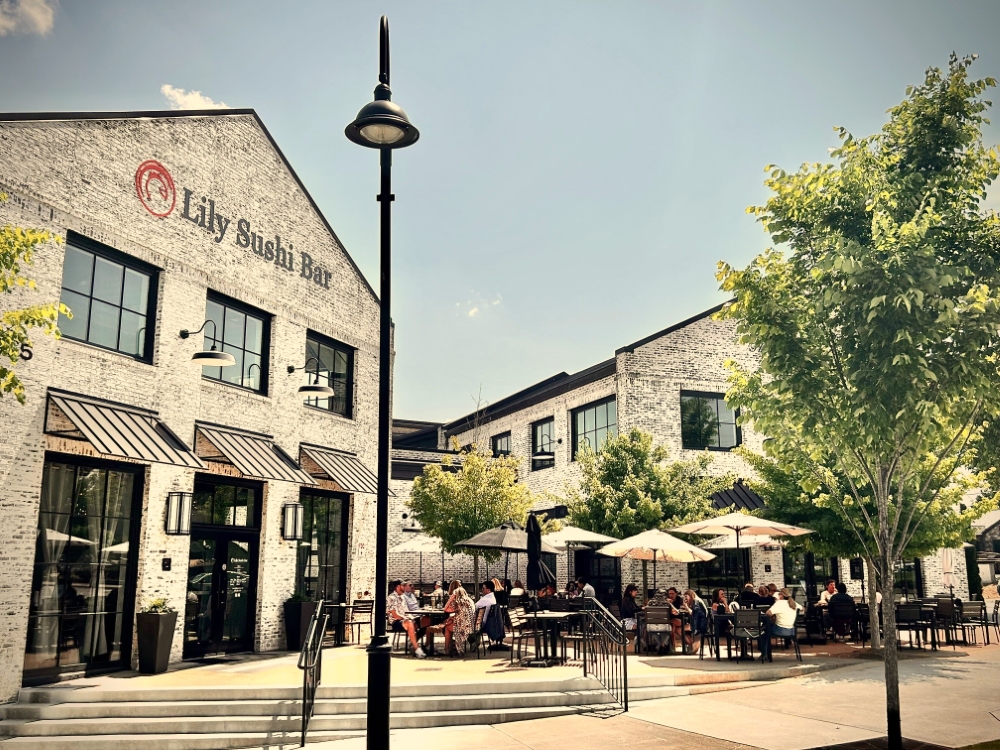
Crabapple (above and below) opened six years ago as the new town center of Milton, a city of 40,000 residents in North Fulton County.
Photo courtesy of City of Milton
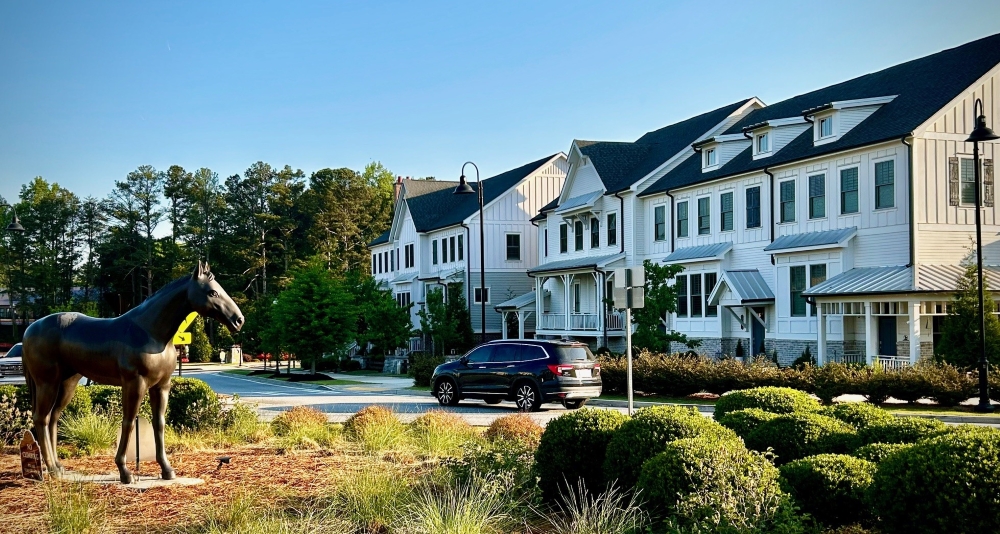
“Bucolic” is a word used to describe picturesque places in the countryside. In Milton, the description is apt. Home to 200 horse farms, Milton cradles some of the largest and priciest homes in the country. Its median house value exceeds $800,000.
Milton may be historic and pastoral, but it’s not stuck in the past. A new city hall and town center anchor Crabapple. Both opened six years ago along Heritage Walk at the south end of this 38.5-square-mile city. Crabapple is a mixed-use, master-planned community featuring single-family homes, shops, greenspace, a variety of restaurants, offices for municipal government, and other public space.
Milton’s main thoroughfares include Georgia 400, Highway 9, Highway 140, Houze Road, Rucker Road, Crabapple Road and McFarland Parkway. Most of these roads lead to Deerfield, a heavily forested office park with divided four-lane streets, large parking lots, and Class A and B office buildings of four and five stories each in size.
Within a 20-minute drive or less, you can leave Milton and be in Alpharetta, Johns Creek, Woodstock, Canton, Roswell or Cumming. Corporate tenants in Deerfield include Ford, Fiserv, Verizon, Regus and Jones Lang LaSalle.
If developers have their way, Deerfield will evolve into something more than a business park, says Farmer. A mixed-use project known as Deerfield Corporate Center by Miami-based B Developments would revitalize and substantially overhaul the City of Milton’s Deerfield Commercial District. Think of the successful mixed-use Avalon development in Alpharetta, but with more offices.
Farmer says the time is ripe for an overhaul. He feels that most Milton residents would welcome it. Data from the Atlanta Regional Commission suggest that Farmer is right.
Area’s Top Goal: Grow the Talent Base
Around North Fulton, redevelopment is the watchword of the day. Exits 10-12 off SR 400 serve Milton. At Haynes Bridge Road Exit 9, Jamestown is proposing a massive redevelopment of the old North Point Mall — the anchor of which would be a National Hockey League arena. The project would be built just 5 miles south of Deerfield. Forsyth County to the north backs its own hockey plan, but that one is considered the underdog.
Two things drive the urge to redevelop older office and commercial districts in North Fulton: the unprecedented success of Avalon in Alpharetta, and the declining population of North Fulton. In the most recent Census numbers reported by the ARC, the population of all six cities in North Fulton — Alpharetta, Roswell, Milton, Johns Creek, Sandy Springs and Mountain Park — declined from July 1, 2024, to June 30, 2025. Alpharetta and Milton each lost 0.3% of their populations, while Roswell and Johns Creek each lost 0.7%. Sandy Springs declined by 0.4%. Meanwhile, South Fulton County increased in population by 0.6%; and the City of Atlanta grew by 1.6%.
This is not an anomaly. An ARC analysis published on June 2 shows that the 6-city region of North Fulton has been losing residents since 2020 — not at an alarming rate, but at a steady and sustained one. It was enough of a jolt, however, to prompt civic leaders last year to organize a regional alliance aimed at countering these headwinds. The new North Fulton Economic Alliance seeks to stem the tide of population outmigration, attract new talent to the area, build brand recognition and establish a regional economic development effort.
If it does not accomplish these things, the group says, the prosperity that North Fulton enjoys today could one day be eclipsed by counties even farther from Atlanta’s urban core. The NFEA foundational document puts it in blunt terms: “Employer demand continuously outpaces the supply of qualified workers. In short, there are more jobs than workers; workforce is THE top-of-mind issue for nearly every industry.”
The report adds that “Greater North Fulton’s population has decreased by about 2% — almost 8,000 residents — over the last 5 years and is projected to decrease by another 0.6% — about 2,285 residents — over the next 5 years.”
At the same time, the number of jobs in Greater North Fulton grew by almost 189,500 since 2020 and is expected to increase by another 23,500 by 2030. Without more workers living in North Fulton, this job growth cannot be sustained, the group notes.
Barriers to population growth include high housing costs and an overall high cost of living, inadequate childcare options, built-out communities, lack of affordable new housing supply, and a lack of a formal, large-scale, region-wide effort to attract and connect local talent to industry, the NFEA report states.

Windward Parkway is not just one of the busiest exits off Georgia 400; it’s a thoroughfare that connects GA 400 motorists to Deerfield Corporate Park in Milton.
Photo courtesy of Georgia Department of Transportation
GA 400: Faster Highway to Prosperity?
Rich Johnson, executive director of the Alliance, says that redevelopment projects like Destination Deerfield in Milton and Medley in Johns Creek hold the key for igniting a turnaround. “Office complexes are being turned into mixed-use projects. The question is — how do we take what we have and reinvent it into what people want? There is still a huge demand from people who want to live here,” Johnson says. “As soon as a home is built here, it is sold. Plus, we have a workforce that can travel into North Fulton now with more ease. The ability to get into and out of North Fulton is improving.”

North Fulton Economic Alliance Executive Director Rich Johnson
Case in point: the Georgia 400 Express Lanes Project. By far the largest and most ambitious undertaking in GDOT history, this $11 billion venture will add four lanes to this heavily traveled highway for 16 miles from the MARTA North Springs Station in Sandy Springs to just north of McFarland Parkway in Alpharetta. With five interchanges on 400, Alpharetta stands to benefit the most from improved access and reduced congestion, according to a recent impact analysis of the project — now the largest highway project expenditure in the U.S.
A key component of the project is a 12-mile-long shared express lane system for Bus Rapid Transit (BRT), operated by MARTA, to improve regional connectivity and shorten commute times for everyone in the region.
“About 150,000 people leave North Fulton daily to commute out. Another 250,000 people commute into North Fulton for work,” says Johnson. “With the new capacity of adding the express lanes to 400, we open the doors for people to get into and out of North Fulton so much easier and quicker. We will look back at this project 30 years from now and see it as a major economic driver.”
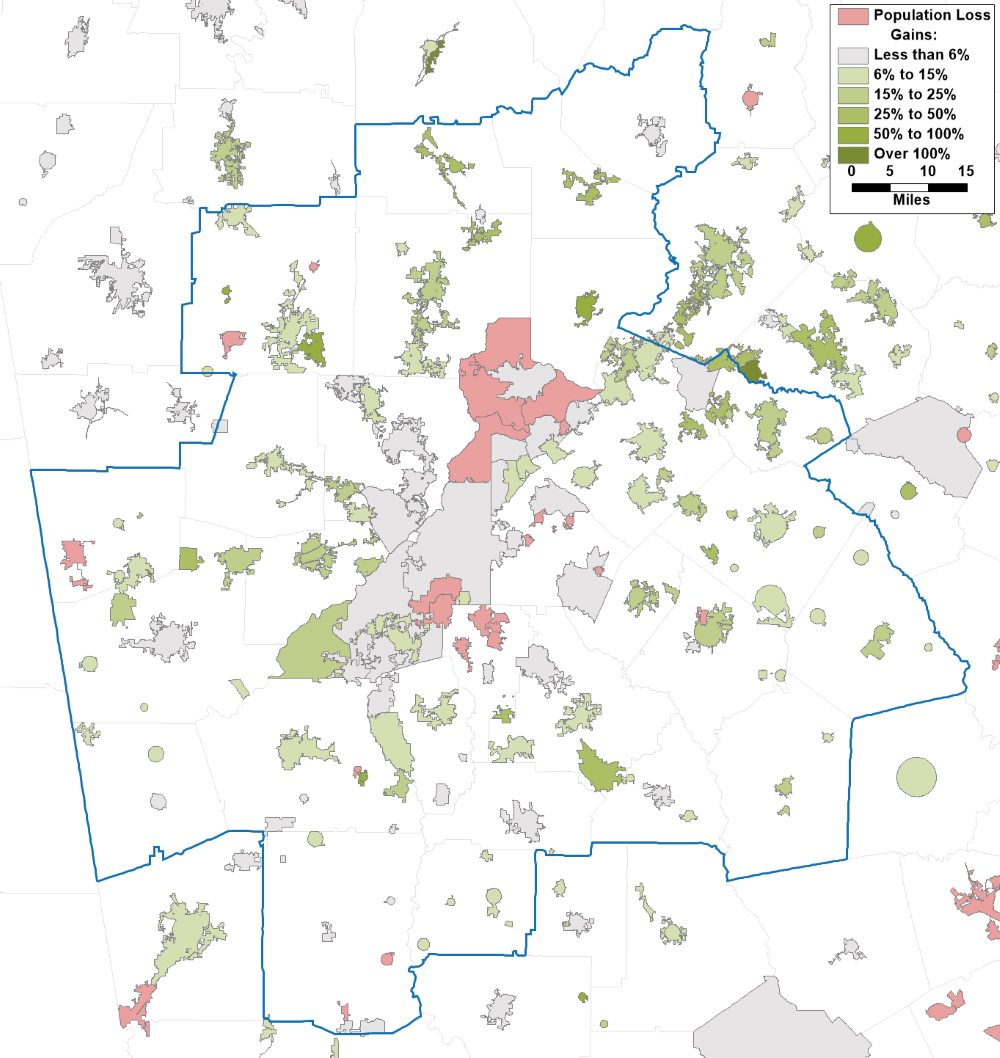
The new North Fulton Economic Alliance seeks to stem the tide of population outmigration from Fulton County.
Map courtesy of ARC
He also sees Destination Deerfield as emblematic of where North Fulton is going. “Deerfield is poised for so much development and lots of new opportunities,” says Johnson. “Some parcels are still designated as greenfield sites, and it has amazing access to 400. It is tucked away along a tree-lined road. It is master-planned with intentionality. It offers amenities and a live-work-play environment. People don’t want to just go to an office. You need to incentivize people to come to the office now. You have to offer more than a pot of coffee. It has to be a place for everybody and everything.”
Kristin Winzeler, executive director of the more transportation-oriented True North 400, says that the Georgia 400 widening “will have an impact on everyone up here. You will see a halo effect from this project. The daytime population is what we’re trying to help. One ARC model shows that 1.8 million people will move to the Greater North Fulton area over the next 30 years. This project will reduce congestion, cut down travel times and spur economic growth. We will lose if we are not invested in it.”
Of Fulton County’s 1.1 million residents, approximately 387,000 live in North Fulton. The largest city in the region is Sandy Springs, at 108,000, followed by Roswell with 91,000, Johns Creek with 82,000, and Alpharetta with 67,000. The challenge for these cities is that their daytime populations can double or more in size depending on employment and various attractions such as Avalon, Alpharetta’s award-winning, 86-acre, mixed-use development that annually draws 7.5 million visitors. The current Census estimate of North Fulton’s average daytime population is 536,551 people — which is even larger than the City of Atlanta’s full-time population of 534,278.
Keeping up with this volume is a constant challenge for Winzeler and her organization. “We are a Community Improvement District,” she says. “Commercial property users pay an additional commercial property tax to fund the CID. We are 8 miles long and hug the 400 commercial corridor. We have spent $30 million over our 20-year history and brought in over $217 million in investment to the area.”
Alpharetta: Technology City of the South
Another leader who’s keenly focused on improving economic fortunes and quality of life in the region is Kali Boatright, president and CEO of the Greater North Fulton Chamber of Commerce. The organization’s offices are located, appropriately enough, in Avalon in the heart of Alpharetta, whose nickname is “The Technology City of the South.”
“A lot of people coveted this development,” she says of Avalon. “Everyone worked together to create a model. It has become so popular that even successful places like The Woodlands and Frisco in Texas send delegations to visit Avalon to learn from its success. Now we have Medley opening in Johns Creek in October and the possibility of bringing an NHL arena and franchise to Alpharetta.”

“We are better positioned today than we’ve ever been to become an NHL city.”
— Kali Boatright, President & CEO, Greater North Fulton Chamber of Commerce
When I asked Boatright if North Fulton would snag an NHL team — which would be Atlanta’s third in the last 50 years — she said, “Yes,” paused, and then added, “That’s a hard yes! We are better positioned today than we’ve ever been to become an NHL city. Jamestown developed Colony Square and Ponce City Market in Atlanta, so they know what they’re doing. North American Properties, the developer of Avalon, merged with Jamestown, so now all of that experience is under one roof.”
Recent corporate expansions in North Fulton give Boatright hope that even better days lie ahead for one of the most prosperous regions in the country. Morgan Stanley expanded by 100,000 sq. ft. in The Edison Alpharetta last year. Boston Scientific is building a $62.5 million, 207,000-sq.-ft. facility in Johns Creek. PBS Aerospace is doubling the size of its turbo jet engine factory in Roswell to 30,000 sq. ft. and increasing its workforce from 58 to 140; and Avalon just landed two new corporate tenants: Hunt Military Communities and Synchrony Bank.
These projects were just a handful of the 63 deals that propelled Fulton County to rank No. 7 among the nation’s 3,244 counties in economic development performance, according to the Conway Projects Database of Site Selection Magazine. (For a complete ranking of America’s Best Counties, see the upcoming July 2026 issue of Site Selection.)
Sandy Springs: Auto and Food HQ Capital
Just 13 miles south down SR 400 from Alpharetta is Sandy Springs, which has one of the highest concentrations of Fortune 500 firms of any city in the South and the largest collection of office buildings in the region, at just over 60 million sq. ft. Among the city’s signature brands are the corporate headquarters of UPS, Mercedes-Benz USA, Intercontinental Exchange and Newell Brands.
Chris Burnett, economic development director for the City of Sandy Springs, says that corporate investment projects are a regular occurrence in this Perimeter Center city on I-285. “The new Asbury Automotive headquarters of 150,000 square feet and 350 employees just opened in the former Newell headquarters building here,” he says. “Asbury relocated from Gwinnett County to Sandy Springs and just cut their ribbon in April. They are No. 242 on the Fortune 500.”
A year ago, Mercedes-Benz announced a huge expansion of its presence in Metro Atlanta, moving 500 corporate, technical and high-tech roles to its existing 1MB facility in Sandy Springs. The announcement establishes Atlanta as Mercedes-Benz’s headquarters in North America, centralizes and unites key corporate functions, and positions the hub to drive success in the U.S. market.
“We have quietly built our brand as one of the major headquarters cities in America,” says Burnett. “We are becoming auto-centric. Cox Automotive runs the largest auto auction business in the U.S. Autotrader is their main brand. Also, three of the largest packaging companies are in Sandy Springs: Smurfit WestRock, Veritiv and Graphic Packaging.”
Sandy Springs is also home to the headquarters of Dunkin, Arby’s, Sonic, Moe’s Southwest Grill, Cinnabon, Carvel, Buffalo Wild Wings, McAlister’s Deli, Edible Arrangements, Krystal and Inspire Brands. “We are the fast-food capital of America,” says Burnett.
Several redevelopments position Sandy Springs to return to its roots. “It’s called City Springs 2.0,” says Burnett. “We were founded to be a bedroom community for young families in metro Atlanta in the 1960s and 1970s. We want to be that place again.”
That theme echoes around North Fulton. When I asked GNFCC’s Boatright what attracts corporate tenants and workers to the area, she said, “It’s everything. It’s public safety, wraparound services, technical colleges, available buildings with open square footage, abundant amenities like interconnected trail systems, great schools, and family-friendly places to live and raise children. Add in what we are doing to improve transportation, and we provide ‘The Golden Corridor.’ People want to be here.”

“Ministry Brands’ decision to relocate its headquarters to Milton is a tremendous win for our community and a strong reflection of our city’s growing appeal as a place where innovative companies want to invest, grow and put down roots.”
— Milton Mayor Peyton Jamison
Ministry Brands’ Chris Bacon confirmed as much when he and his team picked Milton over every other city in the Southeast.
As Milton Mayor Peyton Jamison said, “Ministry Brands’ decision to relocate its headquarters to Milton is a tremendous win for our community and a strong reflection of our city’s growing appeal as a place where innovative companies want to invest, grow and put down roots. Bringing so many jobs to Milton strengthens our local economy, supports our business community and further reinforces our position as a premier destination for high-quality employers.”
For a faith-based organization like Ministry Brands, choosing Milton was not a leap of faith; it was a vote of confidence in a place that is quietly and forcefully on the move. It may also be a sign of things to come for Georgia’s most successful county.