In an age where the world has never been more connected, it’s important to remember where we began. Movement of goods and services has taken on many modes of transportation since the dawn of time, as we continue to find new methods that streamline the delivery of essential products.
It is a bit curious how fast the nation looked to advance past traditional rail systems, especially when considering how vital this weaving transportation infrastructure remains today. Mississippi maintains rail freight superiority by keeping its tracks hot, moving some of the nation’s most in-demand products on time with ease.
Over 2,550 miles of railway weave throughout 30 rail systems in the state, offering a portfolio of five Class I railroads intertwined with 24 Class III short-line railroads. Beyond the capabilities housed within the state’s borders, Mississippi is well-positioned to reach every North American market within the nation’s massive rail network.
Top commodities heading out by freight are led by chemicals, steel products, lumber and wood products and pulp and paper. These account for 7 million of the 10.8 million tons of product moved by 140,900 carloads in 2023, according to the American Association of Railroads. Commodities moving in — a majority of which were chemicals, crushed stone & sand, grain and food products — brought 159,600 carloads carrying 14.7 million tons the same year.
Better Connections
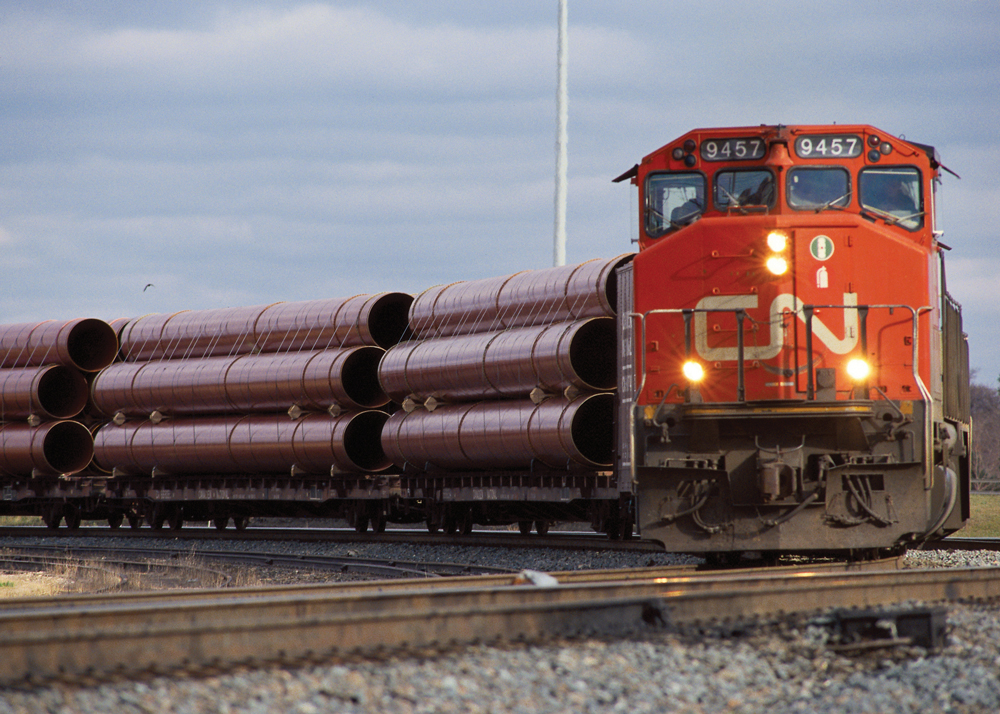
The health of this transportation infrastructure is a priority for operators such as Canadian National Rail (CN), which operates a 575-mile route in Mississippi. CN announced a $75 million investment into this segment in June 2025, aiming to ensure seamless movement of goods and support long-term growth in the state. The funding targets track maintenance and future strategic initiatives planned for the state.
The move builds upon CN’s $56 million investment for track maintenance the year prior, which saw a $250,000 investment to upgrade the company’s railyard in Jackson and afforded increased capacity on the Beaumont Subdivision between the cities of Jackson and Collins.
“We believe that investing in our network is about building for the future. Our continued infrastructure investment in Mississippi will help strengthen the resiliency and efficiency of our network across the state,” said CN President and CEO Tracy Robinson. “Our focus remains on providing exceptional service to our customers and supply chain partners, supporting strong economic growth for North America and across communities where we operate.”
The future of rail is not lost on the Mississippi Department of Transportation (MDOT), who worked alongside local governments, the U.S. Department of Transportation, the Federal Highway Administration and the Federal Transit Administration to develop its MULTIPLAN 2050 report. Upon completing its 2022 State Rail Plan, MDOT was able to gather detailed information on the current conditions of Mississippi railways, finding that a combined $349 public and private investment is needed to maintain the state’s competitiveness.
This investment would tackle future infrastructure expansions, new technology implementation, better data collection, access to services and increased sustainability. The MULTIPLAN 2050 report additionally found that Mississippi is projected to see a significant increase in freight volumes over the next 20 years, particularly across chemicals, agricultural products and transportation equipment.
Ahead of then, MDOT has been increasing freight capacity designed to drive fresh economic growth through the state’s three-year-old Strategic Multi-Modal Investments Fund (SMIF). In 2026, SMIF awards were distributed among various airport, port and railroad projects in the state. The Mississippi Central Railroad received $820,000 to construct siding track in Alcorn, while Gloster Southern Railroad used its $1 million award to support the renovation and rehabilitation of its 35-mile rail segment that spans from Gloster to Slaughter, Louisiana.
Other awarded projects included over $1 million toward privately owned Grenada Railroad’s rail expansion in north Mississippi, Norfolk Southern’s $820,000 Meridian Yard Switch improvement, more than $827,000 to Columbus & Greenville Railway for its Columbus Rail-Truck Transload, a $500,000 award for siding extension for Tishomingo County Rail and Mississippi Southern Railroad’s $850,000 award for industrial access improvement.
A Location That Tracks
As of now, Mississippi houses 28 publicly owned industrial sites that are rail-served or identified to be potentially viable rail-served sites with pre-engineering conducted.
That list includes the BNSF certified Springs Industrial Park in Marshall County; the Cinco Megasite with access to Canadian Pacific Kansas City Rail (CPKC) mainline in Lowndes County; and the Chickasaw Trails Industrial Park, which connects to the adjacent Norfolk Southern rail line by way of a 120,000 capacity heavyweight haul road.
Regardless of location, the state’s transportation infrastructure and legacy rail operators have become a vital pull for corporates aiming to avoid a supply chain snafu. In May 2026, International Paper broke ground on a new $225 million sustainable packaging facility at the East Metro Center in Rankin County. The fresh 468,000-sq.-ft. operations, which are expected to launch by the end of 2027, will boost manufacturing capabilities of the company’s current box plant in nearby Richland.