Research parks transform and fuel the lab-to-market pipeline.
What defines success for a research and university park? In terms of numbers in a ledger, the economic value is unquestionable. A recent economic development study involving over 200 North American research parks that are in University Research Parks (AURP) member communities, conducted by market research and strategic planning firm Stiletto, showed that this sample of parks alone supported approximately 2.5 million jobs, contributed $295 billion in GDP annually and generated $33 billion in federal tax revenue.
Beyond the dollars, research parks are home to science and technology breakthroughs that touch nearly aspect of industry. In an email interview, AURP CEO Vickie Palmer writes, “research parks play a central role in bringing regional and federal strategies to life. These Communities of Innovation are the central players in shaping America’s next innovation frontier. They must accelerate industry–university partnerships; build inclusive and diverse innovation pipelines; support bio, AI, quantum and clean-tech infrastructure; foster regional cluster development in emerging technologies, and mobilize talent and capital to enhance national competitiveness.”
Innovative Communities
The AURP is a global nonprofit organization connecting and supporting innovation ecosystems for 40 years. According to Palmer, the mission of this network “is to help communities learn from one another, scale successful models and strengthen regional innovation capacity.”
What does a successful research-based site look like? there are a few markers that one could go by:
- Firms attracted to the park;
- Job growth in existing/new business organizations;
- Job growth in the region;
- Average salaries of park tenants relative to region;
- Number of state or community residents hired;
- Headcount growth in non-profit organizations;
- Community benefits agreement in place;
- Number of people that receive workforce training.
Palmer adds that research parks frequently anchor both National Science Foundation engines and U.S. Economic Development Administration (EDA) Tech Hubs, saying that “the scope and scale of their infrastructure and their proximity to anchor institutions make them reliable sites for complex long-term planning.”
EDA Tech Hubs initially launched in 2023 after being signed into law the previous year under the CHIPS and Science Act. The program was retooled last year by the Trump Administration and relaunched with $220 million in funding following award cancellations and political clatter involving the U.S. Department of Commerce. To date, there are 31 Tech Hubs designees under the program.
Diversified and Specialized
Occupancy rates at research and science parks are healthy. In North America and across the globe, the number of occupants in innovation districts has mostly returned to or exceeded the number of occupants recorded there before the COVID-19 pandemic, writes Palmer, attributing the successful rebound to these entities emphasizing specialized sector clustering and innovation-driven tenants.
“Research parks, innovation districts, tech hubs, national labs and more — defined as Communities of Innovation — are purpose-built communities that bring together universities, industry, entrepreneurs, investors and government partners to accelerate research, technology commercialization, workforce development and economic growth,” Palmer says. “Unlike traditional business parks, they actively foster collaboration and provide the infrastructure, programming and connections needed to move ideas from the laboratory to the marketplace.”
Many research parks maintained leasing occupancy above 90% through 2023. An AURP Benchmarking Survey from 2023 showed that more than 75% of North American research park survey-responders had at least 86% of their space occupied. In 2025, the average vacancy rate among respondent parks was 9%. Based on recent AURP survey responses, that vacancy number is expected to drop to 6% by 2030. The commercial office vacancy rate in the United States was 18% to 19% in 2023 and 2024 before shrinking to 13% in 2025.

“Research parks play a central role in bringing regional and federal strategies to life. These Communities of Innovation are the central players in shaping America’s next innovation frontier.”
— Vickie Palmer, CEO, Association of University Research Parks
“A common denominator in the physical development of university research parks is having a mix of multi-tenant and single-tenant commercial space supportive of research and development activities with flexibility and variety of space such as mix of office, laboratory and support space,” Palmer says, adding that R&D-oriented commercial real estate buildings often include a range of enhancements not typically found in commercial office space like increased air-handling systems, higher floor heights, chilling and wastewater pretreatment systems, and increased and redundant electrical power systems.
Tech transfer services are often found at university research centers that are seeking to engage in industry collaborations. Asked what factors help accelerate tech transfer out of research sites into commercial applications, Palmer replies, “Ultimately, technology transfer succeeds when innovation ecosystems reduce friction. … Research parks are uniquely positioned to serve as those connecting environments because they combine university research assets, commercialization expertise, entrepreneurial support and industry engagement within a single community of innovation.”
Bridging the Translation Gap
Despite rebounding from the pandemic successfully, research and university parks still face challenges. Near the top of that list is the “translation gap,” which means moving innovative findings from research institutions to market. Another challenge is ensuring that innovation benefits a broader scope of regions outside of the typical areas where tech and science research hubs can be found.
Other challenges that research parks are wrestling with:
- Competition for talent in emerging fields such as AI, semiconductors, biotechnology, quantum and advanced manufacturing
- Rising construction and infrastructure costs for specialized laboratory and research facilities
- Access to early-stage capital for startups
- Increasing demands for workforce development and industry-responsive training programs.
- The need to demonstrate measurable economic and community impact
Notably, federal initiatives like NSF Engines, EDA Tech Hubs and the CHIPS and Science Act are actively widening the net of geographic locations when selecting the next sites of innovation in the United States.
Palmer notes that “the most successful parks are those that combine federal funding opportunities with state incentives, private capital, industry partnerships and university assets to create sustainable innovation ecosystems. Research parks are increasingly serving as the convening platforms and implementation sites for major federal innovation initiatives.”
Key funding opportunities for research and university parks include: TIP Directorate and NSF Regional Innovation Engines, which support place-based innovation ecosystems; Small Business Innovation Research (SBIR) and Small Business Technology Transfer (STTR) programs that provide non-dilutive capital to startups; ARPA-H for transformative health technologies; and the U.S. Department of Energy programs.
Palmer explains that the most successful technology commercialization ecosystems share several common characteristics, including strong industry engagement earlier in the research process; utilizing experienced tech transfer and commercialization professionals; an entrepreneurial culture that encourages researchers to access mentoring, commercialization training and other resources beyond the lab; access to capital and many types of private and government funding; specialized infrastructure for research activity; and the presence of a university connected to a research park that can help launch and scale new ventures.
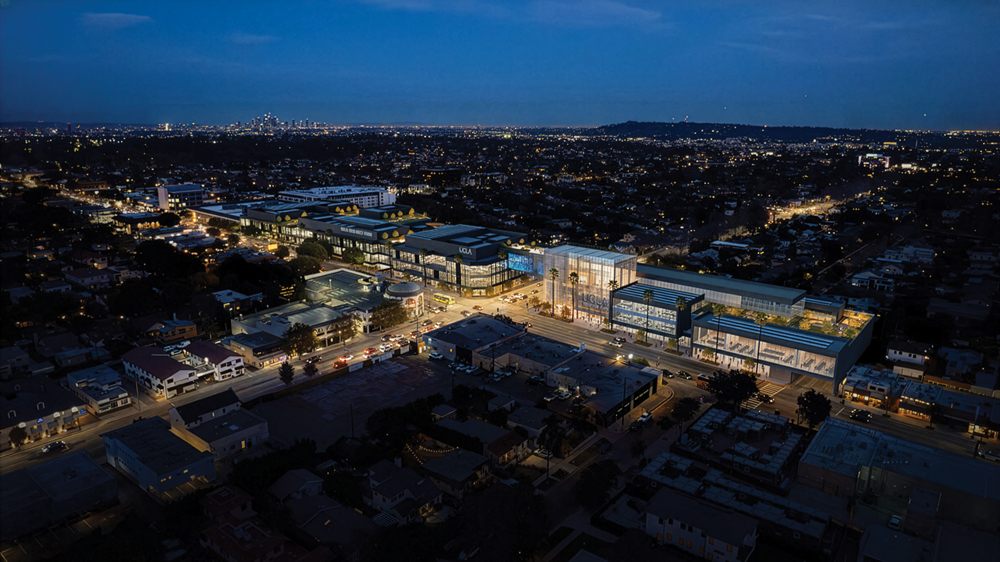
One highly anticipated university park will soon be found in Los Angeles. The UCLA Research Park will open in 2028 and will be located at a former mall (Westside Pavillion) on Pico Boulevard two miles south of the university’s campus. The existing footprint of the site UCLA Research Park will be taking over measures 700,000 sq. ft., which will leave ample room for several types of research activity that includes quantum, medical science and biotechnology.
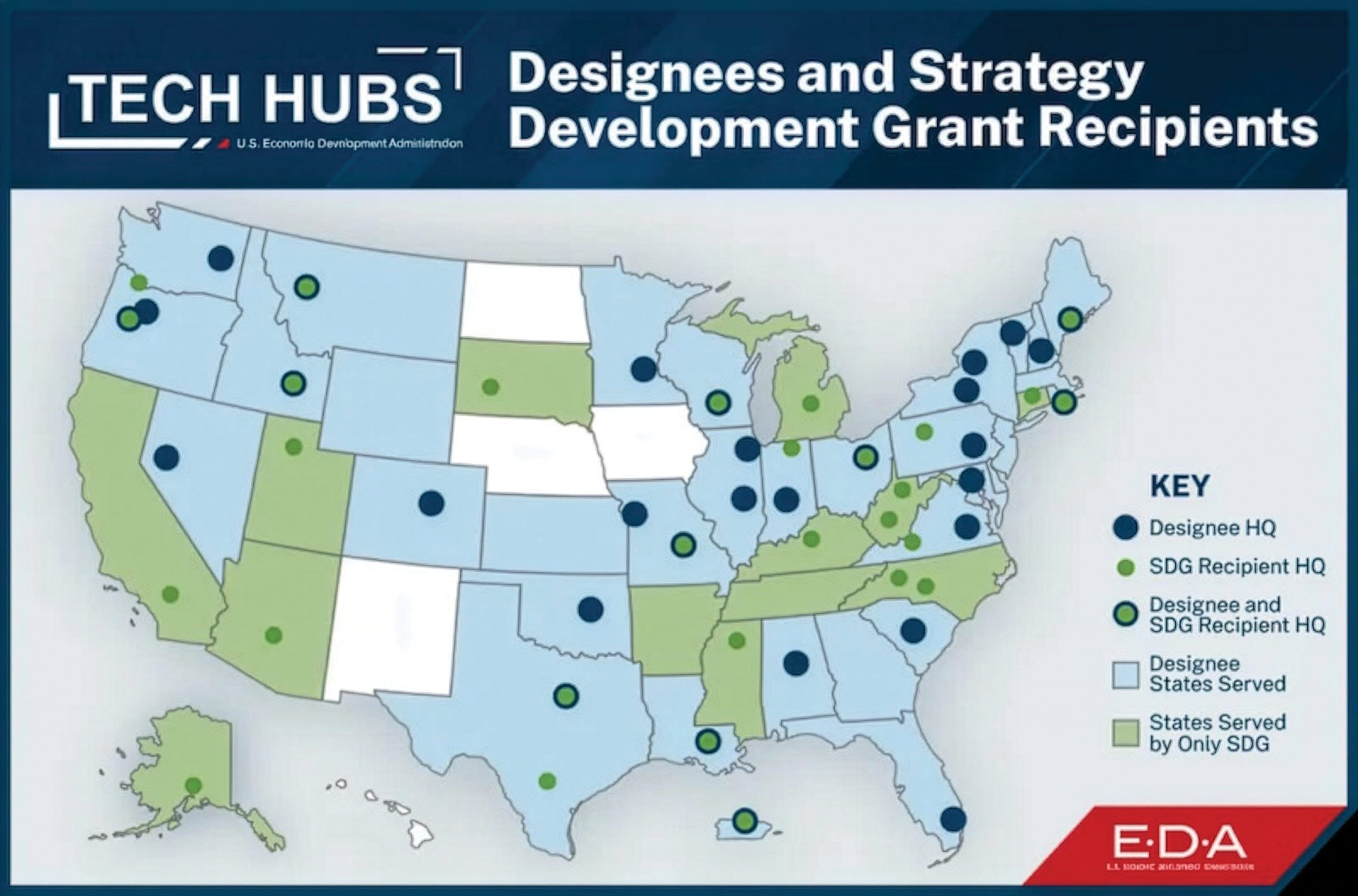
Photo credit: U.S. EDA
From Research to Implementation
In September 2025, the U.S. Economic Development Administration (EDA) opened new funding to 19 of its existing Tech Hubs that did not receive EDA Tech Hubs Implementation Awards. They span several key industry sectors:
Autonomous Systems
Ocean Tech Hub (Rhode Island and Massachusetts)
Materials Manufacturing
Pacific Northwest Mass Timber Tech Hub (Oregon and Washington)
American Aerospace Materials Manufacturing Tech Hub (Washington & Idaho)
Forest Bioproducts Advanced Manufacturing Tech Hub (Maine)
Semiconductor Manufacturing
Corvallis Microfluidics Tech Hub (Oregon)
Texoma Semiconductor Innovation Consortium (Texas and Oklahoma)
Vermont Gallium Nitride Tech Hub (Vermont)
Critical Minerals Supply Chain
Critical Minerals and Materials for Advanced Energy (CM2AE) Tech Hub (Missouri)
Qunatum Technology
The Bloch Tech Hub (Illinois)
Biotechnology: Drugs and Devices
Advanced Pharmaceuticals Manufacturing Tech Hub (Virginia)
Kansas City Biosecure Manufacturing Tech Hub (Missouri and Kansas)
PRBio Tech Hub (Puerto Rico)
Biotechnology: Precision and Prediction
Baltimore Tech Hub (Maryland)
Birmingham Biotechnology Hub (Alabama)
Minnesota MedTech 3.0 (Minnesota)
PROPEL Tech Hub (Pennsylvania, Delaware, Maryland and New Jersey)
Energy
Gulf Louisiana Offshore Energy (GLOE) (Louisiana)
Intermountain-West Nuclear Energy Corridor (Idaho and Wyoming)
New Energy New York (NENY) Battery Tech Hub (New York)