

The objection from inside the room.
By Wendi J. Gedzun
This is the second installment of a two-part report. Read part 1 here. — Ed.
The objection I hear most often inside our own discipline is that all of this pre-development community engagement slows deals. That is true. It slows them by the duration of one extra cycle of engagement, which is roughly the duration of one cycle of organized litigation, plus the duration of one election cycle, plus, in the worst cases, the duration of the news cycle that follows a bullet hole in a councilor’s door.
The slowdown is not new cost. It is the same cost, paid earlier, on terms the project still controls.
We have a name for that elsewhere in business. We call it insurance, and we accept it as competence. We do not ask our risk officers to defend the existence of the function each quarter, because we already know what the line item buys us. The case for early, structured community engagement is the same case, in another vocabulary. The cost of doing it sits inside the development schedule. The cost of skipping it sits, in aggregate, across the $162 billion of blocked and delayed projects now visible in the public record, and inside the carrying cost of every site that is still in entitlement six months past plan because no one in the deal room could be moved to fund the right people early enough.
The JLL Outlook says this directly, in the section of its 2026 report written for investors. Community opposition and sustainability compliance now materially influence timelines and returns. The same report recommends proactive outreach as one of five investor priorities for the coming year, on the grounds that it protects project timelines and internal rates of return. The case for engagement is no longer a soft case. It is, inside the discipline’s own research function, an investor-priority case.
The other objection is that this work is somehow soft. It is not. The community whose “no” arrives organized at the planning commission is operating on the most sophisticated risk-assessment system any of us own, the one that kept the species alive long enough to write deal terms in the first place. Calling that system irrational is not analysis. It is the discipline declining to read instruments it has decided in advance not to credit.
Toward an instrument, and a room to run it in
A pattern this consistent deserves an instrument. There is room in this work for a structured early-stage screen that evaluates proposed sites against the neural realities of the communities receiving them, scoring at least three dimensions:
Continuity preservation. How much of what makes this place feel like itself remains intact under the proposed plan?
Gain salience. How directly and immediately can the community experience the promised benefit, in people they can name rather than projections they are asked to trust?
Pacing alignment. Whether the project’s required timeline matches the community’s capacity to assimilate change without the threat circuit doing the deciding.
The screen is not a substitute for the quantitative work site selection has always done. It is an additional gate, run earlier in the process, that surfaces projects likely to fail at the human layer before the capital is committed. It costs hours to run. It saves, in many cases, the entire entitlement schedule.
What the field needs alongside the screen is a room to run it in. Call it a Community Fit Review. Convene it on the same schedule as the financial and technical reviews already are. Staff it with people whose compensation is not contingent on the deal closing on its current site. Give the review the authority to say one of three things, with equal institutional weight. Recommend proceed. Recommend redesign. Recommend reconsider site.
The third option is the one the discipline does not currently allow itself to recommend out loud. Until it does, the discipline will keep absorbing the cost of decisions it would not have made if the recommendation had been a permitted exit. We did not invent quality assurance for products by asking the engineers to grade their own designs. We should not be running site selection that way either.
When ‘no’ is the answer
There is a harder question beneath all of this, the one I find myself returning to and one I suspect I am not alone in returning to. When do companies and their consultants accept that “no” can be the right answer? The discipline I came into built itself, over four decades, around the assumption that opposition is something to be worked through. The neuroscience invites a different reading. A community’s “no” — sustained, organized, considered — is rarely noise. More often, it is the project being told something true about itself.
There is a parallel here the discipline tends to dismiss as soft, and the dismissal is itself the error. A person making a decision that shapes the balance of their own life is generally trusted to consult more than the math. To weigh their values. To listen to the people who know them best. To honor the part of themselves that recognizes when something is amiss even when the spreadsheet looks sound. We call that integrity, and we trust it.
Communities operate the same way at scale. A neighborhood’s collective “no” is rarely fear of progress and rarely an absence of reasoning. It is a kind of distributed intuition, assembled from thousands of small observations the consultant has not made. How the streets feel after dark. How the schools are holding up. What was lost the last time something of this scale arrived. To call that resistance is to discard data we paid nothing to gather and cannot afford to ignore.
None of this argues against moving forward. It argues for moving forward with the whole picture in view. The environmental load, the community fabric, the texture of place itself. A decision made on financial grounds alone is half a decision in the guise of a thorough one. The best step forward is not always the one with the highest return. Sometimes it is the one a place can carry without losing what made it worth investing in.
A neighborhood’s collective “no” is rarely fear of progress and rarely an
absence of reasoning. It is a kind of distributed intuition, assembled from
thousands of small observations the consultant has not made.
There is a quieter version of this lesson in nature. When a gardener deadheads a rose or prunes a fruit tree at the right season, the plant does not retreat. It returns more vigorous than before. The cut is not damage. It is a structural reset that sends the organism’s energy somewhere it can actually grow. Communities work with similar logic. A “no” that arrests a poorly-fitted project is not, in the long arc, a refusal to grow. It is the deadheading that makes the next, better-suited investment possible. We accept this in our gardens. We have not yet learned to accept it in our economic development.
The cost of treating opposition as something to be managed away is no longer abstract. Indianapolis offers the version of that cost this discipline most needs to look at directly. On April 6, 2026, at approximately 12:45 in the morning, City-County Councilor Ron Gibson of District 8 was awakened by gunfire. Thirteen rounds were fired into the front of his home. A note tucked into a small bag and left under his doormat read “NO DATA CENTERS.” His eight-year-old son was inside the house.
Five days earlier, on April 1, the Indianapolis Metropolitan Development Commission had voted six to two to approve the rezoning for the Metrobloks project, a half-billion-dollar data center proposed for the Martindale-Brightwood neighborhood. Gibson, who represents the district where the project would be built, had publicly supported the rezoning at the commission’s hearing, where he was booed by residents. The community group most prominently organizing against the project, Protect Martindale-Brightwood, condemned the shooting before anyone else did, and noted that any signage at the scene was not affiliated with their work.
(Read the May 7, 2026, Online Insider “A More Civil Data Center Discourse,” by Larry Gigerich and Chris Lloyd. — Ed.)
Violence is what desperation looks like when a community has come to believe no other channel will work. The coalition opposing that project condemned the shooting before anyone else did, and they were right to. But the harder question, the one the discipline has been declining to ask, is what happens inside a community whose “no” has been heard, year after year, as an obstacle to dismantle rather than a position to respect. Pressure that has no path becomes pressure that builds. When the formal channels are perceived as foregone, the informal ones get louder. Indianapolis is what that escalation looks like in the worst case. Most communities will not get there. Some will. The work of the discipline is to make sure many fewer do.
Sometimes the answer to “Will this project work here?” is “Not here.” That answer is rarely audible inside the deal team, because the deal team is structured to find a way, and finding a way is what those of us in this work were trained to do, and what we have spent careers learning to do well. The work requires the second room described earlier. The Community Fit Review exists, in part, so that “not here” becomes a recommendation the institution can produce in writing, on time, before the cost of producing it informally lands on someone’s front porch.
What the discipline owes itself
The site selection discipline I came up in measured what could be measured and treated everything else as exogenous. That worked when the pace of community pushback was slower than the pace of capital deployment. It does not work now. There is an old line, traveled enough that no one quite owns it, that fits this moment. If you always do what you’ve always done, you’ll always get what you’ve always gotten. The discipline is living that sentence in real time.
Communities have learned faster than the playbook has updated. Social media has compressed the timeline between a project announcement and an organized opposition into days, sometimes hours. The $98 billion in delays and cancellations recorded in a single recent quarter is not a one-off.
There is something 36 years of work in technology, program, change and knowledge management has taught me, and it has never stopped being true. Adults do not take on change because they were persuaded. They take on change because they participated in shaping it. Every learning system that has ever worked at scale has known this. Every change initiative that has ever failed at scale has refused to. Site selection, as a discipline, is currently operating closer to the failed change-initiative side of that line than it likes to admit. The fix is not better persuasion. It is earlier participation, by people whose participation is materially honored in the final design.
This is the insight the engagement consultants keep trying to translate into language the deal team will hear. The deal team will hear it when the timeline reflects it and when the org chart reflects it. Until then, the deal team is making a bet that 20 years of organizational change research has, with remarkable consistency, declined to make.
Adults do not take on change because they were persuaded.
They take on change because they participated in shaping it.
The good news is that the science we need is mature. Threat detection, loss aversion and place identity have been robustly characterized for 40 years. The change-management literature is older than that. Other fields are reaching the same conclusion along different paths. The complexity-science work of Shade Shutters and his colleagues at Arizona State University, profiled in these pages in 2015 and developed at ASU since, treats cities as living systems whose coherence is never the sum of what we can count about them. Which is, in another vocabulary, what the neuroscience has been working to articulate all along.
The qualities that make a place itself are seldom the qualities most easily measured. The work ahead is integrating them into the standard operating model of site selection. Into the early-stage screens. Into the engagement design. Into the timeline assumptions. Into the deal architecture itself.
The news that the discipline does not yet repeat enough is that the trajectory is not uniform. The JLL Outlook notes a regional variation worth holding next to the U.S. numbers. In EMEA, community sentiment toward data centers has actually improved, largely because several governments have reclassified data centers as critical infrastructure and streamlined the planning process to match. The structural change moved the social one. Meanwhile, the AMER market continues to face increasing resistance in several states, and APAC is showing mixed reception with significant activism in key development areas.
The asymmetry is the lesson. Where institutions changed the frame, the public position changed with it. Where institutions kept the old frame and asked the public to update on its own, the public did the opposite. None of this is about messaging. All of it is about which room the decision actually got made in, and who that room was structured to listen to.
That integration is, in my view, the next decade of work for those of us in this field. The 58-point gap is the warning. The asset class will keep expanding the list of projects affected. The question is whether site selection evolves into a discipline that holds both the financial model and the human nervous system in view at the same time, or whether it remains a discipline that calls human responses irrational and watches its capital migrate steadily to the path of least resistance, which is rarely the path of greatest return.
Capital that learns to read the nervous system will compound. Capital that does not will keep being surprised in public hearings.
I keep thinking about the ore walls. From DuSable Lake Shore Drive they appear suddenly, set back behind the native-prairie plantings, and then they are gone again, the kind of structure the city has lived alongside long enough that most drivers no longer register them. That habituation is what the discipline I came up in has done with the harder parts of its work. We have lived alongside community resistance long enough to stop noticing it as anything but friction.
The opposite of habituation is recognition, and the IQMP project is interesting because someone, somewhere in the design process, appears to have recognized what was already there. The walls were not preserved because they were sentimental. They were preserved because they are part of how the place knows itself, and because a quantum campus built over them would be evaluated, neurologically and politically and morally, by what it asked the place to forget. Designing with what is already there is not nostalgia. It is the recognition that a community’s relationship to its own ground is older than any project’s relationship to it, and that the project is the visitor in the conversation, not the host.
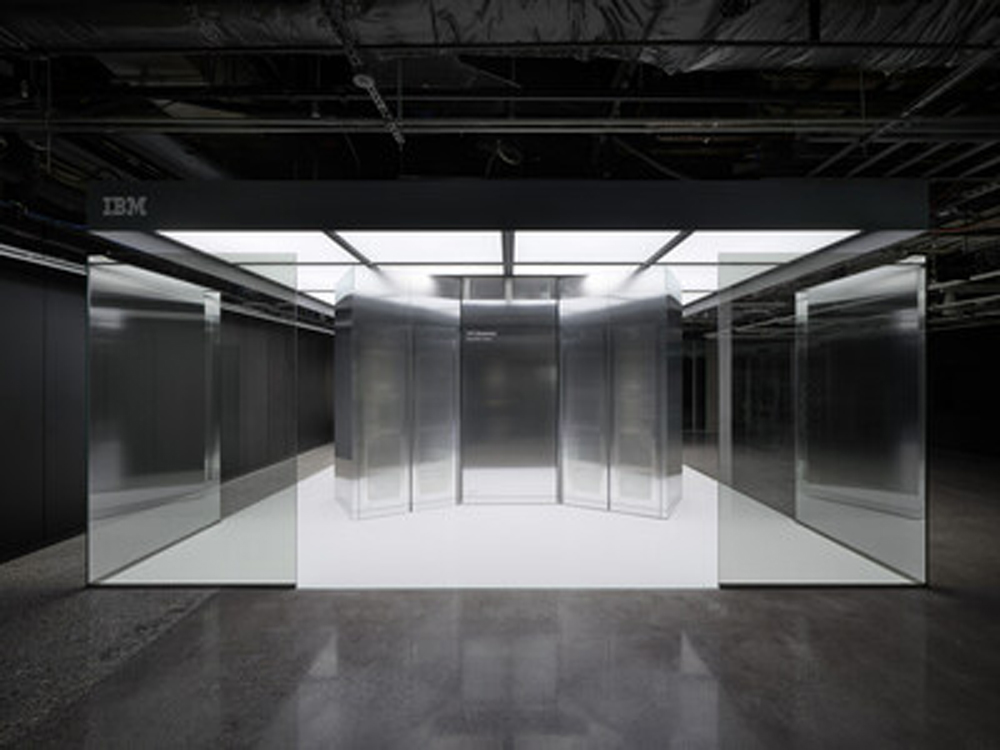
IBM’s National Quantum Algorithm Center in the Illinois Quantum and Microelectronics Park (IQMP) in Chicago will deploy IBM’s next-generation quantum computer, IBM Quantum System Two.
Photo courtesy of IBM
There is a deeper insight tucked inside that recognition, and the discipline has been avoiding it. The places that have absorbed the heaviest losses, such as the South Sides and the Martindale-Brightwoods, and the rural counties whose tax base dried up two governors ago, are also the places where the next round of large-scale infrastructure is most likely to be located. They have available land and the ability to add power capacity and political structures that the larger project sponsor can usually outweigh.
The discipline has historically read that combination as opportunity. The communities have read it, accurately, as a pattern. Each successive project assumes a community whose history of being asked to absorb has produced no learning, no caution, no organized capacity to evaluate the terms on offer. The 58-point gap is, in part, the discipline being surprised that places that have been treated like infill have learned to recognize being treated like infill. The communities are not, generally, against progress. They are against being, again, the place where progress is sited rather than felt.
The IBM Chicago campus will be one of the most-watched site selection test cases of the next five years. It may yet stumble. Many do. But the choreography is, for once, oriented in the right direction, and the questions we should be asking of every project of comparable scale are now legible inside it. Does this design preserve the things that make this place feel like itself? Can the community see the gain in people it can name, on a schedule the body can feel? Has the timeline been built to the nervous system or to the pro forma? Is there a room inside the deal that has the authority to recommend “not here,” and is anyone in it whose paycheck does not depend on the answer being something else?
The case for changing the operating model is no longer rhetorical. It is, by now, simply the math. One hundred and sixty-two billion dollars across two reports. Twenty-four states in the first count, 40 in the most recent. One hundred and eighty-eight organized groups and rising. One bullet-marked door in Indianapolis.
And on the other side of the same ledger, one quantum campus rising on the South Side of Chicago that may, if the choreography holds, become the example the field has been waiting for. The discipline is being asked, by all of this, to decide what kind of discipline it wants to be over the next decade. The decision is not whether to honor community judgment, since community judgment is now organized enough to honor itself. The decision is whether the discipline arrives at that table with something to contribute beyond a closing schedule. The IQMP project suggests that arrival is possible. The Indianapolis door suggests the alternative. The discipline could use the example. The country could use it more.

Wendi J. Gedzun is senior director, Solutions Development, at JLL. Her 36-year career spans technology, program, change and knowledge management, with the last 20 years applied inside commercial real estate. She is the author of “Neuropolis: Building Cities of the Future Through Neuroscience and Place” (2025) and “Building Greensboro: A Strategic Vision for Place, Potential, and People” (2025), a member of the Academy of Neuroscience for Architecture, and a licensed real estate broker in Illinois and North Carolina. She begins a doctorate at Case Western Reserve University’s Weatherhead School of Management in the fall of 2026.