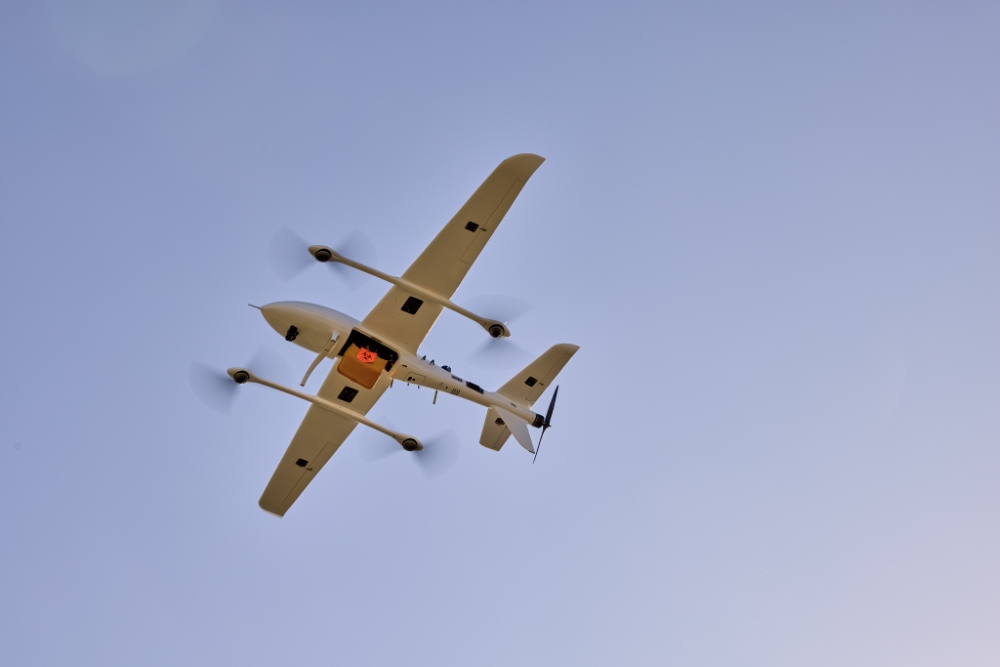
Innovation in aerospace and aviation technology will soon see a boost on Choctaw land.
With over 200,000 tribal citizens, the Choctaw Nation of Oklahoma (CNO) is third in terms of largest tribes in the United States, and its tribal jurisdictional area comprises over 10 counties in the state. The tribe, which has already hosted testing of cutting-edge aviation technology for years, will soon see a significant acceleration of this activity.
In January 2026, the Federal Aviation Administration (FAA) and U.S. Department of Transportation chose the CNO as one of two locations that will host an FAA-designated unmanned aircraft systems (UAS) test site, with the other test site going to the Indiana Economic Development Corporation. This marks the first time in a decade that new FAA-designated sites have been approved for UAS testing. James Grimsley, executive director of advanced technology initiatives at the CNO, walked me through the significance of the decision and its potential impact on the Choctaw Nation of Oklahoma and beyond.
Drones Align Over the Rez
“Historically, areas like this suffer from many, many decades of generational poverty, high unemployment and all the ills that come with that,” he explains. “So, this is an area that for 150 years was economically depressed. People never dreamed or imagined that these big, neat technology opportunities would actually come to the region. Growing up, I was fascinated with NASA and the Apollo missions. I was fortunate to be alive and watched those happen live, in black and white. Never did I dream that the deep things like that in aviation and aerospace would be happening literally in my backyard. It’s a point of great pride for not only the tribe, but the entire Southeast Oklahoma region because it’s showing that we’re preparing for the future and embracing it in a way that’s going to be productive for everybody.”
Grimsley grew up on the Choctaw reservation in Atoka County where the FAA-designated UAS site will be located on 44,600 acres of greenfield land. Existing facilities, safety infrastructure, ground base radar and command control radio network resources have already been built there to support current and future testing. When asked what makes the Choctaw Nation an ideal partner and location for the new site, Grimsley cites the direct impact of one of the fastest growing metro areas in the United States that the tribe borders — Northern Texas and the Texoma area. Several other factors came into play as well.
“There is immense economic potential that we’re seeing roll out here,” he says. “But what makes it neat is the tribe itself is the right size. The reservation is 11,000 square miles. It has a very sophisticated form of government. We have a great Choctaw Nation government. The Choctaw Nation has resources. Literally everything fell into place where we have land, we have opportunities, and we have resources, but we have structure and the right size of structure that we’re able to go be aggressive and do things like this.”
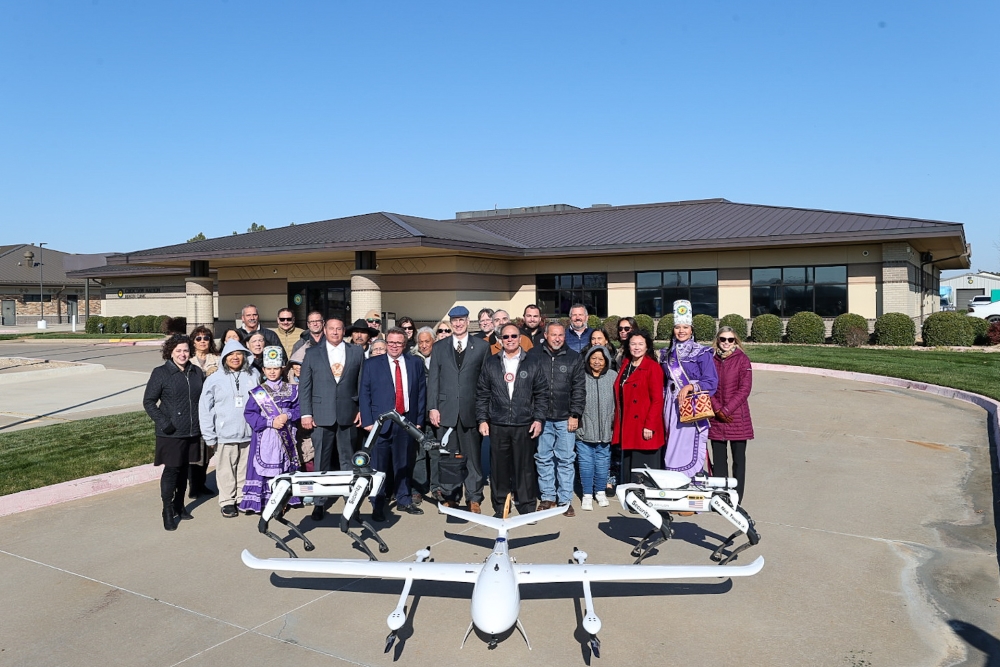
The Choctaw Nation of Oklahoma received $2 million in federal funding from the U.S. Department of Transportation to support medical drone operations and transportation innovation on the reservation.
The Choctaw Nation of Oklahoma was something of a dark horse, winning the federal UAS project even in the face of steep rivalry from other locations with more resources. Grimsley says it’s important to note that “we competed against states with very deep pockets and very longstanding aviation programs, and we still were able to win. We came out, prevailed and won. And that’s because of our unique situation. We have some nimbleness. We’re able to do things quickly. … If you look globally over the past 50 or 60 years, areas that have been economically depressed [or considered] emerging, have been able to leapfrog a lot of times. That’s what technology does — you can leapfrog and jump ahead because you may not have this infrastructure, but if it’s a greenfield opportunity, sometimes it can work to your advantage. This is one of those situations where we are looking at things that will leapfrog the Choctaw Nation reservation.”
Grimsley says the entire Choctaw Nation is effectively now a test site, and that the government is looking at applications of the aviation technology that will be tested there to serve tribal members and communities and better the quality of health and life for all people living there.
“Even though we’ve started with this 44,000 acres, the entire reservation is, in a sense, our sandbox because we’re pioneering what it will look like for tribes as we embrace this technology in the future in a way that benefits tribal members and benefits society at large,” he says, noting that the tribe also has an eye on preserving their natural resources and environment. “It’s just a perfect alignment of size, the state of our government, where we’re at in terms of the evolution of the Choctaw government right now, the initiatives we have, the political will within the Choctaw Nation to do it, and then the setting where we’re poised — even though it has been historically economically depressed — for pretty significant economic growth in the next few decades.”
A Trailblazing Mission
The CNO is no beginner when it comes to aviation technology testing and garnering FAA approvals. The Tribe has an expansive regulatory approval toolbox and a large set of FAA approvals already, currently performing advanced operations for tests and research for the FAA.
“We’ve been very active with the FAA and some of the other agencies and really shaping what the regulatory future will look like for all of this technology,” Grimsley explains. “So not only are we doing the testing [and] technology, but we’re very involved on the national level in rulemaking and policy.”
Grimsley predicts that by 2030, the technology being tested at the UAS site will be ubiquitous in the Choctaw Nation. Current missions that are carried out on a regular basis are designed with the aim of moving toward normalization of the aviation tech over the next four to five years.
With almost 10 years of experience in contributing to federal rulemaking around UAS and other aviation tech tested at the CNO, the Choctaw Nation is also aware that their work in this field will likely impact other tribes in the future. That’s important to Grimsley, who has Choctaw ancestry on both sides of his family going back several generations.
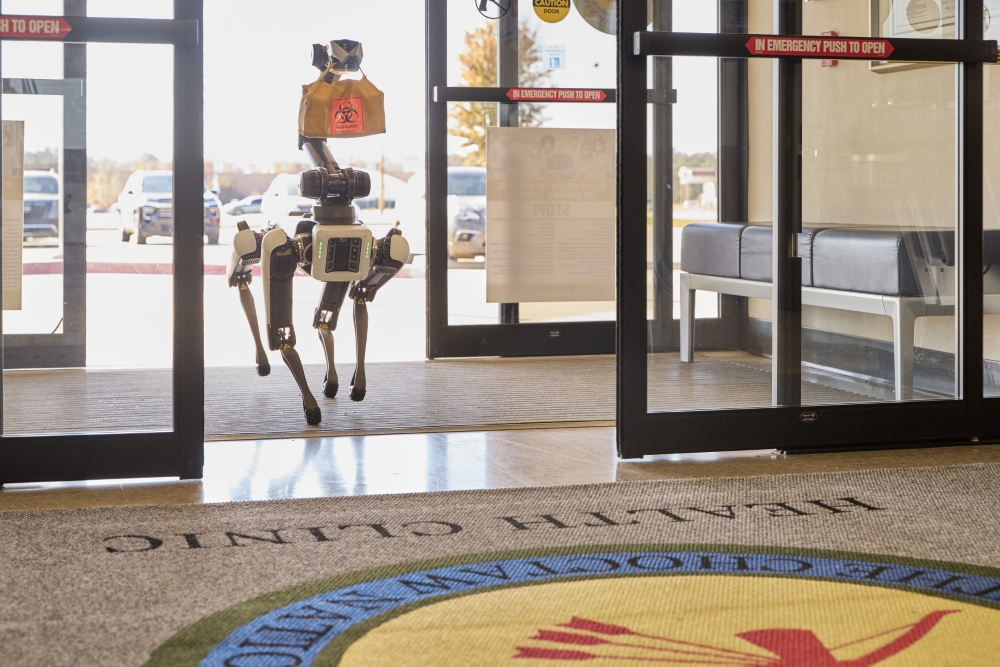
A special robotic delivery takes place at the Atoka Clinic.
“It’s the first time the tribal government has ever been selected for a very significant, nationally important transportation technology initiative,” he says. “Tribes historically have not been involved in these things. Tribes have been overlooked, and we are very honored to be blazing the trail. So, it’s very important to us because we’re showing what tribes can do. Not only can tribes compete and hold their own — tribes can actually excel and do extremely well. We’re showing what it means to be able in a unified way to pull resources and our political will together, and then have a shared vision. It’s exciting when you see what tribes are capable of and what tribes are going to be capable of in the future. We’re very honored. We’re very humbled by the fact that we’re getting to blaze this trail for what tribal nations can do, but we’re also excited that we’re able to use all those things that are uniquely tribal in terms of our sovereignty, our standing, how we operate. We’re using those things to solve very important technology problems and challenges to the United States.”
Grimsley says the test site is extremely relevant in attracting investors and people wanting to do business with the CNO, and that it will likely help with future aviation and advanced technology companies looking to visit and test their own technologies at the site.

“Tribes have been overlooked, and we are very honored to be blazing the trail.”
— James Grimsley, Executive Director of Advanced Technology Initiatives, Choctaw Nation of Oklahoma
“That opens the door for us to look at more strategic collaboration in the future [when it comes to] manufacturing opportunities,” he says. “A lot of times, these companies want to be close by where the testing happens, and it starts to become part of their overall research and development, testing and evaluation organizational structure. So, we’re looking at growth in terms of manufacturing and relocation, and that’s where tribal governments can differ from ordinary state governments. Tribes have the ability to function in multiple different facets. They can become joint venture partners or investors or different types of business partners. That flexibility, that agility where tribes can operate with these different facets makes it very attractive where we can get to grow a very productive ecosystem. Not only are we providing a tool, which is a very advanced test range that lets people do things early [and] lets people test things in a very safe environment, it also allows us to use that [test range] to grow a larger economy around it. We call it the ‘low-altitude aviation economy.’ ”
New modes of transportation and flight may very well be born out of the research and testing being done in drones, emergency aviation and electric propulsion advancing mobility. Drones are, according to Grimsley, “flying robots” capable of doing difficult work with more agility than humans can: moving medical supplies or blood samples between clinics, or pulling people out of dangerous road conditions. The implications of more perfected drone technology in the Choctaw Nation and beyond are vast and promising, especially in addressing health care and improving the standard of living.
The Choctaw Nation also participates in the FAA’s UAS Integration Pilot Program and BEYOND program. The same month that the CNO was approved for the UAS site, the tribe received almost $2 million in federal funding from the U.S. Department of Transportation in the form of a Strengthening and Revolutionizing Transportation (SMART) Grant, which will help support rural medical drone operations and transportation innovation on the reservation.
Will Tribes Receive Congressional Approval for Equal Business Incentives?
Abill introduced in the U.S. House of Representatives is aiming to get Indian Tribal Governments access to the same tax programs and economic incentives available to state and local governments. The Tribal Tax Investment and Reform Act of 2026 (HR 7705), a bipartisan piece of legislation introduced in February by Representatives Gwen Moore of Wisconsin and David Schweikert of Arizona, seeks to do this through an amendment of the Internal Revenue Code of 1986.
Asked why she believes this bill is important for the business community and how it may improve investment opportunities in tribal communities, Congresswoman Moore tells Site Selection that “for too long, tribal members and Indian Country have faced long-standing inequities and disinvestment. As a member of Congress, I have championed tribal sovereignty and economic empowerment in Indian Country, using my position on the Ways and Means Committee to advance these efforts. Our bipartisan legislation breaks down unfair barriers, ensuring that tribal governments can access the same tax and economic programs available to state and local governments. By building parity into our tax code, our bill can help tribal governments use bonds to fund economic development projects in their communities. It also supports more affordable housing through enhancements to the Low-Income Housing Tax Credit and promotes economic opportunities with New Market Tax Credits. Wisconsin has 11 federally recognized tribes that stand to benefit from this legislation. I’m proud to work with Rep. Schweikert and am looking at all avenues to enact this legislation.”
When the bill was introduced, Schweikert stated that “right now the tax code treats tribal governments like an afterthought instead of governments with the same basic responsibilities as states and counties. When tribes cannot use the same bond tools, housing credits and investment incentives everyone else takes for granted, projects stall and growth in Indian Country falls behind. This bill starts to clean that up so tribal governments can finance infrastructure, housing and private investment under clear, predictable rules. I am grateful to work with Representative Moore on a reform that respects tribal self-government and focuses on real economic opportunity instead of red tape.”
Key provisions of the bill include the ability of tribes to issue governmental bonds, including private activity bonds for economic development purposes; select excise taxes, including manufacturing and communication excise taxes; widen the eligibility and increase the effectiveness of Tribal Low-Income Housing Tax Credits to create affordable housing on Tribal land; and the creation of an annual $175 million New Markets Tax Credit for low-income tribal communities and for projects that serve or employ tribe members. — Kelly Barraza