
Florida has spent years building the infrastructure for a transportation industry that is still taking shape. Now, at SunTrax in Auburndale, Florida’s early bet on advanced air mobility is starting to deliver, attracting companies preparing to turn a futuristic mode of transportation into a commercial industry.
In August, AIR announced plans to establish its U.S. headquarters, eVTOL production and flight operations hub at the 775-acre campus, where the company has already taken approximately 20,000 sq. ft. AIR plans to begin U.S. manufacturing of its AIR ONE personal eVTOL aircraft and autonomous heavy-lift cargo aircraft by the end of 2026, while relocating flight-test programs for both aircraft to SunTrax.
The move gives Florida something more significant than another advanced-aircraft testing program. AIR is bringing headquarters functions, manufacturing and flight operations together at a state-owned facility built to help emerging transportation technologies move toward commercialization. For SunTrax, it is an early sign that the infrastructure Florida built for advanced mobility is starting to attract the companies needed to turn that investment into an industry.
A Florida Foundation
AIR’s decision did not begin with SunTrax. The company had already established an initial U.S. flight operations center in Florida in 2024 and began eVTOL flight testing in the state the following year. CEO and Co-Founder Rani Plaut says that experience gave AIR a clearer understanding of the advantages of operating in Florida and helped reinforce the decision to make the state the foundation of its longer-term U.S. presence.
AIR also entered the expansion with an existing market in place: Plaut says the company already has more than 300 customers in Florida, creating a local base for future aircraft operators, demonstrations, training and customer engagement.
“Florida stood out for its ability to meet both our immediate operational requirements and our longer-term growth objectives,” Plaut says. “For an aircraft company, the ability to conduct flight testing and operations throughout much of the year is a meaningful advantage. Florida also has a well-established aerospace and aviation industry, with a workforce that understands the highly specialized requirements of aircraft development and operations. Another consideration was the depth of the regional talent pipeline. The concentration of major aerospace and aviation universities gives us access to engineering, aviation and technical talent as we build our team.
“Rather than relying on a single advantage,” he says, “Florida offered the broadest combination of operating conditions, talent, infrastructure and long-term growth potential for AIR.”
Built for the Next Stage
SunTrax ultimately offered AIR something more specific: the ability to support several stages of aircraft development and commercialization at the same site. As AIR moves toward expanded production, it expects to need space and infrastructure for aircraft assembly, testing, validation, flight operations, maintenance and customer activities.
That flexibility matters because those requirements will continue to change as AIR ONE moves from development and flight testing toward production, customer demonstrations, training and operational deployment, Plaut says.
Owned and operated by the Florida Department of Transportation, SunTrax was originally developed to advance connected and autonomous vehicle technologies and has since expanded into advanced air mobility (AAM) through SunTrax Air. The campus includes dedicated airspace, the nation’s first AAM Aerial Test Track, vertiports, high-speed aircraft charging stations and maintenance facilities, along with space that can support research, light manufacturing and final assembly.
“Florida’s investment has been foundational,” says Central Florida Development Council President and CEO Sean Malott. “Building specialized infrastructure requires significant resources and long-term vision, and SunTrax provides capabilities that few locations can offer. The state’s commitment reduced barriers for companies seeking a place to test, validate and commercialize emerging technologies. Rather than having to build costly infrastructure independently, companies can leverage an established environment designed specifically for innovation and advanced mobility applications. That investment sends a powerful signal that Florida is serious about supporting cutting-edge industries and attracting global technology leaders.”
Room to Grow
AIR expects its Florida operation to expand alongside the AIR ONE program and its U.S. business. Plaut says the company anticipates significant workforce growth over the coming years, with jobs spanning manufacturing, engineering, aircraft operations, maintenance, flight testing and business operations.
“We view this as the beginning of a longer-term presence rather than a fixed-size operation,” Plaut says. “As production volumes increase and our aircraft enter broader operational use, the capabilities and workforce at the site can grow with them.”
The advantages extend beyond the SunTrax campus itself.
“Success in advanced air mobility depends on far more than facilities,” Malott says. “Polk County is fortunate to be part of a broader Central Florida ecosystem that includes leading educational institutions, specialized workforce training programs, aerospace and advanced manufacturing expertise, and a strong network of technology suppliers.”
Florida Polytechnic University, Polk State College, the Aerospace Center for Excellence and regional workforce partners are among the institutions helping build talent in engineering, aviation, robotics and advanced manufacturing, while companies also have access to regional aerospace expertise, suppliers and economic development partners.
AIR is not the only international AAM company looking to SunTrax. U.K.-based Skyfly Technologies has signed a letter of intent with FDOT to establish its first dedicated U.S. presence at the campus and plans to begin occupying leased space in the fourth quarter of 2026. The parties intend to finalize a formal lease agreement in the coming months.
“Access to SunTrax gives us a world-class testing environment and puts us at the heart of one of the most important advanced air mobility ecosystems in the country,” said Skyfly CEO Michael Thompson. “This is an important step in bringing Skyfly’s technology to the U.S. market.”
For Polk County, AIR and Skyfly are helping turn that infrastructure into the beginnings of an AAM cluster. “We believe these investments are important indicators of the momentum building around SunTrax and advanced air mobility in Central Florida,” Malott says. “Successful industry clusters often begin when pioneering companies establish a presence and demonstrate the value of a location.” As additional firms recognize the advantages of locating near specialized infrastructure, talent, suppliers and industry partners, he expects interest from manufacturers, component suppliers, software developers, maintenance providers, flight operations companies and research organizations.
AIR’s commitment, reinforced by Skyfly’s planned U.S. presence, provides some of the clearest evidence yet that Florida’s investment in AAM infrastructure is beginning to produce the industry activity it was designed to support.
Read more about the Southeast Project Bulletin here.

Transforming a Site to Power Up Alabama
A Virginia-based company with designs on meeting America’s unrelenting demand for electrical power infrastructure scoured the Eastern U.S. and decided that the best place to build a massive new transformer plant is in Muscle Shoals, Alabama.
Virginia Transformer Corp., headquartered in Roanoke, Virginia, announced May 19 that it will invest $302 million to develop a 600,000-sq.-ft. factory and create 1,100 jobs in the Shoals Research Airpark in Colbert County in Northwest Alabama. The company is a U.S.-owned, minority-owned enterprise that is the No. 1 power transformer manufacturer in North America.
Why VTC chose this site — and what it means for the Southeast — is a lesson in the paramount value of site infrastructure. With a Norfolk Southern rail spur to support shipping and logistics, this Muscle Shoals site will become VTC’s seventh North American manufacturing location and help the company meet ever-growing demand for critical electrical equipment that serves utilities, data centers, renewable energy plants, industrial customers and commercial markets in the U.S. and Canada. The power transformers to be produced on site will range from 2 MVA to 500 MVA.
The factory will be built on 90 acres in the Airpark and feature a dedicated on-site training center; digital manufacturing dashboards and real-time online portal for customers; automated warehousing to deliver material to point of use within the plant; and a design-to-machinery interface. The design, technology and process at the plant will be an extension of the company’s 500-kV factory in Rincon just outside Savannah, Georgia, which recently set a world record by achieving a streak of 86 consecutive power transformers that successfully passed FAT (final acceptance testing).
VTC CEO Prabhat Jain said, “This investment represents the latest addition in our ongoing expansion across North America and reflects our confidence in the markets and customers we serve, as well as our dedicated workforce. We are recognized throughout the industry as an engineering company that crafts and delivers premium-quality transformers within the shortest lead times — products designed for a 60-year service life.”
Giving North Alabama a Jolt
Adam Himber, vice president of The Shoals Economic Development Authority, says that his organization found out about the initial site inquiry through the Alabama Department of Commerce and the Tennessee Valley Authority. “It was code-named Project Jolt,” he says. “It was a pretty lengthy process to get to where we are today. The company actually began looking at our speculative buildings. We had built two spec buildings back at the end of 2024. One of them was a 250,000-square-foot building that is expandable up to 500,000 square feet. When they realized that they needed a bit more height to accommodate these very large transformers they would be assembling, they decided to build their own facility.”
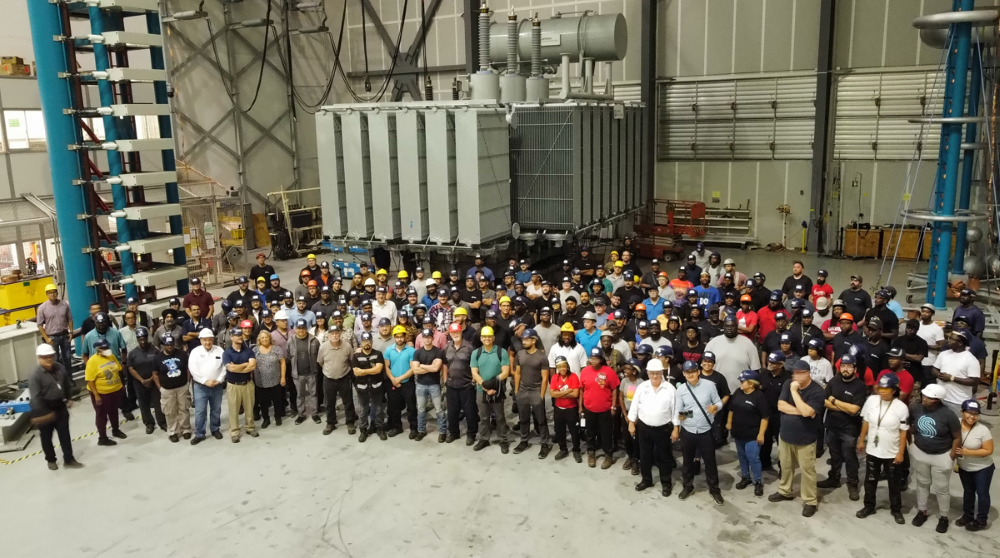
Workers at Virginia Transformer Corp. celebrate completion of the company’s largest transformer to date: a 345 MVA transformer for the renewables market. The liquid-filled step-up unit is more than 36 feet long, 25 feet high, 22 feet wide, and weighs more than 542,000 pounds. It was produced at the firm’s GTC facility in Rincon, Georgia, for Rosendin Electric’s Nighthawk project.
Photo courtesy of Virginia Transformer Corp.
Workforce development played a crucial role. “The University of North Alabama created a program called engineering technology in 2015,” Himber notes. “In 2024, they created a bachelor of engineering program. The Virginia Transformer jobs require very high-skilled people, and we will provide that to them.”
With a Norfolk Southern Railroad rail line running directly through Colbert County and the Sheffield Classification Yard located about a mile from Shoals Research Airpark, the site offers everything VTC needs for logistics, says Himber. “We’re not Limestone County or Athens or Huntsville, and we’re not on the interstate, but we have tremendous four-lane, high-speed highways. You can drive 65 mph with very little traffic and be on I-65 in 45 minutes and go north or south, or take Highway 72 all the way to Memphis, which then opens up tremendous transportation corridors.”
The icing on the cake, says Himber, is that VTC will pay its workers over $28 an hour, on average, across all 1,100 jobs. “That’s more than a living wage in Colbert County,” he says. “The workers will love these jobs and enjoy a good standard of living.”