Assembled to accompany “Where and When Will Attainable Housing Materialize?” in the July 2026 print issue of Site Selection, here we present updates, graphics and links to resources that paint a picture of the current housing situation and solutions already in motion. — Ed.
At midnight on July 11, the 21st Century ROAD to Housing Act became law. “By removing unnecessary regulatory barriers and improving the processes that govern housing development, this new law creates stronger conditions for residential construction and represents a significant victory for LBM dealers and the customers they serve,” said National Lumber and Building Material Dealers Association President and CEO Jonathan Paine. “NLBMDA looks forward to building on this progress by advancing additional supply-side policies, strengthening the residential construction workforce and ensuring our industry can help meet the nation’s growing demand for housing.”
Indeed, said an NLBMDA statement, the organization will continue “advocating for workforce-development policies that expand career and technical education, apprenticeships, and other pathways into residential construction and the broader LBM industry.” NLBMDA stated it will also prioritize passage of the bipartisan Neighborhood Homes Investment Act, which would establish a federal tax credit to support the construction and substantial rehabilitation of affordable, owner-occupied homes in distressed urban, suburban and rural communities where development costs often exceed a home’s potential sale price. “By helping close that financing gap,” the association said, “the bill would make otherwise infeasible housing projects economically viable and is projected to support the construction or rehabilitation of 500,000 homes over 10 years.”
Smart Growth America (SGA) called the bipartisan law “the most significant housing bill in generations” and “an important step toward addressing the nation’s housing affordability crisis. But passing this bill is just the first step to delivering more homes in the right places, at a range of types and at prices people can afford.” Among other things, said the organization’s analysis, the measure merely authorizes funding. “Congress still has to go through the appropriations process to issue funding for the bill’s programs.” SGA points out a number of limitations and programs it describes as left on the cutting-room floor, such as the Build More Housing Near Transit Act and the Identifying Regulatory Barriers to Housing Supply Act, “which would have required CDBG recipients to report to HUD on their progress towards adopting a series of pro-housing land use and zoning policies.” But it also salutes a number of smart growth provisions in the new law:
- Supports smaller homes and infill housing by “right-sizing” the National Environmental Policy Act of 1969 (NEPA) review process to speed up home construction timelines for those housing types (section 206) and by creating exemptions to NEPA for Rural Housing Service (RHS)-funded projects. (section 103)
- Provides pre-approved home plans and other design resources to streamline the development process and accelerate housing construction. (section 209)
- Increases transparency and expands access to underutilized land by creating a publicly accessible, searchable database of undeveloped land owned by local governments. (section 104)
- Provides policy guidance on zoning and land use to help communities address barriers to more housing (section 107)
- Prioritizes resilience planning by funding the Community Development Block Grant–Disaster Recovery (CDBG-DR) program for three years (section 504)
- Promotes manufactured housing to reduce construction costs by authorizing the Preservation and Reinvestment Initiative for Community Enhancement (PRICE) grant program for seven years, removing outdated requirements, and increasing financing eligibility for modular and manufactured homes (title 3)
- Protects homeownership opportunities while ensuring access to development capital by limiting large institutional investors’ purchases of single-family homes (section 1001)
- Unlocks additional private capital for affordable housing by increasing the Public Welfare Investment cap from 15% to 20% (section 203)
- Preserves older affordable housing stock by increasing access to the Rental Assistance Demonstration (RAD) program by 100,000 units and codifying tenant protections (section 212)

The dilapidated but historic Wellman-Seaver-Morgan Engineering Company building in Cleveland will now be redeveloped as a manufacturing operation for modular housing.
Photo courtesy of City of Cleveland
Some regions are getting a jump on housing innovation without waiting for Congress. Mayor Justin M. Bibb, the City of Cleveland and the Site Readiness for Good Jobs Fund (SRF) this summer announced “two major milestones in Cleveland’s industrial and housing strategy with the selection of MMY US (MMY) as the City’s preferred modular housing manufacturer, and the award of $2.56 million in Ohio Historic Preservation Tax Credits for the redevelopment of the historic Wellman-Seaver-Morgan Engineering Company building at 7000 Central Avenue.”
A release stated that the announcements “reflect a coordinated effort to expand housing production capacity in Cleveland, create quality manufacturing jobs and activate one of the Midline’s most significant historic industrial assets … MMY’s investment will support the City’s Housing Innovation District,” a focused strategy designed to “accelerate housing production through modern zoning, incentivized permitting, innovative construction techniques and infrastructure investments.”
I spoke with Mayor Bibb about the historic Wellman-Seaver-Morgan building when we met in Atlanta two years ago at the national conference of the African American Mayors Association. Founded by Samuel T. Wellman, inventor of the first open-hearth furnace in the United States, alongside Charles H. Wellman and John W. Seaver, the facility served as home to the Wellman-Seaver-Morgan Company until 1978. “The company earned an international reputation for engineering some of the largest material-handling systems ever built, including Cleveland’s renowned Huletts,” the city explained in its announcement.
Bibb and his city council colleagues several years ago directed $50 million of American Rescue Act monies toward a new Site Readiness for Good Jobs Fund, which worked with Cuyahoga County Land Bank to close its acquisition of the Wellman-Seaver Engineering Company plant and adjoining 10 acres. Cleveland has about 4,000 to 5,000 acres of vacant, abandoned or underutilized industrial property, redevelopment of which could help create some 25,000 jobs.
The program meshes with Cleveland having been chosen by Bloomberg Philanthropies as one of 25 U.S. cities to join Bloomberg American Sustainable Cities, a three-year, $200 million initiative to “leverage historic levels of federal funding to incubate and implement transformative local solutions to build low-carbon, resilient, and economically thriving communities” through “transformative solutions in the buildings and transportation sectors.”
Bibb told me in Atlanta he believes the Site Readiness Fund program will help attract companies to the city’s urban core, as will a $7 billion makeover of Cleveland waterfronts from the banks of the Cuyahoga River to Lake Erie. The “Shore-to-Core-to-Shore” strategy is key to his team’s walk-to-work agenda. The idea of Cleveland being one of the world’s “15-minute cities” started for Bibb when he, like everyone, needed to find a place to exercise during the pandemic because all the gyms were closed.
“Luckily there was an outdoor park in walking distance that allowed me to have my own open-air gym,” he says, which led him to learn more about the 15-minute city concept from Franco-Colombian urbanist Carlos Moreno and experiments in Paris, France. The idea is to have things like a job, a park, quality public transit, a fresh grocery store within 15 minutes of home, all the things, Bibb says, that “are critical for a healthy, safe, vibrant city where there is equity, joy, jobs and justice. I decided to run for mayor and made it my vow to make Cleveland one of the first 15-minute cities in North America.”
Bibb is part of the coalition of leaders who in 2024 founded the National Housing Crisis Task Force, a non-partisan organization whose work has included assembling case studies of more than 15 solutions developed across the country.
Asked for further insight into this latest step in Cleveland, the mayor’s office provided Site Selection this comment from the mayor:
“As a city with more than 18,000 vacant residential parcels, we have a tremendous opportunity to lead in urban infill. Now it’s time to match that opportunity with the ability to build at the speed and scale our residents deserve. If we want to expand access to affordable homes, we have to expand our ability to produce them. That means investing in advanced manufacturing, creating good-paying jobs and building a stronger local supply chain for housing. We’re aligning industrial revival with neighborhood vibrancy so economic growth creates more opportunity for Cleveland residents.”
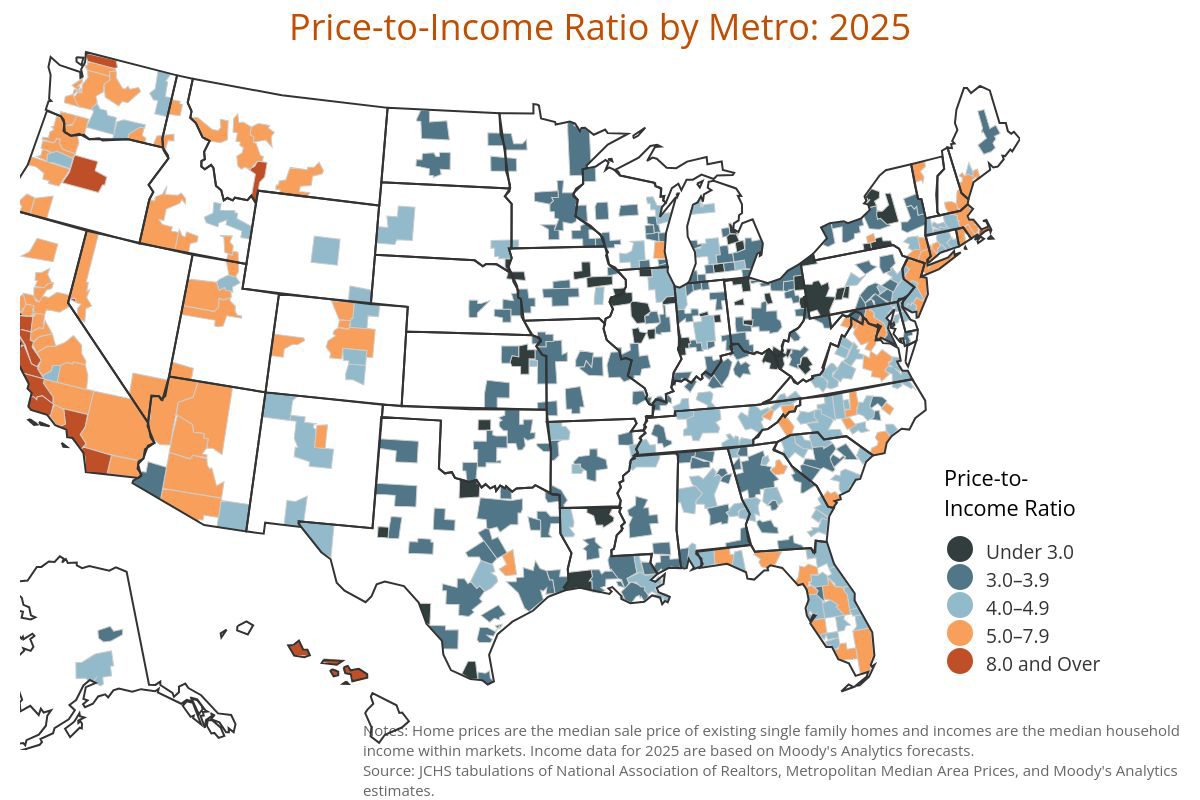
Home prices have increased 54% nationwide since 2020, and in 2025 the median existing single-family sales price was nearly five times the median household income.
Map courtesy of Harvard Joint Center for Housing Studies
The State of the Nation’s Housing 2026 report released this summer by the Harvard Joint Center for Housing Studies found that household growth slowed for the third consecutive year in 2025, falling from an average of 2 million households in 2021 to just 1.1 million in 2025. The report also documents a record-low residential mobility rate of 11.2% in 2024, driven primarily by declining moves among homeowners, who are often “locked in” by below-market mortgage rates. “Interstate moves have also fallen,” the Center stated, “easing population gains in fast-growing states like Texas and Florida and stemming losses in states such as California and Illinois. Housing demand is further threatened by severely restricted immigration and increased deportations. Net international migration fell by half in 2025, and is expected to drop another 75% in 2026, to roughly a third of its average level from 2001 to 2019.”

Viva L.A. at Warner Center proposes to deliver 3,192 affordable senior units and rank among the largest affordable housing developments ever proposed in California.
Rendering courtesy of Gensler and Wellpointe Inc.
The idea of attainable workforce housing doesn’t mean that workforce gets cast aside as it ages. In mid-July, residential assisted living and health care services provider Wellpointe Inc. announced plans for Viva L.A. at Warner Center, a four-phase 100% affordable senior housing community planned in Warner Center’s downtown district. The development represents a total estimated investment of $2 billion at the 4.71-acre Woodland Hills site that a Wellpointe property-holding affiliate acquired late last year from Parkview Financial.
“Viva represents our conviction that affordable housing, paired with assisted living services as needed, can be delivered at the scale and density that California’s aging population in core urban centers actually needs,” said Wellpointe Inc. Co-Founder and CEO George Kutnerian. “Despite the overwhelming need for a new model, senior living continues to be built out rather than up — even in dense urban areas — and quality is treated as incompatible with affordability. Viva rejects that premise and builds upon Wellpointe’s mission of democratizing access to quality housing and care for older adults — now through transit-oriented, high-density, community-serving urban social infrastructure.”
As a 100% affordable project, the development being designed by Gensler is vested and has been submitted under Los Angeles Mayor Karen Bass’ Executive Directive 1 (ED 1), the affordable housing measure made permanent in late 2025, qualifying the project for streamlined approval.
“With Viva, we set out to prove that high-density senior housing can be as thoughtful and humane as it is efficient — a vertical community designed around light, connection and care,” said Gensler Studio Director and Principal Eric Stultz. “This groundbreaking project will redefine what is possible in the world of affordable assisted living. Having the opportunity to shape both Viva L.A. at Warner Center and the neighboring Rams Village lets us think about Warner Center not as a series of separate projects, but as a new urban neighborhood taking form.”
A new report from JLL finds that residential development has emerged as the single largest replacement use for former office properties in New Jersey, accounting for 46.6% of all office redevelopment activity during the past decade. “Combined with warehouse development, these projects represent more than 80% of all former office sites that have been repurposed since 2017,” says JLL. The report found that redevelopment activity has accelerated during 2026, with approximately 2 million sq. ft. of office inventory removed to date, marking the highest level of redevelopment since 2022 and part of a drop of more than 10 million sq. ft. of office inventory since 2017 in Northern and Central New Jersey.
“For this report, we analyzed office inventory removals, demolitions and redevelopment activity across the region over the past decade to better understand where these projects are occurring, what is replacing obsolete office buildings and how redevelopment is changing local market fundamentals,” said JLL Senior Director of Research Stephen Jenco. “The data shows this is no longer an isolated trend. Redevelopment is systematically removing obsolete inventory, creating opportunities for higher and better uses, and helping reposition the office market for its next phase.” Among the report’s key findings:
● More than 80% of demolished office buildings have been replaced by residential developments and warehouses. Residential projects account for 46.6% of redevelopment activity, while warehouses represent 34.3%.
● The Lower 287 and Parsippany submarkets account for nearly 30% of all office redevelopment activity across Northern and Central New Jersey.
● New Jersey’s affordable housing obligations are creating additional pressure for redevelopment as municipalities seek opportunities to convert underutilized office properties into residential developments that help satisfy mandated housing requirements.

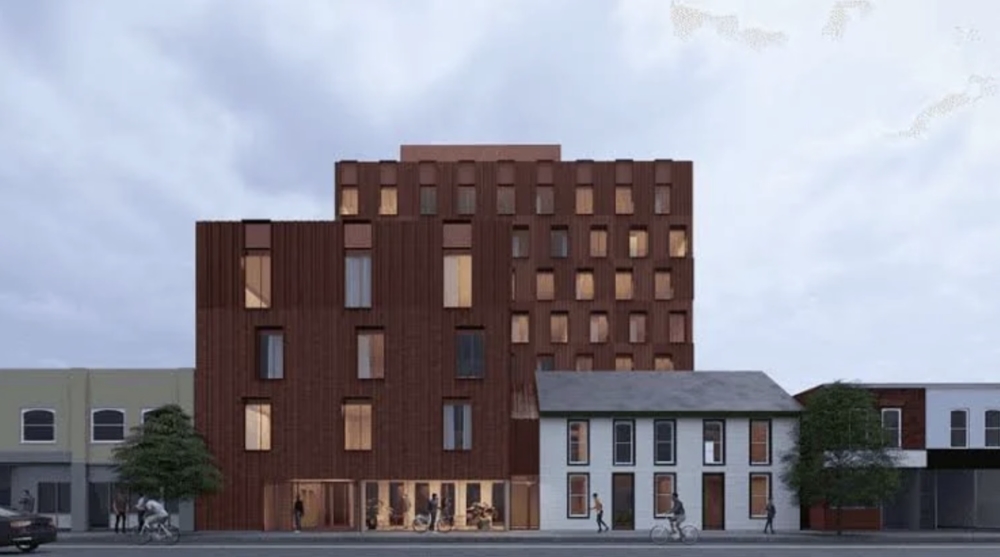
The 56,000-sq.-ft. 2720 Danforth transit-oriented development in Toronto incorporates an existing heritage structure on a site served by both subway and regional transit.
Concept for the interior courtyard at 2720–2734 Danforth Avenue by Batay-Csorba Architects Inc., courtesy of Collecdev-Markee and Element5
The same mass timber movement explored by Site Selection Managing Editor Kelly Barraza in the publication’s July story on Atlantic Canada is alive and well in Toronto too. In June, mass timber manufacturer Element5 celebrated its partnership with the automated design and costing platform from GENERATE in developing the 2720 Danforth project just east of downtown Toronto.
The eight-story project will offer 64 units once complete, providing affordable, community-oriented housing for what the companies call the “missing middle” — medium-density, lower-rise apartment buildings ideal for many city dwellers seeking affordable housing. “The project is the first start in the Missing Middle Rental Portfolio conceived by Toronto-based real estate developer Collecdev-Markee, led by CEO Jennifer Keesmaat,” a release explained. “The collection of properties, which will grow to include five new apartment buildings, all employ prefabricated modular mass timber construction.”
“Because we’re focused on faster, de-risked project delivery, we’re able to help project teams transform an architect’s schematic design or an engineer’s concept into a fully occupied mass timber building in as little as 12 to 15 months,” said Lee Scott, the director of sales at Element5 who has a background as a civil engineer and surveyor. “That’s why we work with GENERATE — they are integral to our process, delivering a generative platform for quickly optioneering the design concept into fully quotable mass-timber buildings in a matter of days, streamlining the path to fabrication and manufacturing — even for affordable housing.”