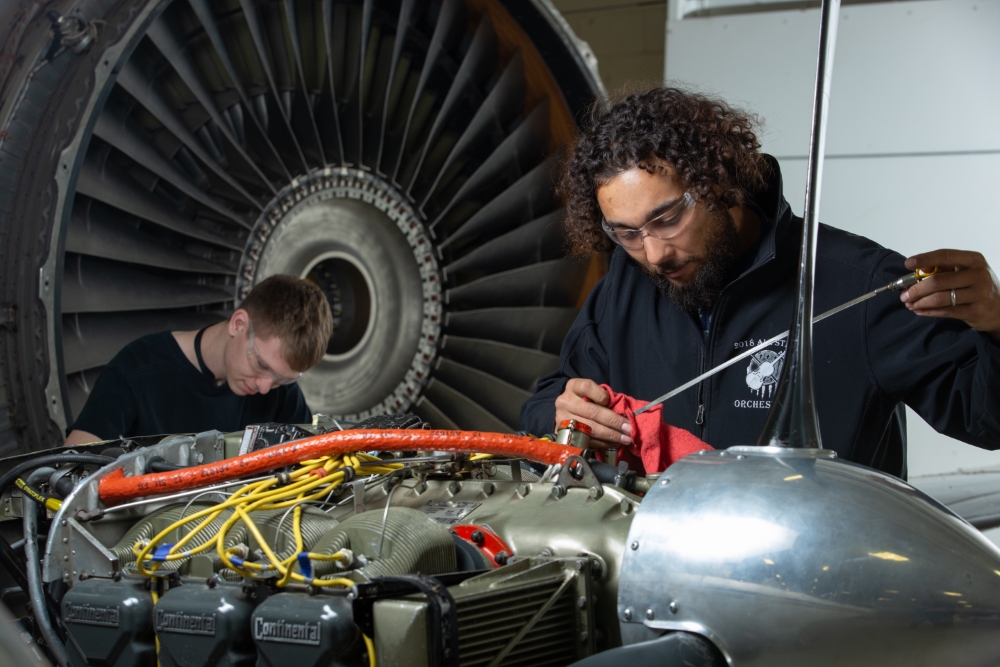
Empowering workers with skills and experience is a long-standing tradition in Oklahoma.
Can a unicorn solve your worker shortage problem? It can if you know where to look.
According to the Federal Reserve Bank of St. Louis, there were over 1.9 million workers in Oklahoma as of February 2026. The state also boasts a well-established agency, the Oklahoma Department of Career and Technology Education, or Oklahoma CareerTech, which involves statewide centers that provide education and training to a swathe of Oklahomans looking to enter and re-enter the job market.
“One of our taglines is ‘Oklahoma’s workforce leader,’ ” says Max McKnight, director of workforce training for the Oklahoma State Department of Career and Technology Education. “We’re kind of a unicorn in the career tech world in that we have 29 technology centers across the state with 62 campuses. Each of them is an independent school district.”
Skilled and In-Demand
CareerTech has been around in some form for more than a century. Today, the program encompasses 392 PK-12 school districts, 20 Skills Centers campuses, 49 Adult Education and Family Literacy providers at 125 sites. In FY2025, CareerTech saw 517,752 people enroll in the program and over 10,000 companies served. Brent Haken, state director of the Oklahoma Department of Career and Technology Education, stated recently that CareerTech has had a 40% increase in demand since 2020.
“Across the state, whether it’s in business or industry, we are viewed as a key player in the workforce development pipeline,” says McKnight, highlighting several fields that CareerTech participants receive training in, including HVAC, plumbing, emergency rescue, welding, lineman training and healthcare. At the High Plains Technology Center in Woodward, located in the northwestern part of the state, future technicians are trained in a wind energy program to service wind towers in the southeastern part of Oklahoma.
“Our training has developed an increased awareness that these are high-paying and in-demand jobs,” he adds. “You can take a healthcare program in one of our technology centers, and you’ll leave with a certificate or a credential that you can go right to work with.”
The agency has implemented CareerTech apprenticeships, state-sponsored training provided at its centers that operates on a shorter term than federal registered apprenticeships developed by the U.S. Department of Labor. In November 2025, delegates from several state agencies (Oklahoma Department of Commerce, Oklahoma Employment Security Commission, Oklahoma CareerTech and the Oklahoma State Department of Education) traveled to Germany on a vocational training tour, making site visits and picking up insights on workforce retention and attraction in energy, aerospace, automotive and manufacturing.
Uniper SE, Lufthansa Technik, Airbus and Volkswagen were all on the itinerary of the Oklahoma cohort visiting Germany, which sports a dual-education apprenticeship system that may influence how future apprentices are trained in the Sooner State.
“Germany has a longstanding history of workforce apprenticeships with a direct connection between the worlds of education and industry,” said Dr. Romel Muex-Pullen, Oklahoma State Department of Education Deputy Superintendent. “It was immensely insightful to have firsthand accounts from both apprentices and employers on the relationship that exits between the education and business systems. As a state, there is so much that we can take from the strong apprenticeship model that exits in Germany. I look forward to the future collaborative conversations that will come from this multi-agency exploration and seeing how we can grow the apprenticeship model in our state to provide strong career paths and to continue to strengthen the state’s economy.”

“Across the state, whether it’s in business or industry, we are viewed as a key player in the workforce development pipeline.”
— Max McKnight, Director, Workforce Training for the Oklahoma State Department of Career and Technology Education
Ready to Work
Like other places, finding the workers needed to fill jobs is a pressing need in Oklahoma. In my conversation with McKnight, he highlights CareerTech’s Training for Industry (TIP) Program, a low-cost or free program that provides training customized to new or expanding companies in the state. TIP targets the manufacturing, aerospace, energy and biotech sectors, providing job analysis, training needs assessment, instructional materials and development, training supplies and more either on-site at a business location or at a technology center. TIP had 3,258 enrollees in FY2025.
“It can help offset some of the training costs of businesses that locate into the state if they fall in our target market areas — aerospace, manufacturing, distribution, transportation,” explains McKnight. “We have some of those TIP dollars that are also available to the local technology centers for existing business and industry expansions in their district. It’s a formula, so it’s contingent on the number of jobs created and an average payroll. They have to offer benefits. There are three or four caveats that they have to meet.”
Oklahoma is always looking to advance the education and skills of its population. In early 2026, The Adult Education and Family Literacy division under CareerTech launched the Oklahoma Career Readiness Diploma, allowing people to count GED and HiSET testing, along with high school credits, toward high school education equivalency status while improving in subject areas where they may not have previously performed well. The program will also have enrollees practice resume writing and job interviewing. The first goal is 1,000 Oklahomans earning the diploma in the first year.
Another effort put forth by Oklahoma CareerTech is ensuring incarcerated people have another chance in re-entering the workforce after being released from prison, offering programs in welding, warehouse skills and logistics to individuals approaching their release date. This allows previously incarcerated people to receive certifications that will allow them to secure jobs from employers open to hiring in this worker pool and reintegrate into a community, explains McKnight.
A Sprawling Formation of Oklahoma-Raised Workers
According to 2024 statewide employment outcomes published by the Oklahoma State Regents for Higher Education, nearly 74% of resident undergraduates in engineering are employed in Oklahoma one year after graduation. Zooming out, nearly 93% of resident graduates work in the state within a year with almost 85% still staying in Oklahoma five years later. Postgraduate employment rates of in-state within one year of graduating from nursing, teaching and STEM programs are 94%, 87% and 80%, respectively, for Oklahoma students.
Overall, the average percentage of Oklahomans who remain and work in the state a year after graduating college is 91.1%; that number is 82.6% five years postgraduation.
It’s no coincidence that the state has had such success retaining its students. Director of Aerospace and Defense at the Oklahoma Department of Commerce Leshia Pearson notes that Oklahoma’s “higher education institutions are also expanding their engineering programs. Our legislature has invested heavily in pumping out more engineers. The engineering faculties, especially at major research institutions, have increased to help with the growing number of engineers that are coming out of our universities.”
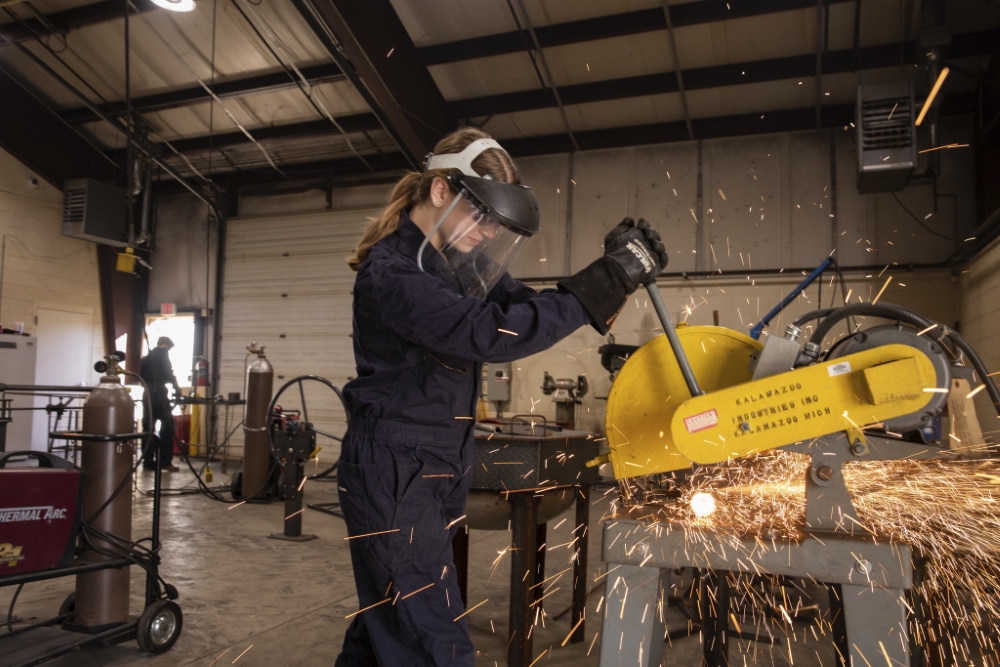
Vocational training is highly sought after and cultivated in the state of Oklahoma, often aided by the Oklahoma State Department of Career and Technology Education, or “CareerTech” for short.
Photo courtesy of Oklahoma Commerce
Pearson speaks highly of Oklahoma’s CareerTech program in supporting the workforce pipeline in aviation and national defense. She notes that “we are really fortunate that Oklahoma’s CareerTech systems is one of the top in the nation at providing a skilled workforce. Many of (the centers) will have support programs — whether it’s welding or sheet metal or CNC programming or logistics or management — those kinds of programs to support the aerospace and defense industry. Even if they don’t offer it and there’s a company in that area that’s growing or expanding, our CareerTech programs can help customize curriculum and programs to help those companies find or train the employees they’re needing.”
The Oklahoma Department of Aerospace and Aeronautics also works with diligence across the state to get high school students engaged in the aviation training and curriculum provided by the Aircraft Owners and Pilots Association (AOPA), explains Pearson. The Maryland-based nonprofit has over 384,000 members, consisting primarily of aviation pilots and aircraft owners. The AOPA’s You Can Fly program has many paths to providing accessible and affordable pilot training and resources, including a free four-year aviation STEM curriculum course for high schoolers, flying clubs to connect and invigorate the pilot community, and a “Rusty Pilots” initiative that helps retrain pilots who have let their skills in the sky lapse.
“Our Department of Aerospace and Aeronautics has also worked diligently across the state to try and get high schools engaged in the AOPA’s curriculum,” adds Pearson. “Oklahoma is leading the nation in the number of high schools that have that program.” Then there’s the Choose Aerospace program, a maintenance-based program that CareerTech is helping to manage.
“We have 166 high schools across the state with those programs,” Pearson says. “This is Oklahoma’s fourth year in a row at being number one in the nation in the number of high schools teaching aviation-based curriculums.”