
An exclusive interview with outgoing Wyoming Governor Mark Gordon
In a September 2026 phone call, Wyoming Governor Mark Gordon shared his thoughts with me on what the state has done to build its economy and improve residents’ lives since he assumed office in 2019.
Looking Back, Looking Forward
“The biggest thing that we learned is that economic diversification doesn’t mean we have to diminish any of our traditional energy sources,” says Gordon. “Our traditional economy has been primarily three things — we always refer to it as the three-legged stool. It’s energy — that would be coal, oil and natural gas. It’s tourism. And then it’s ag.”
Wyoming is the leading coal producer in the United States. In 2025, there was a successful push to restore coal mining at the Black Butte Mine in Sweetwater Count. Nuclear is on the menu too. Talks between the governor’s office and Bill Gates, Rocky Mountain Power and the U.S. Department of Energy have revolved around building a sodium reactor.
TerraPower, a Washington state-based energy company founded by Bill Gates, is building an advanced nuclear plant in Kemmerer, Wyoming, leveraging a 345-MWe sodium-cooled fast reactor and a molten-salt energy storage system capable of boosting output to 500 MWe. The project is targeted to be complete in 2030, will generate enough energy to power about 400,000 homes and will create approximately 250 permanent jobs when finished.
Overall, the impetus to diversify and grow Wyoming’s energy resources and its broader economy has been essential to the Gordon administration’s strategy. Gordon describes the state’s business landscape as “much more vibrant” compared to what it was in 2018, noting that his administration has concentrated on initiatives that can move the needle.
“We’ve come on strong with digital assets, data, with manufacturing, both large and small, and we’ve really expanded all of that. We’re much more diverse than we were,” he says. “We need to do even more, but the momentum is built. It’s been built from the schools, educational components, right on through those economic sectors.”
Gordon also discusses cryptocurrency and stable tokens, casually mentioning Wyoming’s milestone in developing the first state-backed stable token, the “Wyoming Frontier Stable Token ($FRNT),” which was made available for public purchase in January 2026. $FRNT is a digital currency representing, and redeemable for, one U.S. dollar. It is fully backed by U.S. dollars and short-duration U.S. Treasuries and is held in a trust by the state of Wyoming.
“We did that in full transparency. It took several years to do,” says Gordon about $FRNT. “The point of it is that it’s in the United States. It’s fully transparent. You can look on our website, and you can see what the reserves are. It’s not some offshore thing, and it’s not speculative. It’s really designed as a useful tool for banks, consumers, businesses, etc.”
Building a Data Center, The Wyoming Way
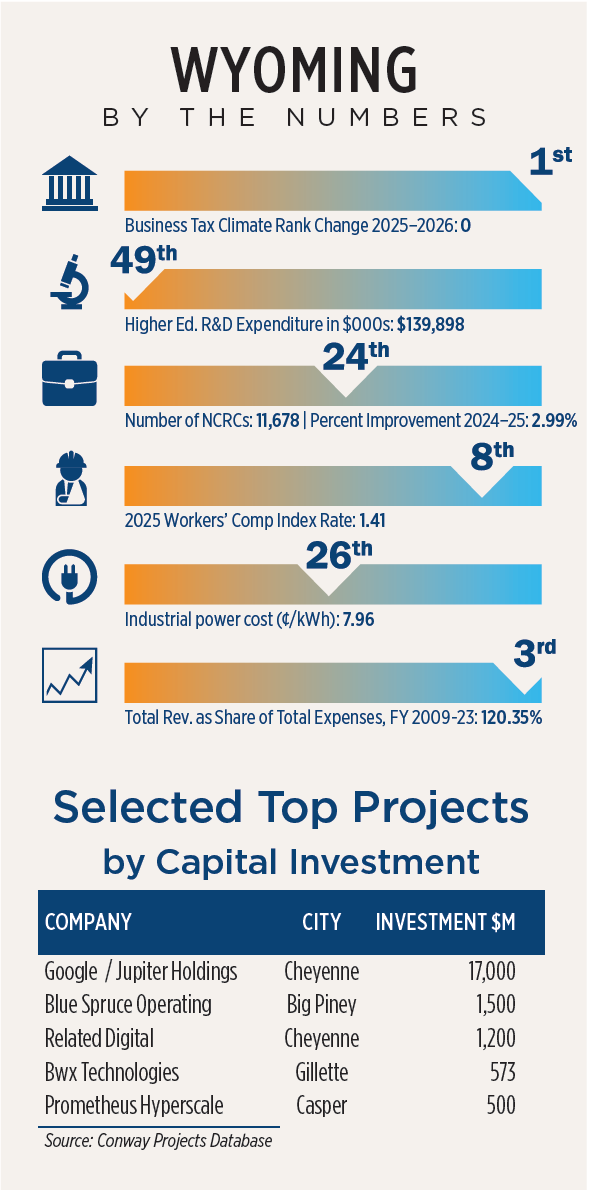
Wyoming has been signing on data center projects with increasing frequency and stature. Microsoft was the first high-profile company to tie itself to Wyoming, doing so between 2012 and 2016 with its Cheyenne data center campus that has received approximately $1.5 billion in improvements and buildouts since its inception. In April 2026, Microsoft announced it plans to purchase approximately 3,200 acres of land to expand data center operations in Cheyenne, divided into two adjacent parcels located southeast of the city that has proved to be a popular waypoint for data center development.
In November 2023, the Cheyenne City Council approved the construction of an $800 million, 715,000-sq.-ft. data center campus labeled “Project Cosmo” and later revealed as Meta’s project. Located on a 960-acre campus in the High Plains Business Park, the Meta facility will handle heavy AI compute workloads and is expected to begin operations in 2027.
“Let’s take a look at the challenges that data centers present at this point as the nation is starting to grapple with data centers,” says Gordon about “Data Centers the Wyoming Way,” an executive order he signed in June 2026 that sets core principles for AI and high-load data center growth. “They’re very worried about water consumption. They’re worried about rates. They’re worried about who pays for infrastructure development. And they worry, ‘Are they losing control of this development?’ So, what my executive order did was to say, ‘We have a number of tools in our legislative framework that allow us to regulate this industry already.’ ”
The first principle Gordon noted as key was making sure that data center projects didn’t raise rates for residents, meaning that data centers would be required “to pay their own way.” The second principle was responsible water usage.
“We wanted to make sure in an arid state like ours that [data centers] didn’t use excess amounts of water,” he explains. “We made sure they wouldn’t use evaporative cooling. They had to use closed loop systems or develop newer types of technology. There are air cooled systems and chip cooling systems, all of which we encouraged.”
“The biggest thing that we learned is that economic diversification doesn’t mean we have to diminish any of our traditional energy sources.”
— Wyoming Governor Mark Gordon
In October 2025, Related Digital broke ground on the first facility of a 302 MW data center campus in the Cheyenne Business Parkway area, with CoreWeave being the project’s planned anchor tenant. The total estimated cost of the project is $1.2 billion. According to a company press release, “Related Digital’s Cheyenne project will use high-efficiency air-cooled chillers, and the project will require only nominal water consumption, primarily for domestic use.”
Gordon says he wanted to ensure that “the site selection was done to make sure that communities weren’t massively affected by traffic or other things” and that data center projects “build our economy.”
Less than 10 days before my call with Governor Gordon, Google announced the official outline of its vast multi-data-center project at Switchgrass Industrial Park in Laramie County, Wyoming. Four data center facilities, an office, a logistics center and other network facilities will populate the 2.7-GW AI campus located eight miles south of Cheyenne on U.S. Highway 85.
Cost estimates for “Project Tembo” range from $17 billion to $50 billion, with 2031 as the target completion date. Approximately 2,500 workers will be present onsite during the construction period, and the campus will support 250 permanent jobs when it becomes operational. Notably, Google took over the Project Tembo campus (previously “Project Jade”) in summer 2026 following the exit of previous site and construction manager, AI and clean energy startup company Crusoe Energy. Google is still set to work with Tallgrass Energy Partners, the infrastructure company attached to Project Tembo since its start.
Wyoming is the least populous state, with an average population density of six people per square mile. With the advent of massive, high-dollar projects gaining traction in the state, Gordon and the state’s executive leadership found it important that data centers “not change the nature of the workforce, but that they add to it. We have asked them to be partners with our education system.”
The first state-backed stable token, a digital currency called the “Wyoming Frontier Stable Token ($FRNT),” was made available for public purchase in January 2026.
Gordon adds that “understanding that things change dramatically over time, we wanted to make sure that we were responsive to that. We’ve asked each of our regulatory agencies to compile improvements that they can recommend to our legislature, and we’ve asked companies to be part of that as well.”
What’s Next
One of the Gordon Administration’s aspirations has been to export low-sulfur coal from the Powder River Basin in northeast Wyoming to Asia.
“As you know, we have several allies in Asia that really depend on Wyoming’s ability to export,” says Gordon, noting opposition from the Biden Administration and West Coast states as impacting this effort. “We are really close to being able to get our coal [exported], which is preferable from an environmental standpoint to anything from the Pacific Rim like Australia or Malaysia because it has low sulfur and lower ash content.”
Citing China’s stranglehold on critical minerals and rare earths, Gordon says that securing an export terminal for low-sulfur coal would also facilitate opportunities for Wyoming to participate more closely in these mining sectors. He lists Japan, Taiwan and South Korea as possible export destinations for low-sulfur coal. Being able to develop and export coal material to these places “would be huge for Wyoming,” he says.
By the time this issue of Site Selection magazine is reaching readers’ hands, the next governor of Wyoming will likely have already been elected. Gordon says he will welcome the conclusion of his gubernatorial term with more time on his ranches with his grandchildren and cattle. Agriculture and conservation efforts in the state remain top of mind for him.
“One of the things that I wanted to revitalize was our agricultural sector so that we can get more young farmers onto the land again,” he says. “You look at the opportunities that are present with digital assets being able to tokenize aspects of agricultural production that can be rewarded at a new market beyond just a commodity that they’re selling. I have friends around the country that are quite interested in trying to make sure that we augment and diversify the income streams for farms.”
Read more here from the Wyoming Economic Development Association on what is transforming the Equality State’s investment landscape.